I disagree with the observation that, since disrupted syntax, shifts in levels of discourse, and other apparently innovative techniques are more common (in submissions, even so, to Salt), they may be designated as mainstream. While stylistic divisions between the so-called mainstream and the innovative schools may be shifting (as styles and aims merge or adapt) in the UK - and I think that, among younger (under-35) poets, they are - there remain actual differences in the poetics behind the choices that lead to, for instance, a disrupted lyric, versus an empirical, first-person, traditional British poem (for instance, that Nick Laird might write). There remains, in Britain, profound mistrust of opaque, excessive, or abstract usage of language, in relation to poetry, which, for most people, is still ultimately a vehicle for expressing something - for saying something - about the self and experience. Or rather, not about the problematic nature of an apparent self apparently trying to say something - but, instead, an easily accepted self easily and transparently conveying truths. Moreover, poems continue to be, on the whole, validated in terms of "making" that Pound, or Orwell would have approved (terms better used for for prose): clarity, hardness, and so on. These are scientific values that work well for language mainly built to control, or sell, things, including sentiments and ideas. In a paradox that I think has not yet fully dawned on British poets, modernism's no-nonsense tenets propelled the sort of Protestant work ethic of the Movement style, and its purities of diction - Davie, after all,
admired Pound.
My chief concern is with the idea of the "good poem" - so cherished by entrepreneurs in the poetry-editing business - since most often, when one examines the sort of criteria even so-called innovative editors swear by, they end up being rather traditional, and usually trite. The idea that poets have something to say, or that form and content are finding an organic match, are hardly cutting edge observations, and could easily sum up the New Lines view of the Movement era. Poetry publishing cannot be everything to everyone, or it stops being the art of publishing, and instead becomes the entertainment of publishing. Recent trends, in poetry, do seem to be moving from theory (as in the English departments) - how much is Eagleton to blame for this? Likely, not much. More seriously, few younger poets read, or understand, Poetic Artifice, and how that work inspired Charles Bernstein in America. There is a very real feedback loop, between 1976 era British Poetry, and Language poetry in the US - just as an earlier British generation found Allen's The New American Poetry foundational. But, in the mainstream, such a loop seems weaker - few American poets read or recognise, for instance, Don Paterson - and fewer British mainstream poets seem to get their bearings from North Americans (other than, say, Billy Collins, and even that seems unlikely).
The most important American poet, in terms of influence, remains O'Hara, who does seem to create a strange brotherhood of followers. The main ongoing tragedy in British poetry, to my mind, remains the unquestioned connection between publishing and poetry, in some minds. Too many young poets seek a career (sadly, or laughably) from the mainstream, one that seems afforded by the capital which publication - vindication - by Salt, or Faber, seems to accord. The main thing should be the composition of the poem. Poems should be read, and appreciated, regardless of, and indeed, apart from, their publisher. Instead, house styles, and publishing cliques no better than small closed clubs, predominate in the UK, whose poetry communities seem, from an outsider's perspective (and I have been kept an outsider), mostly incurious, and certainly, anti-internationalist, except in mainly avant-garde, circumstances.
Wednesday, October 15, 2008
Thursday, August 14, 2008
David Kennedy: Drifting Hungers and Accessory Rage
In ‘Saws’, Trevor Joyce writes of ‘Drifting hungers and accessory rage’. Eléna Rivera writes in ‘See’, ‘The limit of reproduction and replica, / of “you” as reflection, of “you” as reaction’. Edmond Jabès has Yukel say in ‘The Time of the Lovers’, ‘A blank page swarms with steps on the point of finding their own tracks. An existence is a scrutiny of signs.’ Trying to answer Robert’s question inevitably raises others: is alternative doing the same thing? Has it changed? I have some sympathy with Chris Hamilton-Emery’s argument that innovative practices are now so commonplace they’re the new mainstream. But I’d want to add that I’m constantly astonished by how alternative elements don’t have to be very big in order to make a poetry that seems completely divergent from what comes from, say, Cape or Bloodaxe. But the poetry that’s excited and interested me the most in recent years seems to have enacted a testing of the whole idea of the alternative, a testing in the same way that Krzysztof Ziarek’s attempted a way past the so-called theory death of the avant-garde with his concept of the ‘forcework’. The alternative work of art is not an object but an event that unmakes and remakes the forces of power that circulate around it and through it. Ziarek’s wrong and right at the same time. He’s wrong because Rembrandt’s ‘Night Watch’ is as much as a forcework as one of Bill Viola’s video installations. But he’s also right because it seems to me that the poetry I’ve found most valuable in the last 8 years is only fully activated off the page, in the air, in bookfair and conference moshpits, and in the upstairs rooms of performance. And that also connects with the fact that the most arresting voices occupying places and spaces have been women’s. Confronted with the work of younger poets—and you really are confronted—like Frances Kruk and Emily Critchley I want to yell something like ‘holy paratactic bad girl word salad Batman’ except it’s there in the work of older poets like Frances Presley and Geraldine Monk too. The voice is thrown out into environments—political, historical, sexual—to see what it catches and catches on. And you have to be there to hear it. I don’t see/hear this is the work of many male poets except Keston Sutherland and Sean Bonney. But then it’s hard to do the overview thing because, as earlier respondents have pointed out, you can’t put poets into boxes marked ‘London’ or ‘Cambridge’ anymore. (Could you ever do that with women poets?) And the actual socialities underwriting alternative poetry are much more interesting and surprising anyway. Overview brings me on to another thing I want to mention which is something that hasn’t happened in the last 8 years. We still don’t have the body of criticism to match the work we love. I’m talking big books not articles. Andrew Duncan and our host here have both made bold stabs but they both seemed to leave a lot out. Or perhaps Duncan was just too eccentric (outside) and Sheppard was just too concentric (inside). I’ve been sceptical about such a project elsewhere but I still think it’s worth an attempt. A final thing that comes to mind is Peter Riley’s appreciation of Andrew Crozier in PN Review 182. Riley mentions Crozier’s seminal essay ‘Thrills and frills: poetry as figures of empirical lyricism’ and its famous summary of Larkin: ‘we are asked to trust the poet, not the poem’. Re-reading that, I know what Crozier means and I’m thankful for alternative poetry because I’m not interested in poets’ lives exponentially smoothed into consumer goods. I want to know that the poets I read and hear can be as confused, angry, sceptical, hysterical or perverted as I can. I want the work to jolt me. But at the same time I want to say ‘yes’ because if we can’t trust our alternative poets to do right by us in language in these dismal times then who? And when? And that’s why we need the criticism I was talking about. We (those who write and read alternative poetry) need to tell our own story. ‘The comic book version destroyed all / possibility for heroic action’, writes Eléna Rivera in ‘Painting our evidence’. Put an ‘almost’ and a date in there somewhere—you choose where and when—and you’ll get closer to what I mean.
Eléna Rivera’s poems are in Mistakes, Accidents and a Want of Liberty (Barque Press, 2006). A useful introduction to Edmond Jabès is From the Book to the Book: An Edmond Jabès Reader (Wesleyan University Press, 1991). Trevor Joyce’s poem is in What’s in Store – Poems 2000-2007 (New Writers’ Press/The Gig, 2007).
Eléna Rivera’s poems are in Mistakes, Accidents and a Want of Liberty (Barque Press, 2006). A useful introduction to Edmond Jabès is From the Book to the Book: An Edmond Jabès Reader (Wesleyan University Press, 1991). Trevor Joyce’s poem is in What’s in Store – Poems 2000-2007 (New Writers’ Press/The Gig, 2007).

Thursday, June 26, 2008
Tom Jenks
Amongst the many interesting things on the Great Works website is Peter Philpott’s explanation of why he publishes on the internet. In it, he states that those who remain “emotionally involved with words on paper…have as much future as trained scribes post-Gutenberg.” I agree with his overarching assertion that the internet is changing the way we access poetry and talk to one another about it. After all, you are almost certainly reading this on a screen, which is where I am writing it. I don’t agree, however, that the printed page is doomed. Rather, I think information technology can reinvigorate it, both in the way that it is created and the way it is distributed. I also think that this applies particularly to experimental and innovative poetry.
I am just about young enough to say that I grew up with computers. I can certainly say that they have been around for all of my adult life. Yet I still, to use Philpott’s phrase, remain “emotionally involved” with the book as artefact, with the physical rather than the virtual text. So too do the people I know in and around Manchester who are engaged with contemporary poetry - editors and small press publishers who all, whilst using the internet, still see the printed page in general and the book in particular as valid. What information technology has done, however, is to give us the keys to the citadel. I was reading recently about the upheavals in the Poetry Society in the 1970s, when Eric Mottram et al somehow sailed their Black Pearl through the reefs and under the radar, boarded the ship of state and seized the wheel. One of the most radical things they did was to make the presses, the physical machinery for producing texts, available to anyone with the ideas and inclination to use it. Such an act now seems impossibly romantic and oddly archaic, like a sit in or a march to Aldermaston. Yet we are now in the very situation Mottram was trying to engineer. Anyone with ideas and inclination can produce a book and, more importantly, thanks to the evolution of print on demand, they can produce the book they want when they want it. By chance, I happened to appear on a Radio 4 programme about the small press scene a while ago. One of the other participants was Michael Schmidt, who declared himself of the opinion that the proliferation of publications facilitated by technological change is a bad thing. His argument seems to be that there should be an elite, a crack team of cultural arbiters who decide what to blast and bless, who know where the ladders are and know when to lower them and when to pull them up – gatekeepers, keymasters, curators, custodians. On one hand, you can see his point. Print on demand and the vanity press are, if not exactly bedfellows, certainly roommates. On the other, why should writers always have to seek approval, to be supplicants holding out bowls for a ladleful of gruel? Visionaries and innovators are, by definition, out of synch with their times. They are not the sort of people who find their way into Waterstones or onto the library shelf amongst the Armitages, Duffys, Copes and 100 Poems To Clean Your Teeth To. I am not saying that such people have not had an outlet before – far from it. But technology has made it easier than ever to produce high quality texts which can be the stuff from which alternative worlds are constructed, the currency of local scenes with their own phenomena and epiphenomena, their own flora and fauna.
In addition to changing the way that the printed page is distributed, technology can also radicalise the way that is created. Philpott’s reference to scribes is oddly apt, for in some ways that is what technology has made us . I grew up around the corner from the site of St. Peter’s monastery on the banks of the Wear where Bede spent his formative years and I’m beginning to think all those childhood trips to Durham cathedral to stand next to what may or may not be his bones did something to me. After years of seeing the page as simply a place to put words, my increasing familiarity with computers has gradually transformed my practice to the extent that I now view myself as a producer of illuminated manuscripts, incorporating images and non-verbal figures to work in a way that is as much about the eye as the ear and the voice. The screen, far from being a stifling, standardising influence, can be liberating, making the page a playground and a palette. Technology can make new forms. It can also make the old forms new.
I am just about young enough to say that I grew up with computers. I can certainly say that they have been around for all of my adult life. Yet I still, to use Philpott’s phrase, remain “emotionally involved” with the book as artefact, with the physical rather than the virtual text. So too do the people I know in and around Manchester who are engaged with contemporary poetry - editors and small press publishers who all, whilst using the internet, still see the printed page in general and the book in particular as valid. What information technology has done, however, is to give us the keys to the citadel. I was reading recently about the upheavals in the Poetry Society in the 1970s, when Eric Mottram et al somehow sailed their Black Pearl through the reefs and under the radar, boarded the ship of state and seized the wheel. One of the most radical things they did was to make the presses, the physical machinery for producing texts, available to anyone with the ideas and inclination to use it. Such an act now seems impossibly romantic and oddly archaic, like a sit in or a march to Aldermaston. Yet we are now in the very situation Mottram was trying to engineer. Anyone with ideas and inclination can produce a book and, more importantly, thanks to the evolution of print on demand, they can produce the book they want when they want it. By chance, I happened to appear on a Radio 4 programme about the small press scene a while ago. One of the other participants was Michael Schmidt, who declared himself of the opinion that the proliferation of publications facilitated by technological change is a bad thing. His argument seems to be that there should be an elite, a crack team of cultural arbiters who decide what to blast and bless, who know where the ladders are and know when to lower them and when to pull them up – gatekeepers, keymasters, curators, custodians. On one hand, you can see his point. Print on demand and the vanity press are, if not exactly bedfellows, certainly roommates. On the other, why should writers always have to seek approval, to be supplicants holding out bowls for a ladleful of gruel? Visionaries and innovators are, by definition, out of synch with their times. They are not the sort of people who find their way into Waterstones or onto the library shelf amongst the Armitages, Duffys, Copes and 100 Poems To Clean Your Teeth To. I am not saying that such people have not had an outlet before – far from it. But technology has made it easier than ever to produce high quality texts which can be the stuff from which alternative worlds are constructed, the currency of local scenes with their own phenomena and epiphenomena, their own flora and fauna.
In addition to changing the way that the printed page is distributed, technology can also radicalise the way that is created. Philpott’s reference to scribes is oddly apt, for in some ways that is what technology has made us . I grew up around the corner from the site of St. Peter’s monastery on the banks of the Wear where Bede spent his formative years and I’m beginning to think all those childhood trips to Durham cathedral to stand next to what may or may not be his bones did something to me. After years of seeing the page as simply a place to put words, my increasing familiarity with computers has gradually transformed my practice to the extent that I now view myself as a producer of illuminated manuscripts, incorporating images and non-verbal figures to work in a way that is as much about the eye as the ear and the voice. The screen, far from being a stifling, standardising influence, can be liberating, making the page a playground and a palette. Technology can make new forms. It can also make the old forms new.
Saturday, March 01, 2008
Adrian Clarke
A Response to Chris Hamilton-Emery
Though his approach modestly takes account of the limitations his need as a publisher to identify a “commercially viable project” impose, Chris Hamilton- Emery’s posting on changes since 2000 from the British Poets list prompts a response to some of its provocations.
I too recognise the declining significance of location and social identity. The schools of Mottram and Prynne are no more and some of their survivors have been evidencing a more generous spirit. Along with the rooms upstairs, poetic activity in pubs has become more elusive, while its nature has become a little more inclusive – with an attendant risk of a certain anonymity; and, yes, “institutional locations” offer a problematic alternative. I myself have been publishing with the Birkbeck-based Veer Books, and in my experience of the ambitious activities of the Contemporary Poetics Research Centre, if it has an institutionally academic agenda it is well disguised. But London and Cambridge Colleges, the University of Southampton, etc. are far from the old dream of an anti-university; they are subject to the administrative imposition of restrictive political agendas, and the kind of ambience they can offer is, rightly or wrongly, unlikely to be perceived generally as one that can foster or disseminate uninhibited creativity.
Provocation comes with the suggestion that “a great deal of innovative writing … is using tools and techniques that are actually rather hackneyed” – particularly when three paragraphs later Hamilton-Emery observes that “new Muslim writing seems to have been branded as identity writing as if this were somehow old hat and not worth investigating”. Innovation would appear to have a variable contextual value; the explanation is that it is, in fact, a red herring, because “what’s being said is suddenly more vital than how it is being said”. - Back to a – once more respectable? – form/content split and the ascendancy of Meaning with its faithful accomplice me-meaning in tow. Nevertheless, irrespective of their hackneyed disrupted syntax and indeterminacy, because of their “huge take up” he considers “it might be more accurate to regard these (innovative) practices as mainstream”. He doesn’t define the term, but if it applies to most of what is received enthusiastically in the Guardian Saturday Review and the like, then the mainstream is so dire as poetry and so naïve and ignorant in its preconceptions that if there is no “binary opposition” between it and our output I see little point in persevering. It is, I think, fair to ask if Marjorie Perloff's account of an emergent materialist poetic with its seeds in early modernism mounting a growing challenge to the credibility of mainstream lyric poetry, year in and year out obedient to the "commands of sense" or "the path of least resistance", may not offer a more pertinent interpretation of what continues to be at issue.
Hamilton-Emery’s eagerness to “see what new European migration brings to the mix” seems distinctly more useful. There is a receptivity to radical poetries in most of Western Europe that shames us, and the decline in the commercial publishing of established contemporary poets from those countries in translation - and now the withdrawal of funding from small presses willing to fill the gap - is a depressing indicator of the health of our literary culture. Eastern Europe approaches from a very different cultural direction, but it is hard to believe its emigrants will readily acclimatize themselves to more or less genteel neuroses, facetious rhymes and the cosy verse essay.
Returning to that “binary opposition of avant-garde (now surely a historical term) and the mainstream”, Hamilton-Emery is certainly right that “there are no power structures that make sense within such a framework”. The operative structures are clearly external. I see no escape from the continuing relevance of Lyotard’s wry observation: “Administrative procedures should make individuals ‘want’ what the system needs in order to perform well.” If the system is “terrorist” it is so by “eliminating or threatening to eliminate, a player from the language game one shares with him”. Our justification is that we are calculatedly not what the system needs, while the “consumption” of our work and that in other genres and media with similar aspirations may offer an index of that system’s efficiency. Look elsewhere enviously we may; here and now it’s the practice of outside alright.
Though his approach modestly takes account of the limitations his need as a publisher to identify a “commercially viable project” impose, Chris Hamilton- Emery’s posting on changes since 2000 from the British Poets list prompts a response to some of its provocations.
I too recognise the declining significance of location and social identity. The schools of Mottram and Prynne are no more and some of their survivors have been evidencing a more generous spirit. Along with the rooms upstairs, poetic activity in pubs has become more elusive, while its nature has become a little more inclusive – with an attendant risk of a certain anonymity; and, yes, “institutional locations” offer a problematic alternative. I myself have been publishing with the Birkbeck-based Veer Books, and in my experience of the ambitious activities of the Contemporary Poetics Research Centre, if it has an institutionally academic agenda it is well disguised. But London and Cambridge Colleges, the University of Southampton, etc. are far from the old dream of an anti-university; they are subject to the administrative imposition of restrictive political agendas, and the kind of ambience they can offer is, rightly or wrongly, unlikely to be perceived generally as one that can foster or disseminate uninhibited creativity.
Provocation comes with the suggestion that “a great deal of innovative writing … is using tools and techniques that are actually rather hackneyed” – particularly when three paragraphs later Hamilton-Emery observes that “new Muslim writing seems to have been branded as identity writing as if this were somehow old hat and not worth investigating”. Innovation would appear to have a variable contextual value; the explanation is that it is, in fact, a red herring, because “what’s being said is suddenly more vital than how it is being said”. - Back to a – once more respectable? – form/content split and the ascendancy of Meaning with its faithful accomplice me-meaning in tow. Nevertheless, irrespective of their hackneyed disrupted syntax and indeterminacy, because of their “huge take up” he considers “it might be more accurate to regard these (innovative) practices as mainstream”. He doesn’t define the term, but if it applies to most of what is received enthusiastically in the Guardian Saturday Review and the like, then the mainstream is so dire as poetry and so naïve and ignorant in its preconceptions that if there is no “binary opposition” between it and our output I see little point in persevering. It is, I think, fair to ask if Marjorie Perloff's account of an emergent materialist poetic with its seeds in early modernism mounting a growing challenge to the credibility of mainstream lyric poetry, year in and year out obedient to the "commands of sense" or "the path of least resistance", may not offer a more pertinent interpretation of what continues to be at issue.
Hamilton-Emery’s eagerness to “see what new European migration brings to the mix” seems distinctly more useful. There is a receptivity to radical poetries in most of Western Europe that shames us, and the decline in the commercial publishing of established contemporary poets from those countries in translation - and now the withdrawal of funding from small presses willing to fill the gap - is a depressing indicator of the health of our literary culture. Eastern Europe approaches from a very different cultural direction, but it is hard to believe its emigrants will readily acclimatize themselves to more or less genteel neuroses, facetious rhymes and the cosy verse essay.
Returning to that “binary opposition of avant-garde (now surely a historical term) and the mainstream”, Hamilton-Emery is certainly right that “there are no power structures that make sense within such a framework”. The operative structures are clearly external. I see no escape from the continuing relevance of Lyotard’s wry observation: “Administrative procedures should make individuals ‘want’ what the system needs in order to perform well.” If the system is “terrorist” it is so by “eliminating or threatening to eliminate, a player from the language game one shares with him”. Our justification is that we are calculatedly not what the system needs, while the “consumption” of our work and that in other genres and media with similar aspirations may offer an index of that system’s efficiency. Look elsewhere enviously we may; here and now it’s the practice of outside alright.
Wednesday, February 27, 2008
Clark Allison: Plural Locutions
Clark Allison
Clark Allison has published the prose poem 'Six Paragraphs' as well as reviews of George Oppen and Barbara Guest at Stride magazine website(http://stridemagazine.co.uk/archive.htm) and well as on Pages.
Plural Locutions: Remarks on recent developments in British and Irish poetry
(Momentary glimpses of the personal amid the plural:)
A poem felt like this:An entirely new way to beginWalking itself first thing in the morning…
It can’t quite help itself.A stranger to being in words
-- John Welch ‘Personal Poem’ in ‘fragmente’ 9, 2007
The historical moment being what it is change in social and aesthetic consciousness can take time to filter through, though there are generally also inescapable fads and fluctuations that happen quicklywithout necessarily at first securing a convincing hold. There may be age stational latency prior to assimilation and the most obvious indication of this now is probably the uptake of digital and electronic poetry, often of a mixed and fluid, fluent nature characteristic of new media (there are now also it must be added a great many interesting and relevant literary blogs on the Web, the British and Irish Poetries mailing list continues as does the British Electronic Poetry Centre . Sometimes exchangeable formats to circulate this kind of work can’t readily be secured so it exists more in its tentative and now centred way as a species of performance fixed to the localities capable of presenting it, not unlike a gallery presentation or a custom, view only type of website, amenable to housing the tangible synchrony of physical and technical specifities needed to display it, poetry being reconceived as new media exhibit or performance. This sort of approach will surely evolve, but looks highly gallery or event space dependent in a way that the traditional,venerable book unequivocally isn’t.
There looks to be a need then to differentiate long term from short term literary/poetic movements and trends, not least because when short-termism does realise assimilation it can, in doing so, be radically reconceived. Among more recent observations and instancings, looking abroad for incoming modern - Modernism incontrovertibly an omnivorous phenomenon that traversed national boundaries - and postmodern inspiration, it is doubtless significant that American avant-gardes likethe New American poetry, which included versions of projective verse, jazz inspired free improvisation and painterly conscious species of abstract figuration, moving onto the dis-locutions and textural disruptions, if not irrepressible postmodern posturings and provocationsof Language poetry (‘L=A=N=G=U=A=G=E’ magazine, ed. Andrews,Bernstein 1978-81, archived in gif format at http://english.utah.edu/eclipse/projects/LANGUAGEn1 is the classic locus), never could credit more than a minor efflorescence here amongsympathetic British readers and respondents. Tricks and torts have been lifted, stolen or tweaked but the full blown package of ideological practice obstinately resisted. Similarly the strong blast of Continental stylistic and theoretical agenda making that proposed an aesthetics of intrinsic, perhaps universalisable structure even along mythic lines of a kind uncovered by Levi-Strauss, only to deconstruct these into the aporias of quirks, uncertainties and shadowwork leaving on dust clearing little other than the dubieties of Lacan’s ever disruptive Symbolic, created a flurry of ripples in Anglophone readers until succumbing to not much more than an unconvincedly resistant scepticism, still attuned to the supposed immoveability of traditional, perennial verities. Oulipo plied much of this radically reformed systematic elaboration (eg in Perec, Queneau) as well as foretasting its irresistible dissolution, not unexpectedly positing a recuperation, if not also a blurring, of past aesthetic spaces along the way.
If British poetic preoccupations have seemed a mite insular, there are numerous signs that pluralism is increasingly making an impact. Pluralism has differing predominant loci of effect, bespeaking aplurality within, an increasing differentiation and heterogeneity, are cognition of multiplying constituencies, as well as an increase in borrowing from without, be it America, the Continent or elsewhere. The plural is ‘Other’, to borrow the title of the Caddel/Quartermain’98 anthology, and is concerned with addressing questions of social and political identity. The notable alternative anthology “The NewBritish Poetry” (ed. Allnutt/D’Aguiar/Mottram/Edwards, Paladin 1988) bundled its contributors into separable categories, feminist, black, younger and British Poetry Revival-inspired, signalling some obstacles to integration as well as locating the '70s BPR experience as a peculiarly potent and aligning event, one that is still discussed, pro and con (see Peter Barry “Poetry Wars” Salt 2006), where the prolonged delay in arriving at detailed documentation looks significant.The Poetry Society and its organ ‘Poetry Review’ wages on, exuding its air of crusty, uncomplicated conservatism, prompting attitudes,variably, to engage or disregard. The most persuasive and reliable recent compendium is Tuma’s “Anthology of Twentieth-Century British and Irish Poetry” (Oxford, New York 2001), which has people in it as varied as John Wilkinson, Catherine Walsh, Carol Ann Duffy and Benjamin Zephaniah but lamentably no Prynne or Andrew Duncan. The categorisations of the classic Paladin anthology, however, are far from arbitrary, and as we find the BPR even now being reassessed there is unlikely to be much confirmation that we have moved as far as we might towards integrating or resolving them, as Chris Hamilton-Emery observed in his pointed commentary earlier, “Innovative poetries in the Black andAsian communities have largely been excluded from recent surveys…and new Muslim writing seems to have been branded as identity writing”. The situation with feminist (or just women’s) writing is perhaps not quite as bleak or intransigent, though the air has stilled a little, perhaps,since the 1996 Gilbert/Gubar ‘Norton Women’ anthology and the Maggie O’Sullivan edited “Out of Everywhere” of the same year. The sheer profusion of graspable cultural identity categories is perhaps so wide that geographical locus or instead the marshalling of more specifically identified ‘issues’, such as environmentalism or cyberpoetry or personal development or obscurities of aesthetic taste (difficult, complex, authentic, transparent etc) or just as consumers what to wear and buy (“no real framework…outside of consumption” Hamilton-Emery), across geographic boundaries, is rather claiming the agenda.
Peter Finch in a persuasively encompassing retrospective survey of the broader developments in British poetry in 2003 thought he could still discern what he called a neo-Georgian line in British poetic development ‘which runs up from Hardy, through D.H.Lawrence, Philip Larkin, Betjeman,’ encompassing the Movement, to in the present day ‘Douglas Dunn, Motion, and Armitage,’ “although is no longer quite as central as it once was” (see www.peterfinch.co.uk/enc.htm). This delineates the mainstream current, the centre, against which the marginal and experimental articulate and contest. We may actually have now, or bemoving toward, a plural “multi-hued, post-modern, culturalenvironment, available to all” (Finch) but the wheels of change are slowly turning.
Clark Allison has published the prose poem 'Six Paragraphs' as well as reviews of George Oppen and Barbara Guest at Stride magazine website(http://stridemagazine.co.uk/archive.htm) and well as on Pages.
Plural Locutions: Remarks on recent developments in British and Irish poetry
(Momentary glimpses of the personal amid the plural:)
A poem felt like this:An entirely new way to beginWalking itself first thing in the morning…
It can’t quite help itself.A stranger to being in words
-- John Welch ‘Personal Poem’ in ‘fragmente’ 9, 2007
The historical moment being what it is change in social and aesthetic consciousness can take time to filter through, though there are generally also inescapable fads and fluctuations that happen quicklywithout necessarily at first securing a convincing hold. There may be age stational latency prior to assimilation and the most obvious indication of this now is probably the uptake of digital and electronic poetry, often of a mixed and fluid, fluent nature characteristic of new media (there are now also it must be added a great many interesting and relevant literary blogs on the Web, the British and Irish Poetries mailing list continues as does the British Electronic Poetry Centre . Sometimes exchangeable formats to circulate this kind of work can’t readily be secured so it exists more in its tentative and now centred way as a species of performance fixed to the localities capable of presenting it, not unlike a gallery presentation or a custom, view only type of website, amenable to housing the tangible synchrony of physical and technical specifities needed to display it, poetry being reconceived as new media exhibit or performance. This sort of approach will surely evolve, but looks highly gallery or event space dependent in a way that the traditional,venerable book unequivocally isn’t.
There looks to be a need then to differentiate long term from short term literary/poetic movements and trends, not least because when short-termism does realise assimilation it can, in doing so, be radically reconceived. Among more recent observations and instancings, looking abroad for incoming modern - Modernism incontrovertibly an omnivorous phenomenon that traversed national boundaries - and postmodern inspiration, it is doubtless significant that American avant-gardes likethe New American poetry, which included versions of projective verse, jazz inspired free improvisation and painterly conscious species of abstract figuration, moving onto the dis-locutions and textural disruptions, if not irrepressible postmodern posturings and provocationsof Language poetry (‘L=A=N=G=U=A=G=E’ magazine, ed. Andrews,Bernstein 1978-81, archived in gif format at http://english.utah.edu/eclipse/projects/LANGUAGEn1 is the classic locus), never could credit more than a minor efflorescence here amongsympathetic British readers and respondents. Tricks and torts have been lifted, stolen or tweaked but the full blown package of ideological practice obstinately resisted. Similarly the strong blast of Continental stylistic and theoretical agenda making that proposed an aesthetics of intrinsic, perhaps universalisable structure even along mythic lines of a kind uncovered by Levi-Strauss, only to deconstruct these into the aporias of quirks, uncertainties and shadowwork leaving on dust clearing little other than the dubieties of Lacan’s ever disruptive Symbolic, created a flurry of ripples in Anglophone readers until succumbing to not much more than an unconvincedly resistant scepticism, still attuned to the supposed immoveability of traditional, perennial verities. Oulipo plied much of this radically reformed systematic elaboration (eg in Perec, Queneau) as well as foretasting its irresistible dissolution, not unexpectedly positing a recuperation, if not also a blurring, of past aesthetic spaces along the way.
If British poetic preoccupations have seemed a mite insular, there are numerous signs that pluralism is increasingly making an impact. Pluralism has differing predominant loci of effect, bespeaking aplurality within, an increasing differentiation and heterogeneity, are cognition of multiplying constituencies, as well as an increase in borrowing from without, be it America, the Continent or elsewhere. The plural is ‘Other’, to borrow the title of the Caddel/Quartermain’98 anthology, and is concerned with addressing questions of social and political identity. The notable alternative anthology “The NewBritish Poetry” (ed. Allnutt/D’Aguiar/Mottram/Edwards, Paladin 1988) bundled its contributors into separable categories, feminist, black, younger and British Poetry Revival-inspired, signalling some obstacles to integration as well as locating the '70s BPR experience as a peculiarly potent and aligning event, one that is still discussed, pro and con (see Peter Barry “Poetry Wars” Salt 2006), where the prolonged delay in arriving at detailed documentation looks significant.The Poetry Society and its organ ‘Poetry Review’ wages on, exuding its air of crusty, uncomplicated conservatism, prompting attitudes,variably, to engage or disregard. The most persuasive and reliable recent compendium is Tuma’s “Anthology of Twentieth-Century British and Irish Poetry” (Oxford, New York 2001), which has people in it as varied as John Wilkinson, Catherine Walsh, Carol Ann Duffy and Benjamin Zephaniah but lamentably no Prynne or Andrew Duncan. The categorisations of the classic Paladin anthology, however, are far from arbitrary, and as we find the BPR even now being reassessed there is unlikely to be much confirmation that we have moved as far as we might towards integrating or resolving them, as Chris Hamilton-Emery observed in his pointed commentary earlier, “Innovative poetries in the Black andAsian communities have largely been excluded from recent surveys…and new Muslim writing seems to have been branded as identity writing”. The situation with feminist (or just women’s) writing is perhaps not quite as bleak or intransigent, though the air has stilled a little, perhaps,since the 1996 Gilbert/Gubar ‘Norton Women’ anthology and the Maggie O’Sullivan edited “Out of Everywhere” of the same year. The sheer profusion of graspable cultural identity categories is perhaps so wide that geographical locus or instead the marshalling of more specifically identified ‘issues’, such as environmentalism or cyberpoetry or personal development or obscurities of aesthetic taste (difficult, complex, authentic, transparent etc) or just as consumers what to wear and buy (“no real framework…outside of consumption” Hamilton-Emery), across geographic boundaries, is rather claiming the agenda.
Peter Finch in a persuasively encompassing retrospective survey of the broader developments in British poetry in 2003 thought he could still discern what he called a neo-Georgian line in British poetic development ‘which runs up from Hardy, through D.H.Lawrence, Philip Larkin, Betjeman,’ encompassing the Movement, to in the present day ‘Douglas Dunn, Motion, and Armitage,’ “although is no longer quite as central as it once was” (see www.peterfinch.co.uk/enc.htm). This delineates the mainstream current, the centre, against which the marginal and experimental articulate and contest. We may actually have now, or bemoving toward, a plural “multi-hued, post-modern, culturalenvironment, available to all” (Finch) but the wheels of change are slowly turning.
Monday, October 29, 2007
Chris Hamilton-Emery
[Chris Hamilton-Emery, of Salt Publications, asked a very similar question to one I was framing on the British Poets list. Zeitgeist or (M)orphic resonance aside, I thought it fitting to begin with his reply to his own question – and sort of to mine -
My feeling is, and I don't want this to be seen as an attack, but a great deal of innovative writing that comes my way is using tools and techniques which are actually rather hackneyed. Disrupted syntax, linguistic borrowings, indeterminacy, hypo-contextualising, hyper-contextualising, heteroglossia, discontinuous texts, types of spatial arrangement. So I wondered whether given what I see as the huge take up of these practices, it might be more accurate to regard these practices as mainstream. I've also pondered on whether new innovations are in fact linguistic but are in fact social, for example, work which innovates a readership, not through the excesses of the text, but through its techniques in drawing people in. I was interested in considering this in the context of different readerships.
Secondly, I do worry that we're at risk of imagining that innovation can only happen in certain social locations, like Cambridge for example, and how this branch of innovation, might not in fact be innovative and might, in fact, have more to do with ideas of privilege and social identity. Not to knock Cambridge, but if I had one sense of changes since 2000, it would be that the Cambridge scene has now ended. But I do doubt that innovation can be understood now in terms of these locations of practice, and that many institutional locations have in fact developed an institutional idea of innovation which is rather weak and is losing reception.
I think the interest in digital poetics is fascinating, though I think the technologies and their usage are moving faster than many practitioners and so a lot of technically inventive poetry can seem rather hackneyed and its reliance on medium is often to the detriment of the actual content. So I think this could be a dead end, or rather, the means have become the ends.
Innovative poetries in the Black and Asian communities have largely been excluded from recent surveys so British Black surrealism and sci-fi writing have it seems to me been missed and new Muslim writing seems to have been branded as identity writing as if this were somehow old hat and not worth investigating.
I'd point out that the writing that seems to me to be most highly charged right now, seems to have greater social concern about community and meaning, and less to do with political empowerment and political enfranchisement - the politics is there in people like Ronnie McGrath or Sascha Akhtar, but language and community seem more pressured and alive. I think people, young people, seem to be looking at a world devoid of standard models for moral and ethical behaviour, largely disinterested in 19thC political theory and its realisation and more concerned with inventing social constructs within poems, constructs which might transcend national, racial, or
community boundaries. There's a great deal of carnivalesque play, and a lot of persona poems come across my desk.
What I'm seeing is this massive diversity of practices, and a happy coexistence of technical approaches, not a case of either or, more a case of this mode of writing is the most appropriate for this content. If I made one last observation, it's that what's being said is suddenly more vital than how it is being said, and that saying things matters. Maybe it's seeing body bags and kids being shot on the street which has writers searching for ways to explore these tragically commonplace occurrences, I don't know, but I think the locus for new writing may lie firmly outside of institutions in the UK right now, and despite the long term relationships and support structures we've all enjoyed, there's something else happening outside these transatlantic conversations. I'm keen to see what new European migration brings to the mix, too.
But I don't have answers, and most of the material which might provide evidence for these observations hasn't made it to a commercially viable project for me, and that, of course, steers are great deal of my thinking and reading. So it's necessarily limited.
… There's no binary opposition of avant-garde (now surely a historical term) and the mainstream, and there are no power structures that make sense within such a framework. What we have now is a multiplicity of practices and readerships and no real framework for understanding their trajectories, outside of consumption.
My feeling is, and I don't want this to be seen as an attack, but a great deal of innovative writing that comes my way is using tools and techniques which are actually rather hackneyed. Disrupted syntax, linguistic borrowings, indeterminacy, hypo-contextualising, hyper-contextualising, heteroglossia, discontinuous texts, types of spatial arrangement. So I wondered whether given what I see as the huge take up of these practices, it might be more accurate to regard these practices as mainstream. I've also pondered on whether new innovations are in fact linguistic but are in fact social, for example, work which innovates a readership, not through the excesses of the text, but through its techniques in drawing people in. I was interested in considering this in the context of different readerships.
Secondly, I do worry that we're at risk of imagining that innovation can only happen in certain social locations, like Cambridge for example, and how this branch of innovation, might not in fact be innovative and might, in fact, have more to do with ideas of privilege and social identity. Not to knock Cambridge, but if I had one sense of changes since 2000, it would be that the Cambridge scene has now ended. But I do doubt that innovation can be understood now in terms of these locations of practice, and that many institutional locations have in fact developed an institutional idea of innovation which is rather weak and is losing reception.
I think the interest in digital poetics is fascinating, though I think the technologies and their usage are moving faster than many practitioners and so a lot of technically inventive poetry can seem rather hackneyed and its reliance on medium is often to the detriment of the actual content. So I think this could be a dead end, or rather, the means have become the ends.
Innovative poetries in the Black and Asian communities have largely been excluded from recent surveys so British Black surrealism and sci-fi writing have it seems to me been missed and new Muslim writing seems to have been branded as identity writing as if this were somehow old hat and not worth investigating.
I'd point out that the writing that seems to me to be most highly charged right now, seems to have greater social concern about community and meaning, and less to do with political empowerment and political enfranchisement - the politics is there in people like Ronnie McGrath or Sascha Akhtar, but language and community seem more pressured and alive. I think people, young people, seem to be looking at a world devoid of standard models for moral and ethical behaviour, largely disinterested in 19thC political theory and its realisation and more concerned with inventing social constructs within poems, constructs which might transcend national, racial, or
community boundaries. There's a great deal of carnivalesque play, and a lot of persona poems come across my desk.
What I'm seeing is this massive diversity of practices, and a happy coexistence of technical approaches, not a case of either or, more a case of this mode of writing is the most appropriate for this content. If I made one last observation, it's that what's being said is suddenly more vital than how it is being said, and that saying things matters. Maybe it's seeing body bags and kids being shot on the street which has writers searching for ways to explore these tragically commonplace occurrences, I don't know, but I think the locus for new writing may lie firmly outside of institutions in the UK right now, and despite the long term relationships and support structures we've all enjoyed, there's something else happening outside these transatlantic conversations. I'm keen to see what new European migration brings to the mix, too.
But I don't have answers, and most of the material which might provide evidence for these observations hasn't made it to a commercially viable project for me, and that, of course, steers are great deal of my thinking and reading. So it's necessarily limited.
… There's no binary opposition of avant-garde (now surely a historical term) and the mainstream, and there are no power structures that make sense within such a framework. What we have now is a multiplicity of practices and readerships and no real framework for understanding their trajectories, outside of consumption.
Sunday, October 28, 2007
Editorial to Pages; fourth series
Welcome to the fourth series of Pages, which I intend to keep focussed upon a single issue.
Under the general title Turning the Pages I am publishing short responses to the following question:
Now. 2007-8. What have been the most significant developments in the alternative British and Irish Poetries (however you define those) over the last 7 years? This can be answered in terms of big picture socio-poetical contexts or in terms of local poetic practices, but please think through both the negative and positive aspects of your chosen sphere. Avoid predictions.
Please do not send unsolicited responses but do re-visit the site and see the latest instalments. I intend to add something every month (subject to responses) but no more than one item a week.
Robert Sheppard
Under the general title Turning the Pages I am publishing short responses to the following question:
Now. 2007-8. What have been the most significant developments in the alternative British and Irish Poetries (however you define those) over the last 7 years? This can be answered in terms of big picture socio-poetical contexts or in terms of local poetic practices, but please think through both the negative and positive aspects of your chosen sphere. Avoid predictions.
Please do not send unsolicited responses but do re-visit the site and see the latest instalments. I intend to add something every month (subject to responses) but no more than one item a week.
Robert Sheppard
Tuesday, February 13, 2007
Editorial to Pages : Third Series
I have been posting these Pages for two years now. It’s time for rest and reflection. The aim of this series was to present a BLOGZINE, to utilise the technology of the blog to produce a little magazine (in the same way that 1960s mimeos mags appropriated the office duplicator). In effect, something different happened: I produced a hybrid form, combining the personal on-going reportage (but I hope not the customary chatter) of the blog, with the compendious embrace of the magazine. There’s nothing wrong in that; it’s simply what’s happened.
As you can see from the Index below, I have published many writers other than myself. I am particularly proud to have presented some new writers here (which has always been the aim of Pages). But I am less sure about the photo of Django’s guitar, or some of my own contributions! They remind me of that Radio 2 programme where John Dankworth and Cleo Laine invite friends into their house; again, there’s nothing wrong in that.
The arrival of photographs has made a difference to the blogzine, of course, and it was particularly good to record the Allen Fisher Poetry Buzz in some detail. Photographs seem so much more suited to the medium than poems!
One of the things I thought might happen (to me) through the experience of editing the third series is that I might learn better to read poetic texts (particularly ones which fill more than a frame) on screen. This hasn’t happened. I still find this difficult and, if research tells us that it is 25% less effective to proof-read on screen than on paper, then there must be a similar loss of clarity when faced with a literary text (I am not talking about web-works, written especially for the medium, of course).
That makes me wonder whether I might devise something more statement-based in the future, for the fourth series. I am going to rest this blogzine, perhaps until July 2007, which would be the twentieth anniversary of the first fascicle edition of Pages! (I’ve a few ideas, constellated around my interest in poetics as a speculative writerly discourse – I am currently thinking about this for my inaugural lecture – but I haven’t settled upon a specific project.)
Watch this space – and meanwhile have a look again at those Sinclair poems or Dee MacMahon’s two contributions, or that Oppen thing, follow that link to those poems you didn’t read the first time round, or give Scott Thurston another chance….
(If you are really quick you can buy some earlier Pages from Alan Halsey Books at
Alan Halsey / West House Books, 40 Crescent Road, Nether Edge, Sheffield S7 1HN
email
alan@nethedge.demon.co.uk
web
www.westhousebooks.co.uk
Sheppard (Robert) ed. Pages. A miscellany of early issues, from both the first and second series: 1987-88: 1-8, 17-24, 25-32, 33-40, 49-56, 57-64, 65-72, 73-80, 89-96, 91-104 (sic), 105-112, 113-120, 129-136. Contribs. incl. A.Fisher, Miller, Edwards, Seed, Clarke, Chaloner, Cobbing, Caddel, Raworth, Hawkins & O'Sullivan. Together w/ a few unnumbered pages, supplements, etc.
The collection £10!)
Robert Sheppard
Pages Third Series: Blogzine 2005-7
© The Authors, Artists and Photographers named, 2005, 2006, 2007
As you can see from the Index below, I have published many writers other than myself. I am particularly proud to have presented some new writers here (which has always been the aim of Pages). But I am less sure about the photo of Django’s guitar, or some of my own contributions! They remind me of that Radio 2 programme where John Dankworth and Cleo Laine invite friends into their house; again, there’s nothing wrong in that.
The arrival of photographs has made a difference to the blogzine, of course, and it was particularly good to record the Allen Fisher Poetry Buzz in some detail. Photographs seem so much more suited to the medium than poems!
One of the things I thought might happen (to me) through the experience of editing the third series is that I might learn better to read poetic texts (particularly ones which fill more than a frame) on screen. This hasn’t happened. I still find this difficult and, if research tells us that it is 25% less effective to proof-read on screen than on paper, then there must be a similar loss of clarity when faced with a literary text (I am not talking about web-works, written especially for the medium, of course).
That makes me wonder whether I might devise something more statement-based in the future, for the fourth series. I am going to rest this blogzine, perhaps until July 2007, which would be the twentieth anniversary of the first fascicle edition of Pages! (I’ve a few ideas, constellated around my interest in poetics as a speculative writerly discourse – I am currently thinking about this for my inaugural lecture – but I haven’t settled upon a specific project.)
Watch this space – and meanwhile have a look again at those Sinclair poems or Dee MacMahon’s two contributions, or that Oppen thing, follow that link to those poems you didn’t read the first time round, or give Scott Thurston another chance….
(If you are really quick you can buy some earlier Pages from Alan Halsey Books at
Alan Halsey / West House Books, 40 Crescent Road, Nether Edge, Sheffield S7 1HN
alan@nethedge.demon.co.uk
web
www.westhousebooks.co.uk
Sheppard (Robert) ed. Pages. A miscellany of early issues, from both the first and second series: 1987-88: 1-8, 17-24, 25-32, 33-40, 49-56, 57-64, 65-72, 73-80, 89-96, 91-104 (sic), 105-112, 113-120, 129-136. Contribs. incl. A.Fisher, Miller, Edwards, Seed, Clarke, Chaloner, Cobbing, Caddel, Raworth, Hawkins & O'Sullivan. Together w/ a few unnumbered pages, supplements, etc.
The collection £10!)
Robert Sheppard
Pages Third Series: Blogzine 2005-7
© The Authors, Artists and Photographers named, 2005, 2006, 2007
Friday, February 02, 2007
Robert Sheppard: Corseted in his cross-hairs
‘September 12’ (the sequence) is made up of ‘sonnets’ written in 2003-4. Numbers one to 12 appeared in Shearsman magazine and numbers one to six may be read at the Shearsman site:
http://www.shearsman.com/pages/magazine/back_issues/shearsman67_68/sheppard.html
Number 7 was posted here on Page 526 (December 2006), but here’s the rest, and links to the rest:
8
Corseted in his cross-hairs for her caveman pockets,
something goes off in her hand and something
goes very dark. He’s a mission to come on her open
territory. She prays upside down as he plays God
away on business, fingering her laptop trigger
Done for a whore’s breakfast she loads herself into
his strip-search vest as he sprays his self with love
She’s fashioning his new long range out of her wide
world vagina flicked across her dead lover’s finger,
slapped on his goggles in the rubble action replay
and spilling generation funds on the saintly dust. He
pushes his Big Picture into her head. She blows it
away. Then he rewinds to the comic Big Bang:
blistering flesh bursts like a blown-up condom
9
Intervene in err… history impure terror full stop
incognito explodes his own cover at what
he plans to do thinking makes him happen stop
follow the line tightly packed hips sway the crowd
He’s a burnt-out f-f-f-fuck-box ah! you’ll waltz
across his set, the CCTV-free short-cut alley stop
His tongue tingles like a um fuse then onto
the triad his poisoned tube is pointing stop
fast-forward to where he fear-fucks a corpse
in a transfer-tube marked import stop
read in five or in the sand-pit he plays
with an imaginary uh friend no no enemy stop
like the ‘child he never was’ his pit-bull strung
up before the erm… next war started?
10
Spiked footsteps, pierced by sound,
push love, wheels turning, through his body
His stutter slot trips a new paw-print stage
of psychotic re-enactment, aloft with 9/11
footage on the scorched hooves of history
Heavenly transport hums on dirty wires.
Flecks drip onto his battery fan Look! flick
the stale sweat of his pre-emptive terror
breezing a brass tiger to his florid cheeks
(the shifting voice of my thumbnail pause
What am I err… for? Echoic c-c-c-cave-cell
or self, I splutter anti-matter, the deep mu-mu-mutter of auto-interrogation, self-torture. I am.
Useless to stop anything believe me leave me
11
The shutter-stop tricks a new poor print. Staged,
the evidence takes off a lie of your own, a bleachy
kiss that strips the warts too much
A chord and a whip? Behold your deformed back! In
the inflammatory century blown in promissory notes
rabid-eyed in a drama of primed monster photo-ops,
they option the past. Irony’s out with an old sunk ally,
tongs of love un-gripped by the sane divorce to sever
Several darts are lighter. They teach restrictions
to heavenly gaudy statesmen. They re-locate
a new sense shelved for their new wharf outing,
the extraordinary City, where they channel hate
calibrate consumption’s sub-limits on the caking of a
horlicks, the binding gossip of conscript kickers
12
no
supreme
court
waves
checks
on
migrants
plotting
whose
brave
facelets
onto
identity
theft
This last one should be centred on the page. More or less the remainder of the 24 may be read on Jacket magazine at
http://jacketmagazine.com/32/sheppard-sonnets.html
The first 7 may also be heard on The Archive of the Now, at
www.archiveofthenow.com
The final group (17-24) will also be available on a CD of work by the Edge Hill University Poetry and Poetics Group.
The poetics of the September 12 project, ‘Rattling the Bones’, may be read at Softblow www.sofblow.com/robertsheppard.html and
The second set of 24 from the project is entitled ‘Burying Bad News’ (but I am also considering ‘Burying Good News’ as a title) and the third, which I finished in December 2006, is called (for the moment at least) ‘Emergency Renditions 2006’. None of these has been published so far. The fourth set is in preparation. Arithmetically astute readers will have noted that that means there will be 96 poems. I have also written 4 floating sonnets (if they are sonnets) to round the number up. I believe this to be my best work to date. See Page 528 for Simon DeDeo’s take on September 12 (link), which encourages me in this, at:
http://rhubarbissusan.blogspot.com/2007/01/robert-shepphard-15.html
Page 531
http://www.shearsman.com/pages/magazine/back_issues/shearsman67_68/sheppard.html
Number 7 was posted here on Page 526 (December 2006), but here’s the rest, and links to the rest:
8
Corseted in his cross-hairs for her caveman pockets,
something goes off in her hand and something
goes very dark. He’s a mission to come on her open
territory. She prays upside down as he plays God
away on business, fingering her laptop trigger
Done for a whore’s breakfast she loads herself into
his strip-search vest as he sprays his self with love
She’s fashioning his new long range out of her wide
world vagina flicked across her dead lover’s finger,
slapped on his goggles in the rubble action replay
and spilling generation funds on the saintly dust. He
pushes his Big Picture into her head. She blows it
away. Then he rewinds to the comic Big Bang:
blistering flesh bursts like a blown-up condom
9
Intervene in err… history impure terror full stop
incognito explodes his own cover at what
he plans to do thinking makes him happen stop
follow the line tightly packed hips sway the crowd
He’s a burnt-out f-f-f-fuck-box ah! you’ll waltz
across his set, the CCTV-free short-cut alley stop
His tongue tingles like a um fuse then onto
the triad his poisoned tube is pointing stop
fast-forward to where he fear-fucks a corpse
in a transfer-tube marked import stop
read in five or in the sand-pit he plays
with an imaginary uh friend no no enemy stop
like the ‘child he never was’ his pit-bull strung
up before the erm… next war started?
10
Spiked footsteps, pierced by sound,
push love, wheels turning, through his body
His stutter slot trips a new paw-print stage
of psychotic re-enactment, aloft with 9/11
footage on the scorched hooves of history
Heavenly transport hums on dirty wires.
Flecks drip onto his battery fan Look! flick
the stale sweat of his pre-emptive terror
breezing a brass tiger to his florid cheeks
(the shifting voice of my thumbnail pause
What am I err… for? Echoic c-c-c-cave-cell
or self, I splutter anti-matter, the deep mu-mu-mutter of auto-interrogation, self-torture. I am.
Useless to stop anything believe me leave me
11
The shutter-stop tricks a new poor print. Staged,
the evidence takes off a lie of your own, a bleachy
kiss that strips the warts too much
A chord and a whip? Behold your deformed back! In
the inflammatory century blown in promissory notes
rabid-eyed in a drama of primed monster photo-ops,
they option the past. Irony’s out with an old sunk ally,
tongs of love un-gripped by the sane divorce to sever
Several darts are lighter. They teach restrictions
to heavenly gaudy statesmen. They re-locate
a new sense shelved for their new wharf outing,
the extraordinary City, where they channel hate
calibrate consumption’s sub-limits on the caking of a
horlicks, the binding gossip of conscript kickers
12
no
supreme
court
waves
checks
on
migrants
plotting
whose
brave
facelets
onto
identity
theft
This last one should be centred on the page. More or less the remainder of the 24 may be read on Jacket magazine at
http://jacketmagazine.com/32/sheppard-sonnets.html
The first 7 may also be heard on The Archive of the Now, at
www.archiveofthenow.com
The final group (17-24) will also be available on a CD of work by the Edge Hill University Poetry and Poetics Group.
The poetics of the September 12 project, ‘Rattling the Bones’, may be read at Softblow www.sofblow.com/robertsheppard.html and
The second set of 24 from the project is entitled ‘Burying Bad News’ (but I am also considering ‘Burying Good News’ as a title) and the third, which I finished in December 2006, is called (for the moment at least) ‘Emergency Renditions 2006’. None of these has been published so far. The fourth set is in preparation. Arithmetically astute readers will have noted that that means there will be 96 poems. I have also written 4 floating sonnets (if they are sonnets) to round the number up. I believe this to be my best work to date. See Page 528 for Simon DeDeo’s take on September 12 (link), which encourages me in this, at:
http://rhubarbissusan.blogspot.com/2007/01/robert-shepphard-15.html
Page 531
Wednesday, January 31, 2007
Robert Sheppard: Love Life - a short story
I have been writing fiction lately, and this piece, Love Life, was written at the invitation of Manchester band Performance, particuarly Joe Stretch, using one of their song titles as a starting point. It is now posted on their website, along with stories by Nicholas Royle and others.
Unfortunately, they seem to have mistyped the title ‘Love Live’. An eagle eye is needed to detect the division of the story into its four sections. It begins:
Love Life
When Sam was a history student the married couple in the larger room next door borrowed his chair for three months.
Imitation black leather with a high metal frame. An uncomfortable compromise between easy chair and desk chair. For the whole term he could stand or even hop a couple of paces, and he could sprawl on the hard bed with his books and Michael Jackson’s Bad, but he couldn’t sit to relax or write his essays and poems. And he couldn’t invite round June, the girl he was starting to see.
He passed his neighbours every day in the narrow corridor leading to the residence’s single kitchen where he boiled an egg or two. She was wiry with a tangle of limp hair, but she smiled, books under her arm. Sam strained to catch their titles. The husband ignored him, stomping by in his blue overalls. He wasn’t a student but, Sam guessed, worked out at Doncaster or somewhere. He always carried a batch of red top newspapers to sell.
They needed the chair for their weekly meetings. Muffled debate pulsed against the hollow partition walls. He would hear the man say, on more than one occasion, and louder than the rest of their talk: ‘When Lenin started out he had only as many as we are today!’….
Now read the whole story (there’s onanism, novelty condoms, and suicide bombers to look forward to) not by clicking here, as this post used to say,
http://www.weareperformance.co.uk/home.php?id=8:2:11
for the Performance website has long gone but the story remains.
It is available in my three short stories collection The Only Life, which is published by Knives, Forks and Spoons at http://www.knivesforksandspoonspress.co.uk/theonlylife.html
Unfortunately, they seem to have mistyped the title ‘Love Live’. An eagle eye is needed to detect the division of the story into its four sections. It begins:
Love Life
When Sam was a history student the married couple in the larger room next door borrowed his chair for three months.
Imitation black leather with a high metal frame. An uncomfortable compromise between easy chair and desk chair. For the whole term he could stand or even hop a couple of paces, and he could sprawl on the hard bed with his books and Michael Jackson’s Bad, but he couldn’t sit to relax or write his essays and poems. And he couldn’t invite round June, the girl he was starting to see.
He passed his neighbours every day in the narrow corridor leading to the residence’s single kitchen where he boiled an egg or two. She was wiry with a tangle of limp hair, but she smiled, books under her arm. Sam strained to catch their titles. The husband ignored him, stomping by in his blue overalls. He wasn’t a student but, Sam guessed, worked out at Doncaster or somewhere. He always carried a batch of red top newspapers to sell.
They needed the chair for their weekly meetings. Muffled debate pulsed against the hollow partition walls. He would hear the man say, on more than one occasion, and louder than the rest of their talk: ‘When Lenin started out he had only as many as we are today!’….
Now read the whole story (there’s onanism, novelty condoms, and suicide bombers to look forward to) not by clicking here, as this post used to say,
http://www.weareperformance.co.uk/home.php?id=8:2:11
for the Performance website has long gone but the story remains.
It is available in my three short stories collection The Only Life, which is published by Knives, Forks and Spoons at http://www.knivesforksandspoonspress.co.uk/theonlylife.html
Sunday, January 28, 2007
Robert Sheppard: Partly Writing 2006
This response to the Partly Writing 2006, I don't think, ever saw the light of day. I had wanted to include it as part of my inaugural, but cut it, and then recently I sent it to Susan Schultz for her collection of Rumsfeldisms. So here it is, crossing with a poetics of September 12.
RS
The session that spoke most to what I am currently writing was the one on textual borrowing, partly because one of the ‘borrowings’ referred to by Jena Osman is ‘in’ one of my poems. While I have no problem about works of mine called ‘texts and commentaries’ which write through back to against in between certain named texts, the discussion about the use of citation, particularly in works which use/appropriate/subvert a dominant political discourse was pertinent. The crux of the issue for me lies in the transformation of such materials. A gallery full of framed sentences of Donald Rumsfeld would not be enough. Nor is it enough to simply quote it (as QD Leavis reportedly said of a supposedly weak opponent: ‘Don’t criticise him; just quote him!’). Going back to the poem, the last in a sequence of 24 ‘sonnets’ called September 12 I find actually that I ‘quote’ the verbal collocation that Rumsfeld didn’t say (i.e. ‘unknown unknowns’ was one of the combinations that he didn’t make in his improvised permutational text), but I also find a quotation from Tony Blair.
Through slatted blinds you spy another
writing a stuttery scrawl of spidery infringement.
You chisel each other into pedestal fear,
nailed to combat mottoes, slashed
and slotted in your mirror-script encryption
You’re unknown unknowns, improper nouns
once announced in a Cold War Nuke Ode.
Same-selved you live: dead meat on the other’s
plate garnished with knowns, lashed to the past
Sirens sing at the fringes of your passage.
Sleep plunders the sickly green of paramedics
under shutters. History was yesterday
In the live moment splintering between two deaths
invade this single body and unblade the truth
What concerns me is: what is this usage? Is this irony? Is this framing? If transformation is the key, as I believe, what is a quality transformation? Hopefully something to do with the interinanimation of these ‘quotations’ with the surrounding text, some of which puns on/rhymes with them. The word ‘critique’ was used a number of times. This strikes me as too ‘comforting’, another term that was used. How complicit are we in the linguistic structures that we borrow? I’ve got enough Adorno still left in me to think that I am making a fiercely impacted object of resistance, but critique must be left to the agency of the reader. A beautiful object, perhaps, containing these ugly words (but not, of course, only these ugly words).
(And I still believe that you can’t have exchange, the weekend’s key word, unless the other party, as it were, has volition. I don’t believe you can have intertextual exchange with a text.).
Robert Sheppard June 6th 2006
Page 529
RS
The session that spoke most to what I am currently writing was the one on textual borrowing, partly because one of the ‘borrowings’ referred to by Jena Osman is ‘in’ one of my poems. While I have no problem about works of mine called ‘texts and commentaries’ which write through back to against in between certain named texts, the discussion about the use of citation, particularly in works which use/appropriate/subvert a dominant political discourse was pertinent. The crux of the issue for me lies in the transformation of such materials. A gallery full of framed sentences of Donald Rumsfeld would not be enough. Nor is it enough to simply quote it (as QD Leavis reportedly said of a supposedly weak opponent: ‘Don’t criticise him; just quote him!’). Going back to the poem, the last in a sequence of 24 ‘sonnets’ called September 12 I find actually that I ‘quote’ the verbal collocation that Rumsfeld didn’t say (i.e. ‘unknown unknowns’ was one of the combinations that he didn’t make in his improvised permutational text), but I also find a quotation from Tony Blair.
Through slatted blinds you spy another
writing a stuttery scrawl of spidery infringement.
You chisel each other into pedestal fear,
nailed to combat mottoes, slashed
and slotted in your mirror-script encryption
You’re unknown unknowns, improper nouns
once announced in a Cold War Nuke Ode.
Same-selved you live: dead meat on the other’s
plate garnished with knowns, lashed to the past
Sirens sing at the fringes of your passage.
Sleep plunders the sickly green of paramedics
under shutters. History was yesterday
In the live moment splintering between two deaths
invade this single body and unblade the truth
What concerns me is: what is this usage? Is this irony? Is this framing? If transformation is the key, as I believe, what is a quality transformation? Hopefully something to do with the interinanimation of these ‘quotations’ with the surrounding text, some of which puns on/rhymes with them. The word ‘critique’ was used a number of times. This strikes me as too ‘comforting’, another term that was used. How complicit are we in the linguistic structures that we borrow? I’ve got enough Adorno still left in me to think that I am making a fiercely impacted object of resistance, but critique must be left to the agency of the reader. A beautiful object, perhaps, containing these ugly words (but not, of course, only these ugly words).
(And I still believe that you can’t have exchange, the weekend’s key word, unless the other party, as it were, has volition. I don’t believe you can have intertextual exchange with a text.).
Robert Sheppard June 6th 2006
Page 529
Saturday, January 13, 2007
Robert Sheppard: New Links for the New Year
I have a new professional web page at Edge Hill University, complete with air-brushed photo so I look like a wax dummy of myself (appropriate for the self-repression in the service of the performance principle of paid employment, even of a professor;
http://www.edgehill.ac.uk/Faculties/HMSAS/English/CreativeWriting/Staff/RobertSheppard.htm
The page I originally wanted was deemed too long by the techie-police and is detailed and linked, but you can get it as a pdf through the page or here.
http://www.edgehill.ac.uk/Faculties/HMSAS/English/CreativeWriting/Staff/RobertSheppard.pdf
Parts of Risk Assessment a collaboration with Rupert Loydell, published by Damaged Goods, 2006, may be read at: http://www.greatworks.org.uk/poems/ra1.html
Finally, read Edmund Hardy’s interview with me may be found on Intercapillary Space at http://intercapillaryspace.blogspot.com/2006/06/signature-ethics.html. In it I talk about both the poetry and the criticism. Edmund’s review of The Lores may be read at Terrible Work:
www.terriblework.co.uk/the%20lores.htm
and his review of my critical book, The Poetry of Saying may be read at Terrible Work too. http://www.terriblework.co.uk/brit%20poetry%20discontents.htm
My review of Peter Barry’s Poetry Wars may be read on Jacket, complete with another strange photograph of me (in Riga) and its decidedly non-academic conclusion about the goings on at Earl’s Court in the 1970s and ‘those radical poets of the 1970s who – yes, I’ve got to say it – fucked it up for the rest of us.’: http://jacketmagazine.com/31/sheppard-barry.html
Page 527
http://www.edgehill.ac.uk/Faculties/HMSAS/English/CreativeWriting/Staff/RobertSheppard.htm
The page I originally wanted was deemed too long by the techie-police and is detailed and linked, but you can get it as a pdf through the page or here.
http://www.edgehill.ac.uk/Faculties/HMSAS/English/CreativeWriting/Staff/RobertSheppard.pdf
Parts of Risk Assessment a collaboration with Rupert Loydell, published by Damaged Goods, 2006, may be read at: http://www.greatworks.org.uk/poems/ra1.html
Finally, read Edmund Hardy’s interview with me may be found on Intercapillary Space at http://intercapillaryspace.blogspot.com/2006/06/signature-ethics.html. In it I talk about both the poetry and the criticism. Edmund’s review of The Lores may be read at Terrible Work:
www.terriblework.co.uk/the%20lores.htm
and his review of my critical book, The Poetry of Saying may be read at Terrible Work too. http://www.terriblework.co.uk/brit%20poetry%20discontents.htm
My review of Peter Barry’s Poetry Wars may be read on Jacket, complete with another strange photograph of me (in Riga) and its decidedly non-academic conclusion about the goings on at Earl’s Court in the 1970s and ‘those radical poets of the 1970s who – yes, I’ve got to say it – fucked it up for the rest of us.’: http://jacketmagazine.com/31/sheppard-barry.html
Page 527
Robert Sheppard: The Archive of the Now (texts for the sounds)
You can now hear me read my work at the Archive of the Now, curated by Andrea Brady at Brunel University, and follow some links there too, here: www.archiveofthenow.com, and click on Authors and click on Robert Sheppard.
But check the site out for other Pages poets, from Adrian Clarke to Scott Thurston, from Lawrence Upton to Kai Ferle-Hedrick.
Here are the full texts (or links) for the poems I read.
from Internal Exile
Writing is impossible without some kind of exile
Julia Kristeva
from Twentieth Century Blues 6
Internal Exile 1
Out from germ-warm subterranean wind into
Business having just been, or about to be.
Hyphens, dashes, asterisks, strokes:
The silver number has been screwed. Red
Flag: blue light. One moment the man stands
With his arms tied behind his back; the next he falls
Head first from our chronicle. Pictures have pictures.
You are the real hero. The image –
That was like walking into somebody else’s poem.
A public zipper porched shadow action. Heroes
Standing under cardboard captions. Masculinity sells
History: four guards on this side, four
On the other, changing according to
House demands. All the victims’ outfits were
Manufactured by the Enemy. It was a fantastic
Feeling, going up stage and turning around for all
The judges. Her writing is content. Watches sold
Doubt as her underhand life expressed the
Heresies. Her clothes burn, turning stories,
Can add fur sovereign meaning
To line-sewn memory dust. Don’t open the door; shut
Your eyes. To slam these columns you took this out.
The shimmering architectural fantasy
Of a slum, purpose built. Entry to that soft-furnished
Dream, riots hanging like petrol vapour
Over the black plastic rubbish bags,
Electric train-flashes crossing the page, from one of the
Languages which blows across Europe like ill-wind.
Bombs implode as a warning underscoring
The essential sentence. He says my
Mind is always somewhere else when I
Kiss her. This sentence is a variation. She’s
Out on the porch, testing the day, transforming
Not only her, but the text, from which she
Could never be exiled. As soon as I write ‘the world’,
It doesn’t invert. Poverty less plentiful
But obscured by wealth and well-being.
The systems began to fail, in domestic adjustment.
The Chinese trains were nicer than the Russian ones.
This sentence is a variation of the next. The flow
Freed from compulsion. Trying to gauge it
All; the woman is not at her mirror. (Skip
A few pages; I will too.) Black girl in a tight leather
Skirt jumps into a waiting passenger-seat:
Pink folds of flesh for his mental
Speculum. I froze and sweated, wanted to burn
The insignia – but who would deck
Themselves in the cloth pages
Of a tattered history? Pretend that some of
The sentences have been removed
Though your meaning heaps. Women desire a war;
Virus men built appearance. Wouldn’t you prefer it
As a straight-out? The bike boys zooming in of each
Other’s rolling captions? What was once
Familiar is now merely strange. Moving clouds behind
The birds rewind their film of homecoming. Swoop
Loop wires in light. A magpie flicker in dirty
Scruff eye. This has to be learned,
Holding language in suspicion. Posturing
About disaster, style demeans. A cold sore
On a child’s mouth predicates a market
Full of bargains. What could she begin to say? How
Will she survive the questioning? Perhaps
It is only the uncurtained window-pane that
Throws the room back at us? Reader:
Worker. Walkman overspill rhythmed by the engine-
Driver’s wiper-lashes. Another realism. She
Remarked the dome of her clichéd perception –
An image for later snuff-movie simulations: murder
Leads door to door. The crystal eye set in the wall.
They did not even notice that the effigies were of them.
Replace the object. She makes the unknown turn –
Feels at one moment a gobbet of raw meat in a
Porno film. She goes to the window to cry.
March-April 1987/March-April 1991
Internal Exile 3
She’s living in the rough
Basement of a condemned house. Street
Level defines a world, its variations
In autonomy. She’s a genuine
Answer, designed to put you off. She’s
In another time; he is in another gender,
The man with the briefcase, practising
Dance-steps on the platform.
Dry water-colours dust off the stiff washing,
Disrupting any finer feelings he may have had.
You cannot see through the whole. What
Began as art was repeated years later
As a political act. She always wore
Black lipstick, tears in her eyes. Men danced
In fire, did press-ups with guns. Others
Flew to posterity. She burnt her other self,
Teasing out the voyeur’s disappointment, the
Beauties of her unbridled
Allegories. The writing returns
To block desire. It’s
A world of spies and disclosures; she
Feels his presence in the room with her, scraped
Again across the grain of history. Territory
(Or no territory) on the shit-
Stained canvas of her language:
Her heavy green front door, and its
Dried spattering of blood. Fulfil desire;
KILL IT. It was her statement, her
Trigger on silence. Now
The writing’s nearly over the work
Withdraws. Is this a model
Of the world that does not exist, straining
For a new referent? Her prejudices
Owe the world no apology.
May 1987
Four Empty Diaries
Twentieth Century Blues 24
Empty Diary 1905
She falls for him, conventional longing well
tutored, no pose held, broken but breathing,
yet she keeps a finger in a
page of last year’s tightly scribbled diary:
the ranked delights of the Paris corsetière,
the dummies’ impersonal whorish display of lace
and china flesh, a flat-buttoned pressing
of chambermaids’ etiquette; I can’t bear his
‘I sleep, I wake, I never dream’
; want to slit his throat, to hoist
him, dripping from his penis; her story
stalled, veins in her bare neck pleading.
Empty Diary 1936
The Proletarian News
For Charles Madge 1
vauxhall was grey she needed blocks of
flats not jewel panopticans she threw back
her hem and did a tight city
fling tyrannical wireless valves on tulip faces
echoes of men patronising answers on folded
blankets heads bubbling with pints of stout
rotten teeth of her voices skin always
gleaming an unblemished marching announcing sore lips
surrealist commodes adorn the scattered floors of
chaotic meal times in houses of the
poor dash of belisha peril in jitters
waiting for the paraffin fire to blow
Empty Diary 1954
We are statues of ourselves, stiffened eulogies
in the arthritic history of imperial endeavour
(the world of his syllabics: the words
we silently mouth: our faces networks of
electric lies: our lips would seal: our
eyes close on a world which will
drill its electrodes into our mermaid flesh
sketched in by the boss) Say it:
We lick the pellicle of your absence,
Nazi leather stitching your bulging zip (stilyagiskinny kids shivering outside the wimbledon palais
filter sin through newsprint skin us alive
Empty Diary 1968
‘For the man who
has me…’
her eloquent slips black
my discourse,
this second skin, or
so she’s
been told by her
second mind.
My tattoo sweats her
name. She
enters me on a
useless giggle,
then squats at the
master controls,
punching slogans into consciousnesses
sweetened for
rotting the fangs of
Capital. I
wrote her onto the
pillow, a
hot boy pressing for
a kiss,
his Anti-Universe, sunrise from
her bathrobe;
Or: truncheoned jeers, diesel
coughs, she’s
manhandled into the gaping
Black Maria.
*
from History or Sleep
Human Dust 3
Lores and Bye-Lores 2
Melting Borders 4
Twentieth Century Blues 31
And we are allowed to be happy
sometimes. Indeed it is our duty.
Anthony Rudolf
Less real than a dream
logged in
archaeologists’ ledgers
propels awareness
along another axis
hangs a veiled
filter for your presence
a gauze a
gaze figures inward
dirtying cuffs on the world
wraps the teeming air
in chalk upon a wall
a voice-activated
future on the blink
surrounded by threats
a new point of view
refugee witness’s
shallow relief
slapping into the silent hallway
herself
on her television
at the fingertips
bigger suits work out
the countryside
its collapse ratios
the people
real news from virtual
travel
stretches
through force; cold defence
in these narratives as
obliterated landscapes
He wants to be watched the
events the camera
misses notate
the little utopias to
turn them to song (almost)
impassive but knowing
eyes
drink the swimming
passion, pleasure’s
measures
beating sunsets each
wall a collision
a vaporous gleam
a sinking body he examines
pleasures
herself rolls across the floor
at a pinch a pluck a
spoor knuckling
happy sometimes, hardly seems
our duty to brush
with the palm
moving
in such a way
sets this in motion so
he enacts
the bye-lores
unscheduled
she pulls him into
the pool of her
watching
pushing aside
each scheduled routine
horror
One raped
can another relax
stroke
orgasmic dead fur
from this catalogue of
terror, frog-eyed navigators
chart us
while enemies invade
(liberate) equivocal
loyalty
tells us we cannot afford
to open the window
you cannot see
another’s sorrow without
hanging
on the breeze, a counter
to think and feel
pleasure empty
as a mouth willing cool
scarecrows itself
replaces
all with its fevered dreams
of possible tomorrows
barkyou wake (your victim
pours from you
virtual memories conflate
occasions
dissolve
salt sweat stains
to find - who? - dead)
the recognition that
another human being has responded
haunts
Small Voice
Hundred 3.7
Twentieth Century Blues 36
January 1997
Only the Eyes are Left
for Mina Loy
What coils under this raw
Sky is pain
Her blind stone eye possessed
By the filth
To which it holds
Faith
In her grandmother’s stays
Girling
Felicity if only looks
Could cure virginity
Only the eyes the dust of
Stars clogging
The celestial chamber the
Bowery the café du néant
She grips the sides of the
Capsizing real in a
Manhattan
Apartment made of
Refuse in a grand refusal she
Makes him reel
Colossal pussyfooter
With lunar junk
from September 12
Note: poems 1-6 are available online at http://www.shearsman.com/pages/magazine/back_issues/shearsman67_68/sheppard.html
Here’s the final poem I read on this recording, the 7th:
Honour killing that slaps a legal face on, when
the evidence takes a life of its own. A breach of
police cooks the entrails warm, holocaust rap
Clawed whip behind a uniformed back:
Switch off your mobile during prayers.Jihad handcuffs locked into media ecology;
all chatter intercepted @bobmarley123
declares White Meat unprepared for barbeque
They remember women as sperm-capped
mountain ranges, out of range, bespoke
bombers in tailored suicide vests, who cannot
drive their delivery van straight - while MI5 bugs
old lectures on Poussin, trying to break the code!
The fourth world war forgives itself forever
A Note on the Texts Recorded
‘Internal Exile 1’ and ‘3’ may be found in Complete Twentieth Century Blues, which is due for publication by Salt, later this year, but 1 is anthologised in Anthology of Twentieth-Century British and Irish Poetry, and 3 in Floating Capital: New Poets from London. They date from 1987, and are the first and last parts of a sequence.
‘Empty Diaries’ (1901-2000) may be found in Complete Twentieth Century Blues, but the 4 here are also anthologised in Other: British and Irish Poetry Since 1970. They date from 1991-3.
‘History or Sleep’ presents the opening sections of the poem of that title, which may be found in Complete Twentieth Century Blues and in The Lores. It was written between August-November 1995.
‘Small Voice’ may be found in Complete Twentieth Century Blues, and in Tin Pan Arcadia. It dates from January 1997.
The remaining selections are not from Complete Twentieth Century Blues:
‘Only the Eyes are Left’, a poem in homage to Mina Loy, and ‘National Security, Huyton 1940’ (which is available on the Archive of the Now site, and are both from Hymns to the God in Which My Typewriter Believes, and written in the early 2000s.
‘September 12’ presents the first seven ‘sonnets’ from the first (of four) series of 24 poems, probably to be collected under that title, written in 2003-4. (See later posts for moe on this.)
Page 526 more soon
But check the site out for other Pages poets, from Adrian Clarke to Scott Thurston, from Lawrence Upton to Kai Ferle-Hedrick.
Here are the full texts (or links) for the poems I read.
from Internal Exile
Writing is impossible without some kind of exile
Julia Kristeva
from Twentieth Century Blues 6
Internal Exile 1
Out from germ-warm subterranean wind into
Business having just been, or about to be.
Hyphens, dashes, asterisks, strokes:
The silver number has been screwed. Red
Flag: blue light. One moment the man stands
With his arms tied behind his back; the next he falls
Head first from our chronicle. Pictures have pictures.
You are the real hero. The image –
That was like walking into somebody else’s poem.
A public zipper porched shadow action. Heroes
Standing under cardboard captions. Masculinity sells
History: four guards on this side, four
On the other, changing according to
House demands. All the victims’ outfits were
Manufactured by the Enemy. It was a fantastic
Feeling, going up stage and turning around for all
The judges. Her writing is content. Watches sold
Doubt as her underhand life expressed the
Heresies. Her clothes burn, turning stories,
Can add fur sovereign meaning
To line-sewn memory dust. Don’t open the door; shut
Your eyes. To slam these columns you took this out.
The shimmering architectural fantasy
Of a slum, purpose built. Entry to that soft-furnished
Dream, riots hanging like petrol vapour
Over the black plastic rubbish bags,
Electric train-flashes crossing the page, from one of the
Languages which blows across Europe like ill-wind.
Bombs implode as a warning underscoring
The essential sentence. He says my
Mind is always somewhere else when I
Kiss her. This sentence is a variation. She’s
Out on the porch, testing the day, transforming
Not only her, but the text, from which she
Could never be exiled. As soon as I write ‘the world’,
It doesn’t invert. Poverty less plentiful
But obscured by wealth and well-being.
The systems began to fail, in domestic adjustment.
The Chinese trains were nicer than the Russian ones.
This sentence is a variation of the next. The flow
Freed from compulsion. Trying to gauge it
All; the woman is not at her mirror. (Skip
A few pages; I will too.) Black girl in a tight leather
Skirt jumps into a waiting passenger-seat:
Pink folds of flesh for his mental
Speculum. I froze and sweated, wanted to burn
The insignia – but who would deck
Themselves in the cloth pages
Of a tattered history? Pretend that some of
The sentences have been removed
Though your meaning heaps. Women desire a war;
Virus men built appearance. Wouldn’t you prefer it
As a straight-out? The bike boys zooming in of each
Other’s rolling captions? What was once
Familiar is now merely strange. Moving clouds behind
The birds rewind their film of homecoming. Swoop
Loop wires in light. A magpie flicker in dirty
Scruff eye. This has to be learned,
Holding language in suspicion. Posturing
About disaster, style demeans. A cold sore
On a child’s mouth predicates a market
Full of bargains. What could she begin to say? How
Will she survive the questioning? Perhaps
It is only the uncurtained window-pane that
Throws the room back at us? Reader:
Worker. Walkman overspill rhythmed by the engine-
Driver’s wiper-lashes. Another realism. She
Remarked the dome of her clichéd perception –
An image for later snuff-movie simulations: murder
Leads door to door. The crystal eye set in the wall.
They did not even notice that the effigies were of them.
Replace the object. She makes the unknown turn –
Feels at one moment a gobbet of raw meat in a
Porno film. She goes to the window to cry.
March-April 1987/March-April 1991
Internal Exile 3
She’s living in the rough
Basement of a condemned house. Street
Level defines a world, its variations
In autonomy. She’s a genuine
Answer, designed to put you off. She’s
In another time; he is in another gender,
The man with the briefcase, practising
Dance-steps on the platform.
Dry water-colours dust off the stiff washing,
Disrupting any finer feelings he may have had.
You cannot see through the whole. What
Began as art was repeated years later
As a political act. She always wore
Black lipstick, tears in her eyes. Men danced
In fire, did press-ups with guns. Others
Flew to posterity. She burnt her other self,
Teasing out the voyeur’s disappointment, the
Beauties of her unbridled
Allegories. The writing returns
To block desire. It’s
A world of spies and disclosures; she
Feels his presence in the room with her, scraped
Again across the grain of history. Territory
(Or no territory) on the shit-
Stained canvas of her language:
Her heavy green front door, and its
Dried spattering of blood. Fulfil desire;
KILL IT. It was her statement, her
Trigger on silence. Now
The writing’s nearly over the work
Withdraws. Is this a model
Of the world that does not exist, straining
For a new referent? Her prejudices
Owe the world no apology.
May 1987
Four Empty Diaries
Twentieth Century Blues 24
Empty Diary 1905
She falls for him, conventional longing well
tutored, no pose held, broken but breathing,
yet she keeps a finger in a
page of last year’s tightly scribbled diary:
the ranked delights of the Paris corsetière,
the dummies’ impersonal whorish display of lace
and china flesh, a flat-buttoned pressing
of chambermaids’ etiquette; I can’t bear his
‘I sleep, I wake, I never dream’
; want to slit his throat, to hoist
him, dripping from his penis; her story
stalled, veins in her bare neck pleading.
Empty Diary 1936
The Proletarian News
For Charles Madge 1
vauxhall was grey she needed blocks of
flats not jewel panopticans she threw back
her hem and did a tight city
fling tyrannical wireless valves on tulip faces
echoes of men patronising answers on folded
blankets heads bubbling with pints of stout
rotten teeth of her voices skin always
gleaming an unblemished marching announcing sore lips
surrealist commodes adorn the scattered floors of
chaotic meal times in houses of the
poor dash of belisha peril in jitters
waiting for the paraffin fire to blow
Empty Diary 1954
We are statues of ourselves, stiffened eulogies
in the arthritic history of imperial endeavour
(the world of his syllabics: the words
we silently mouth: our faces networks of
electric lies: our lips would seal: our
eyes close on a world which will
drill its electrodes into our mermaid flesh
sketched in by the boss) Say it:
We lick the pellicle of your absence,
Nazi leather stitching your bulging zip (stilyagiskinny kids shivering outside the wimbledon palais
filter sin through newsprint skin us alive
Empty Diary 1968
‘For the man who
has me…’
her eloquent slips black
my discourse,
this second skin, or
so she’s
been told by her
second mind.
My tattoo sweats her
name. She
enters me on a
useless giggle,
then squats at the
master controls,
punching slogans into consciousnesses
sweetened for
rotting the fangs of
Capital. I
wrote her onto the
pillow, a
hot boy pressing for
a kiss,
his Anti-Universe, sunrise from
her bathrobe;
Or: truncheoned jeers, diesel
coughs, she’s
manhandled into the gaping
Black Maria.
*
from History or Sleep
Human Dust 3
Lores and Bye-Lores 2
Melting Borders 4
Twentieth Century Blues 31
And we are allowed to be happy
sometimes. Indeed it is our duty.
Anthony Rudolf
Less real than a dream
logged in
archaeologists’ ledgers
propels awareness
along another axis
hangs a veiled
filter for your presence
a gauze a
gaze figures inward
dirtying cuffs on the world
wraps the teeming air
in chalk upon a wall
a voice-activated
future on the blink
surrounded by threats
a new point of view
refugee witness’s
shallow relief
slapping into the silent hallway
herself
on her television
at the fingertips
bigger suits work out
the countryside
its collapse ratios
the people
real news from virtual
travel
stretches
through force; cold defence
in these narratives as
obliterated landscapes
He wants to be watched the
events the camera
misses notate
the little utopias to
turn them to song (almost)
impassive but knowing
eyes
drink the swimming
passion, pleasure’s
measures
beating sunsets each
wall a collision
a vaporous gleam
a sinking body he examines
pleasures
herself rolls across the floor
at a pinch a pluck a
spoor knuckling
happy sometimes, hardly seems
our duty to brush
with the palm
moving
in such a way
sets this in motion so
he enacts
the bye-lores
unscheduled
she pulls him into
the pool of her
watching
pushing aside
each scheduled routine
horror
One raped
can another relax
stroke
orgasmic dead fur
from this catalogue of
terror, frog-eyed navigators
chart us
while enemies invade
(liberate) equivocal
loyalty
tells us we cannot afford
to open the window
you cannot see
another’s sorrow without
hanging
on the breeze, a counter
to think and feel
pleasure empty
as a mouth willing cool
scarecrows itself
replaces
all with its fevered dreams
of possible tomorrows
barkyou wake (your victim
pours from you
virtual memories conflate
occasions
dissolve
salt sweat stains
to find - who? - dead)
the recognition that
another human being has responded
haunts
Small Voice
Hundred 3.7
Twentieth Century Blues 36
darkness drags
a headlight’s irradiated cone fading to an
English print of shredded lane rheumy vapours
tickling in time the throat catches on
slices of transitory purpose lost in decline
watch a row of identical open trucks
head somewhere archaic like a Midland colliery
not singing praises it’s not even singing
the sharp rasp rustles in the ear
a redundant germ that drifts this Age
of Irony now happening to be forged
it barely sustains its volume of displacement
the vandals have fled the gate bangs
scoop phlegmy lyric from the clogging drone
from the rusted hinges’ lament
bitter croak
January 1997
Only the Eyes are Left
for Mina Loy
What coils under this raw
Sky is pain
Her blind stone eye possessed
By the filth
To which it holds
Faith
In her grandmother’s stays
Girling
Felicity if only looks
Could cure virginity
Only the eyes the dust of
Stars clogging
The celestial chamber the
Bowery the café du néant
She grips the sides of the
Capsizing real in a
Manhattan
Apartment made of
Refuse in a grand refusal she
Makes him reel
Colossal pussyfooter
With lunar junk
from September 12
Note: poems 1-6 are available online at http://www.shearsman.com/pages/magazine/back_issues/shearsman67_68/sheppard.html
Here’s the final poem I read on this recording, the 7th:
Honour killing that slaps a legal face on, when
the evidence takes a life of its own. A breach of
police cooks the entrails warm, holocaust rap
Clawed whip behind a uniformed back:
Switch off your mobile during prayers.Jihad handcuffs locked into media ecology;
all chatter intercepted @bobmarley123
declares White Meat unprepared for barbeque
They remember women as sperm-capped
mountain ranges, out of range, bespoke
bombers in tailored suicide vests, who cannot
drive their delivery van straight - while MI5 bugs
old lectures on Poussin, trying to break the code!
The fourth world war forgives itself forever
A Note on the Texts Recorded
‘Internal Exile 1’ and ‘3’ may be found in Complete Twentieth Century Blues, which is due for publication by Salt, later this year, but 1 is anthologised in Anthology of Twentieth-Century British and Irish Poetry, and 3 in Floating Capital: New Poets from London. They date from 1987, and are the first and last parts of a sequence.
‘Empty Diaries’ (1901-2000) may be found in Complete Twentieth Century Blues, but the 4 here are also anthologised in Other: British and Irish Poetry Since 1970. They date from 1991-3.
‘History or Sleep’ presents the opening sections of the poem of that title, which may be found in Complete Twentieth Century Blues and in The Lores. It was written between August-November 1995.
‘Small Voice’ may be found in Complete Twentieth Century Blues, and in Tin Pan Arcadia. It dates from January 1997.
The remaining selections are not from Complete Twentieth Century Blues:
‘Only the Eyes are Left’, a poem in homage to Mina Loy, and ‘National Security, Huyton 1940’ (which is available on the Archive of the Now site, and are both from Hymns to the God in Which My Typewriter Believes, and written in the early 2000s.
‘September 12’ presents the first seven ‘sonnets’ from the first (of four) series of 24 poems, probably to be collected under that title, written in 2003-4. (See later posts for moe on this.)
Page 526 more soon
Friday, December 15, 2006
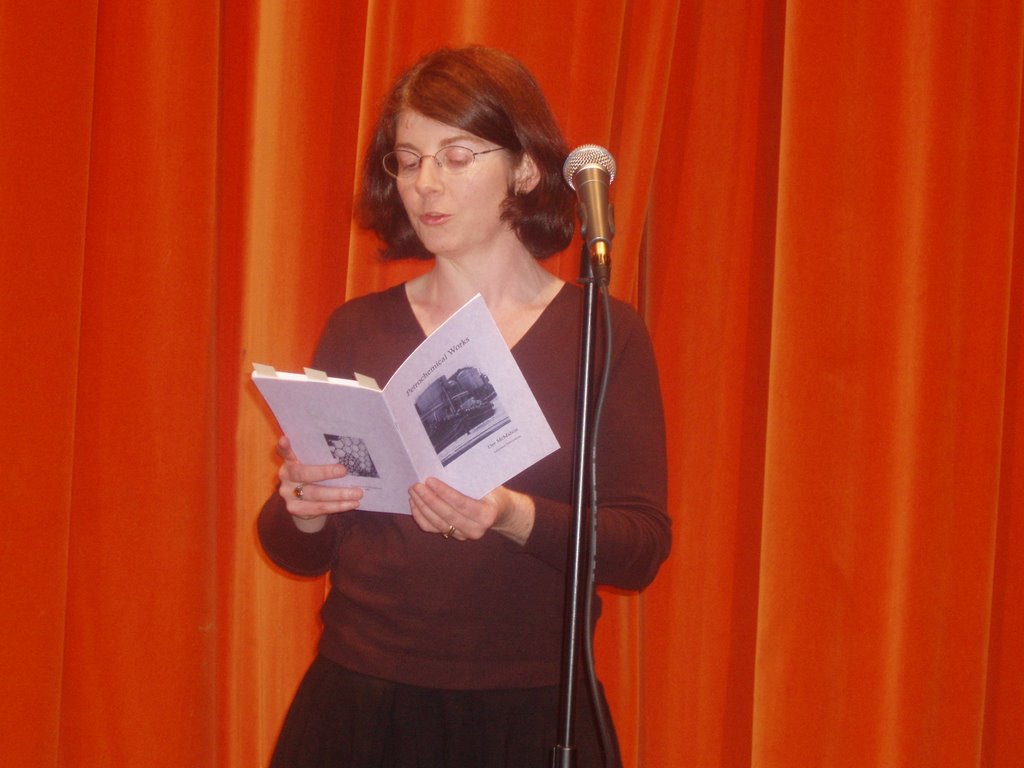
Monday, December 04, 2006
Dee MacMahon : Three Texts
Wind a Dead Tired No More
Rushed in flesh stretched tubes before the word was known, before the actual canal was mine in my mother’s reality. The fluidity of pulsing plasma, bloody composition in it’s growing groaning vessels, whistling ore the rim to sound an eeriness that sings of hairy animal strangeness, ever changing
Wind in double u’s and dees but alone as if there existed only one ebbing and flowing in a turmoil of molecules lowing over Venice, France, the Veldt, Innisowen, Benbulbin, Paraggi, but never Birmingham
It is light. I am in a space in-between. Standing up. The woman I know floats by baby pink doll material movement, then back again. That is all
Outside is different. I listen to the suck and furl dragging from somewhere to toss a wholeness of all air holding sway in the whorlground. A million tinsel ties on branches taped out to the thinnest tinness in flurries of perfect pitch. A metallurgist injecting leaves with liquid elements to solidify in the airy presence of others
Scudding grey edge trimmed white flesh behind three layers before the sky
Heard and recognised, modulation in constant stream of sentence, the sense of intention imagined in their pitch pull depth scale rising hang, then hung
The swirl around some vortex of shuddering skylight, roof and room a distant rush mellowing to whooshing circular motion. Three sides open, two glassed the loudness the pitch increased decreased in inches of frame pushed pulled. What change a circle square or cube? Break down these walls my castle
A volley of half filled bean bags soft breaking on barren moor, landscape fuelled no bush tree windbreak, snatching and twisting in non determination. Snatched crinkle sheeting, cracked and set down, cracked and set down, cracked down, crack dow lulled in the thickness of billowing deflation, warmed in the energy of changing crystals forever opaqued to weaker clacking less crisp
Overtowering Atlantic rush
To the Power of Signs
Waiting in wood fast hare or hounds sandwiching the earth in pincer movement, elusive dicers of death. The numbers ringing in ear torn ripped nose gashed worsted skin, skin hanging returned to the ringhome standing still, relating memories of future fili[1] castings. Not pict not norse adorned with ores these puck and slither mincers of men sucked of bloodling kings
Your father’s ashes, stiff
Childhood’s lost language in natural ascendancy rehearses arise regroups in head the flash of gathering tribes see sawing the fierce and loyal actors and doers, pull pushed in the finest fiery words which pacify pump plump pacify pump plump consensus of a warless or warring force that will be still or will be fast fearless in active bloodlines of the Queen
Your mother’s foreword
The bard winds his tail through master warrior runner server in halls of fire praise to the God of Trees, boar dripping spit fuel swelling the flames to spiral conspire twist and curl in mellow burnt orange on the famish feast, feeling the words snuff nose picture this rich in the history of ash carbon dust hurling down green roads of connection
Satiety
One whiff a six year old idyll damp rotting blackberry leaves. Red fruit the size of little finger painted nails surrounded by glistening bottle green
Exotic, it is not. Nor absent from the impact. In that Ambre Solaire moment, the blue chlorine pooled tinkle laughter shrieked on a summer’s day, resonant and rightfully owning all the airwaves. Tobacco juiced brown on my finger sister skin, rolled to break down what it offers, tracing the experience of tweedy aromas, clinging peat smokiness rack tacked to nerve ends in diminishing sense until one day a passer by retrieved
Expectation of taste
Turkish delighted or body shopped tea citrussy fresh with a colour that lies of lemon connections, and black velvelteen deep. Assulted outside my door purpled and bushy scenting the way. Scrambled on Ligurian hills boar family thicket in autumnal pursuit of fear. Perugia materialising in you, your young on a hillside in seasoned wilderness and sage. A sudden drop to be fodder forgotten
The panic attack stench of a Cologne train station high summer heat flies. Lies between friends ride on expectations directionless alien cities sense loss in the break down rip up tear of redundant maps. You oblivious wanting to be found. Finding you at that pissed up place exhausted out of all. Waiting to be told. What to grow to
Minerals on air iodine laced and braced to it through humid fresh flesh skin hair laying down salty elemental tissue. Nourishing slime rubbered sun dried stands a tangle of washed hair on rocky heads. Blankness tinged to white grey blue mirrored in my delivery of this always home always
A barrier for some
This is important. Hot sand on white slabs dried dune blue air grasses distant wash throughrush
[1] Fili is the Irish word for ‘Poet’
Dee MacMahon is an Irish poet living and working in Ormskir. A former student of the MA in Writing Studies at Edge Hill University, she is currenly a member of the universitiy's Poetry and Poetics Research Group.
Rushed in flesh stretched tubes before the word was known, before the actual canal was mine in my mother’s reality. The fluidity of pulsing plasma, bloody composition in it’s growing groaning vessels, whistling ore the rim to sound an eeriness that sings of hairy animal strangeness, ever changing
Wind in double u’s and dees but alone as if there existed only one ebbing and flowing in a turmoil of molecules lowing over Venice, France, the Veldt, Innisowen, Benbulbin, Paraggi, but never Birmingham
It is light. I am in a space in-between. Standing up. The woman I know floats by baby pink doll material movement, then back again. That is all
Outside is different. I listen to the suck and furl dragging from somewhere to toss a wholeness of all air holding sway in the whorlground. A million tinsel ties on branches taped out to the thinnest tinness in flurries of perfect pitch. A metallurgist injecting leaves with liquid elements to solidify in the airy presence of others
Scudding grey edge trimmed white flesh behind three layers before the sky
Heard and recognised, modulation in constant stream of sentence, the sense of intention imagined in their pitch pull depth scale rising hang, then hung
The swirl around some vortex of shuddering skylight, roof and room a distant rush mellowing to whooshing circular motion. Three sides open, two glassed the loudness the pitch increased decreased in inches of frame pushed pulled. What change a circle square or cube? Break down these walls my castle
A volley of half filled bean bags soft breaking on barren moor, landscape fuelled no bush tree windbreak, snatching and twisting in non determination. Snatched crinkle sheeting, cracked and set down, cracked and set down, cracked down, crack dow lulled in the thickness of billowing deflation, warmed in the energy of changing crystals forever opaqued to weaker clacking less crisp
Overtowering Atlantic rush
To the Power of Signs
Waiting in wood fast hare or hounds sandwiching the earth in pincer movement, elusive dicers of death. The numbers ringing in ear torn ripped nose gashed worsted skin, skin hanging returned to the ringhome standing still, relating memories of future fili[1] castings. Not pict not norse adorned with ores these puck and slither mincers of men sucked of bloodling kings
Your father’s ashes, stiff
Childhood’s lost language in natural ascendancy rehearses arise regroups in head the flash of gathering tribes see sawing the fierce and loyal actors and doers, pull pushed in the finest fiery words which pacify pump plump pacify pump plump consensus of a warless or warring force that will be still or will be fast fearless in active bloodlines of the Queen
Your mother’s foreword
The bard winds his tail through master warrior runner server in halls of fire praise to the God of Trees, boar dripping spit fuel swelling the flames to spiral conspire twist and curl in mellow burnt orange on the famish feast, feeling the words snuff nose picture this rich in the history of ash carbon dust hurling down green roads of connection
Satiety
One whiff a six year old idyll damp rotting blackberry leaves. Red fruit the size of little finger painted nails surrounded by glistening bottle green
Exotic, it is not. Nor absent from the impact. In that Ambre Solaire moment, the blue chlorine pooled tinkle laughter shrieked on a summer’s day, resonant and rightfully owning all the airwaves. Tobacco juiced brown on my finger sister skin, rolled to break down what it offers, tracing the experience of tweedy aromas, clinging peat smokiness rack tacked to nerve ends in diminishing sense until one day a passer by retrieved
Expectation of taste
Turkish delighted or body shopped tea citrussy fresh with a colour that lies of lemon connections, and black velvelteen deep. Assulted outside my door purpled and bushy scenting the way. Scrambled on Ligurian hills boar family thicket in autumnal pursuit of fear. Perugia materialising in you, your young on a hillside in seasoned wilderness and sage. A sudden drop to be fodder forgotten
The panic attack stench of a Cologne train station high summer heat flies. Lies between friends ride on expectations directionless alien cities sense loss in the break down rip up tear of redundant maps. You oblivious wanting to be found. Finding you at that pissed up place exhausted out of all. Waiting to be told. What to grow to
Minerals on air iodine laced and braced to it through humid fresh flesh skin hair laying down salty elemental tissue. Nourishing slime rubbered sun dried stands a tangle of washed hair on rocky heads. Blankness tinged to white grey blue mirrored in my delivery of this always home always
A barrier for some
This is important. Hot sand on white slabs dried dune blue air grasses distant wash throughrush
[1] Fili is the Irish word for ‘Poet’
Dee MacMahon is an Irish poet living and working in Ormskir. A former student of the MA in Writing Studies at Edge Hill University, she is currenly a member of the universitiy's Poetry and Poetics Research Group.
Friday, December 01, 2006
Robert Sheppard: Smokestack Lightning
 This is what happened to me. Tony thrust a copy of Tin Pan Arcadia into my hands and made me get up on stage and not sing, which I might have predicted, but read a passage from 'Smokestack Lightning' (printed below), which is something he always does when they play 'Motherless Child Blues'. Written about 1930 by Barbecue Bob, this song was one that Tony and I used to do, but which he now plays as an electric up-tempo number. However when I read it, the band softened to a Bob Diddley shuffle and I read these words:
Kid Bailey's the name I travel with, kidding
around: the name on the only phonograph;
walked up to the shop window, the glitter
of the diamond-fretted Dobro a death squad
tuning up. My handkerchief shields
the chord shapes from
your thieving eyes. Just pull the razor
and shave him. The gun in the guitar case was
no use - jealous man stepped up to Charley
as if to ask for Pony, retuned. Bill-
boards tell women what
to be: a circle of music-stands
dreaming thrills, dancing the Shimmy-She-Wobble -
some guy called it a dry fuck -
the guitar dances too, spins
above Charley's head. I could see
my own rapt reflection in the shine,
an invisible piano whose pedals are moody
bendings. Love my suitcase and the road.
(You can see a very different performance of the poem from 2008, here.)
Page 524
Tony Parsons at Fifty July 2006
 This is my friend Tony Parsons, to whom I dedicated my poem 'Smokestack Lightning', and with whom I used to sing in Little Albert Fly, playing in his new T-shirt at his own 50th birthday party with his band The Blind Lemons. A glutton for punishment, he also played with another band he plays in, The Ant Hill Mob. The event took place in the Duke of Wellington, Shoreham-by-Sea, Sussex, on 7th July 2006. The guitar's called Nellie.
Wednesday, November 22, 2006
Moralis: George Oppen Interview 1973
George Oppen talks of his tireless ear; that he believes he has it and then looks for the words for it, through hundreds of drafts (think about that!) and then the interviewer asks whether this quality of "ear" is the reason why, when we read early and later Oppen, we don't hear 'influence'. We then enter the interview, though we would have liked to have heard the earlier parts (which we may never).
George Oppen: I think the thing's said it to me. My secret belief is that the thing finally says it to me. As if it's shone out - that's what 'phenomena' means: a shining out. What I'm talking about is consciousness.... But I have this point to make about consciousness, that, like Descartes' proof about the cogito, you know your own consciousness exists, and your own consciousness is actual and therefore consciousness in itself and by itself creates, affirms, the fact of actualness. And we are plunging into this miracle of actualness. That's why the little objects mean so much to me. I'm not playing with little objects....
‘The primary elements can only be named.’ [Plato's Theaetetus.] I'm not naive about the object and I think they (the artists of The Art of the Real exhibition, about whom Oppen had been asked) are. What I'm talking about is consciousness.
Interviewer: But we had a long conversation before about George Eliot, the way that she uses consciousness, ethics, sympathy, to work upon her readers in a very didactic way. She's got an ideal of human behaviour in mind, doesn't she? Do you?
George Oppen (answering two questions at once): Her's - yes, I do, - her's is (an art of the real). It tests morals against what really happens to people and what people really want. That girl in the flood runs back to her brother. There is no popular moral point in that. She's just telling what - (smiling) you'll excuse me - a heart (says). And she thinks an ethic in society must be, you know, based on what you want. It's nice once in a while for somebody ever to mention that, aside from theories.
Interviewer: But George Eliot wanted sympathy. She wanted her readers to break down the barriers of class and consciousness and the barriers of selfishness, and to feel with other people. I think that, for her, was the highest state of consciousness.
George Oppen: I do too. Her morality can be attacked, and will be attacked now by a great many people, and it's absolutely non-political. It doesn't put forward a programme. And as to women, it seems to accept how women are at the moment.... The point about this ... this. This is a little bit difficult.... There's a metaphysic of morality, and I don't know if George Eliot covered that. I mentioned it somewhere. You see, this is a question ‘of being numerous’, that is, of the concept of mankind. Now, again, I'm not moralising, I didn't invent this; I just say it exists and we can't be happy without it. I pointed out, people of a certain age (a certain age I might well say!): the length of time we might possibly live is not an unimaginable length of time, in terms of one's memory. It's less than one has experienced.
If they had, say, twenty years before the world was going to end, they would probably not bother to live it out. The end of one's own life is by no means equivalent to the end of the world. There is something called humanity which makes it possible for us to live. It's a metaphysical concept. The old men in the Indian tribe in my poem were dancing for the return of the sun. They're not going to be alive very long. They care.
There's a metaphysic of morality which absolutely must be taken - and I'm talking about a pure hedonism: what we want. But the metaphysic is there; it's in us. We can't disregard this little factor. Socrates tried to, you know. It's a tragic and touching scene....
Interviewer: But so much contemporary writing ...
George Oppen: Oh, indeed it does!
Interveiwer: ... does totally ...
George Oppen: Oh, indeed it does!
Interveiwer: ... ignore the fundamental humanism of what you're describing.
George Oppen: This metaphysical humanism: there's something we believe. There's something we want mankind to be or to become, and that's all we care about, actually. And where we use the word ‘moral’, it's one of those funny words. It 's very hard, and I believe particularly, it's hard to make a word mean what it didn't mean to start with. We think we did and we don't. Moralis means the common practice around us, the manners. We find we use the word morality where we think something involves the destiny of mankind. I'm sorry for the pretensions... but that's where we use the word ‘moral’.
(Interview transcribed and made available by Andrew and Natalia Brighton during the Norwich years)
Page 523
George Oppen: I think the thing's said it to me. My secret belief is that the thing finally says it to me. As if it's shone out - that's what 'phenomena' means: a shining out. What I'm talking about is consciousness.... But I have this point to make about consciousness, that, like Descartes' proof about the cogito, you know your own consciousness exists, and your own consciousness is actual and therefore consciousness in itself and by itself creates, affirms, the fact of actualness. And we are plunging into this miracle of actualness. That's why the little objects mean so much to me. I'm not playing with little objects....
‘The primary elements can only be named.’ [Plato's Theaetetus.] I'm not naive about the object and I think they (the artists of The Art of the Real exhibition, about whom Oppen had been asked) are. What I'm talking about is consciousness.
Interviewer: But we had a long conversation before about George Eliot, the way that she uses consciousness, ethics, sympathy, to work upon her readers in a very didactic way. She's got an ideal of human behaviour in mind, doesn't she? Do you?
George Oppen (answering two questions at once): Her's - yes, I do, - her's is (an art of the real). It tests morals against what really happens to people and what people really want. That girl in the flood runs back to her brother. There is no popular moral point in that. She's just telling what - (smiling) you'll excuse me - a heart (says). And she thinks an ethic in society must be, you know, based on what you want. It's nice once in a while for somebody ever to mention that, aside from theories.
Interviewer: But George Eliot wanted sympathy. She wanted her readers to break down the barriers of class and consciousness and the barriers of selfishness, and to feel with other people. I think that, for her, was the highest state of consciousness.
George Oppen: I do too. Her morality can be attacked, and will be attacked now by a great many people, and it's absolutely non-political. It doesn't put forward a programme. And as to women, it seems to accept how women are at the moment.... The point about this ... this. This is a little bit difficult.... There's a metaphysic of morality, and I don't know if George Eliot covered that. I mentioned it somewhere. You see, this is a question ‘of being numerous’, that is, of the concept of mankind. Now, again, I'm not moralising, I didn't invent this; I just say it exists and we can't be happy without it. I pointed out, people of a certain age (a certain age I might well say!): the length of time we might possibly live is not an unimaginable length of time, in terms of one's memory. It's less than one has experienced.
If they had, say, twenty years before the world was going to end, they would probably not bother to live it out. The end of one's own life is by no means equivalent to the end of the world. There is something called humanity which makes it possible for us to live. It's a metaphysical concept. The old men in the Indian tribe in my poem were dancing for the return of the sun. They're not going to be alive very long. They care.
There's a metaphysic of morality which absolutely must be taken - and I'm talking about a pure hedonism: what we want. But the metaphysic is there; it's in us. We can't disregard this little factor. Socrates tried to, you know. It's a tragic and touching scene....
Interviewer: But so much contemporary writing ...
George Oppen: Oh, indeed it does!
Interveiwer: ... does totally ...
George Oppen: Oh, indeed it does!
Interveiwer: ... ignore the fundamental humanism of what you're describing.
George Oppen: This metaphysical humanism: there's something we believe. There's something we want mankind to be or to become, and that's all we care about, actually. And where we use the word ‘moral’, it's one of those funny words. It 's very hard, and I believe particularly, it's hard to make a word mean what it didn't mean to start with. We think we did and we don't. Moralis means the common practice around us, the manners. We find we use the word morality where we think something involves the destiny of mankind. I'm sorry for the pretensions... but that's where we use the word ‘moral’.
(Interview transcribed and made available by Andrew and Natalia Brighton during the Norwich years)
Page 523
Friday, October 06, 2006
Rupert Loydell and Robert Sheppard: Risk Assessment
Rupert Loydell and I wrote this 26 part sequence together and it is now published by Damaged Goods, apress you might never heard of, and of which you may never hear again. Email me for details.
See also further excerpts on Stride and on Neon Highway .
There's also a review of it here:
http://www.stridemagazine.co.uk/Stride%20mag%202007/Feb%202007/risk%20assess%20rev.htm
A MUTUAL MIRRORING
A mutual mirroring of egos under the influence of
conjunctions and conversations where desires clash tinged
with contrived contempt adopted posture adopted pleasures
where the words work well re-inventing a tongue twisting
current lost in breathy intonations let it percolate through
this new dream of mine energy flows where it will
soft palm offered to itself self-embrace for each
a reliable comfort zone fantasy pushing against ignorance
glove-puppet her into ‘situations’ hand up her back
back up against the wall strokes her to pleasure
in athletic manoeuvres dissolves not dissolved
nipples should be plural desire drips from each
metaphor leavens language’s expected rise and fall
attending to that in the other which is deeply strange
enclosures and the assumed narrative of mumbled prayers
held between them extensive incorporeal perverse
COINS
Coins glued to pavement systems we devise unstuck
a world of permanent echo tapping its way across the
flesh of the city the last night bus growls
at the next morning’s light cluster of balloons
caught on telephone cables collapsed whirligig
strings of sad jewels listing rubbish by the railway
a waste of time a taste of sour wine
and cider on the wind fresh pint clearing mist rises
limitless sky clouds of science thunder heavy weather
storms upset my little world heavy on the seat I’m
about to shit on silence shout out loud and listen
to myself in the distance pierced by sound a ritornello
sporadic orchestration before we steadily sink
my hand-held recorder coils my wordless haiku
into dislocated syllables of syntactic collusion
unwinding winking eye of lorry reversing no way back
DRAWN FACE
Drawn face in misted mirror masked marvel in
a tobacco dream superhero’s alibi crumbles
as water seeps down and Britannia’s boiled clean on
the gables of the Bank income for the coming year
looks likely to be down an axeblow of wit debits
weasel words upon the block submits accounts too late
tender disabled returns gold crosses stolen to be
melted up to human value faith sold for scrap
a belief in basic matter drips its guilty fat
in front of the fire greasing the sleepy relief
as last cigarette burns out three bigwigs in a fog
well up to accuse us where is our interlocutor now?
he’ll wear his rage like medals sheered to scale
anger shearing silvered memories of redemption
monsters warming themselves on a furnace of repealed statutes
endless amendments ring fence of fudge selfish concern
EMPIRE
Empire like a fist shooting like a sniper
blind in one eye we’ll bite the bullet
and torch the dummies tongues seared metal
minds alight with plans humid Disney jungles
shed light on people’s whys look the other way
turning the hand over morse fingers tickertape
a skull in Irish peat warring bleach and brown
in cartoon apathy encoded in this pot bellied
wood carving the glue of the world
is coming unstuck fake shirt bursting like Europe‘s
MultiKulti castaway cargo cults tight jeans
already patched and worn roots uncommonly exposed
how truth changes as it travels across language
as democratic eyes ‘like’ a millionfold column of gas
glow unseeing in the night that never ends
a multi-dimensional setting across the playing fields of Europe
PERSONAS CONJOIN
Personas conjoin and dissolve imagine sweaty fat men
tugging their penises stretch and rise fall away
endless and breath taking a mid-point arrest
tickles their fanciful restlessness premature to think ahead
damp patch of memory beating out to hairy thinness
the skin I love too much hands stuffed between his knees
too much humble virgin pie flat on the tiger rug
turned inside out and spitting sabre-toothed desire
mired in marital memories she breathes to his pump
he eases for her rump sniggering among uncertainties
smokes his last cigarette an experiment with an apple
a vigorous gentleman's vicious grace demanded but not given
the sprouting of wings brushed from a dusty shoulder
whispered, breathless song of lisping choristers and boys
tasty orgasms juice their tongues licking leopard lips
a fanaticism for fetish inside each other’s heads
UNSITUATION
Unsituation of the unprison unsurprising freedom
unhurt by time not passing she piles the archive high
in her cell unseen and unattended unsure memorial
by the unmade bed resident magistrate in the nursery
Untested pulse of history usurped by ur-traditions
intent on uncalled-for change the uncalled call in perfect
recall an Odyssey of reading an undecided homer pigeon
miles off course catalogued as the body’s culture
Ulysses stretched on the slab a corpse undone by unkindness
unwired cables and skin a dead face watches her
as it walks away unseen not the usual suspects nor
an unusual case it seems but untrained out of love
it is unclear how unlikely umbrage is given here
taken that her unreliable face is under consideration
her ulterior memory and unopened eyes are full of it
epic images released from successive un-imagining
VIOLENCE IS
Violence is a wasting disease with headbanging flesh-meets
with wigs like Pharoahs’ stones and paper cut fingerprints
with bruised shadow sightlines snatching from yourself what's
given as little unforgiveables human life’s distilled from it
Violet is a burning light with scorched splinters
with swallows from tilted microphones and cut glass senses
with heavy blue shadows fossils lifted like kippers
onto smoking walls humane files dictated for it
Viola is a wooden mask with antidotes to vision
with scratched veneers of bones a voice that scars
with highly-strung fractures humming the epic ballad
all the way to China where man directed: fire it
Violate each pile of chaos once it’s stopped smouldering
Vindicate each other once you have hit the concrete
Vitiate bimbo men with suntan streaks firing plastic guns
Votive offering to war and power voracious need
Page 522
See also further excerpts on Stride and on Neon Highway .
There's also a review of it here:
http://www.stridemagazine.co.uk/Stride%20mag%202007/Feb%202007/risk%20assess%20rev.htm
A MUTUAL MIRRORING
A mutual mirroring of egos under the influence of
conjunctions and conversations where desires clash tinged
with contrived contempt adopted posture adopted pleasures
where the words work well re-inventing a tongue twisting
current lost in breathy intonations let it percolate through
this new dream of mine energy flows where it will
soft palm offered to itself self-embrace for each
a reliable comfort zone fantasy pushing against ignorance
glove-puppet her into ‘situations’ hand up her back
back up against the wall strokes her to pleasure
in athletic manoeuvres dissolves not dissolved
nipples should be plural desire drips from each
metaphor leavens language’s expected rise and fall
attending to that in the other which is deeply strange
enclosures and the assumed narrative of mumbled prayers
held between them extensive incorporeal perverse
COINS
Coins glued to pavement systems we devise unstuck
a world of permanent echo tapping its way across the
flesh of the city the last night bus growls
at the next morning’s light cluster of balloons
caught on telephone cables collapsed whirligig
strings of sad jewels listing rubbish by the railway
a waste of time a taste of sour wine
and cider on the wind fresh pint clearing mist rises
limitless sky clouds of science thunder heavy weather
storms upset my little world heavy on the seat I’m
about to shit on silence shout out loud and listen
to myself in the distance pierced by sound a ritornello
sporadic orchestration before we steadily sink
my hand-held recorder coils my wordless haiku
into dislocated syllables of syntactic collusion
unwinding winking eye of lorry reversing no way back
DRAWN FACE
Drawn face in misted mirror masked marvel in
a tobacco dream superhero’s alibi crumbles
as water seeps down and Britannia’s boiled clean on
the gables of the Bank income for the coming year
looks likely to be down an axeblow of wit debits
weasel words upon the block submits accounts too late
tender disabled returns gold crosses stolen to be
melted up to human value faith sold for scrap
a belief in basic matter drips its guilty fat
in front of the fire greasing the sleepy relief
as last cigarette burns out three bigwigs in a fog
well up to accuse us where is our interlocutor now?
he’ll wear his rage like medals sheered to scale
anger shearing silvered memories of redemption
monsters warming themselves on a furnace of repealed statutes
endless amendments ring fence of fudge selfish concern
EMPIRE
Empire like a fist shooting like a sniper
blind in one eye we’ll bite the bullet
and torch the dummies tongues seared metal
minds alight with plans humid Disney jungles
shed light on people’s whys look the other way
turning the hand over morse fingers tickertape
a skull in Irish peat warring bleach and brown
in cartoon apathy encoded in this pot bellied
wood carving the glue of the world
is coming unstuck fake shirt bursting like Europe‘s
MultiKulti castaway cargo cults tight jeans
already patched and worn roots uncommonly exposed
how truth changes as it travels across language
as democratic eyes ‘like’ a millionfold column of gas
glow unseeing in the night that never ends
a multi-dimensional setting across the playing fields of Europe
PERSONAS CONJOIN
Personas conjoin and dissolve imagine sweaty fat men
tugging their penises stretch and rise fall away
endless and breath taking a mid-point arrest
tickles their fanciful restlessness premature to think ahead
damp patch of memory beating out to hairy thinness
the skin I love too much hands stuffed between his knees
too much humble virgin pie flat on the tiger rug
turned inside out and spitting sabre-toothed desire
mired in marital memories she breathes to his pump
he eases for her rump sniggering among uncertainties
smokes his last cigarette an experiment with an apple
a vigorous gentleman's vicious grace demanded but not given
the sprouting of wings brushed from a dusty shoulder
whispered, breathless song of lisping choristers and boys
tasty orgasms juice their tongues licking leopard lips
a fanaticism for fetish inside each other’s heads
UNSITUATION
Unsituation of the unprison unsurprising freedom
unhurt by time not passing she piles the archive high
in her cell unseen and unattended unsure memorial
by the unmade bed resident magistrate in the nursery
Untested pulse of history usurped by ur-traditions
intent on uncalled-for change the uncalled call in perfect
recall an Odyssey of reading an undecided homer pigeon
miles off course catalogued as the body’s culture
Ulysses stretched on the slab a corpse undone by unkindness
unwired cables and skin a dead face watches her
as it walks away unseen not the usual suspects nor
an unusual case it seems but untrained out of love
it is unclear how unlikely umbrage is given here
taken that her unreliable face is under consideration
her ulterior memory and unopened eyes are full of it
epic images released from successive un-imagining
VIOLENCE IS
Violence is a wasting disease with headbanging flesh-meets
with wigs like Pharoahs’ stones and paper cut fingerprints
with bruised shadow sightlines snatching from yourself what's
given as little unforgiveables human life’s distilled from it
Violet is a burning light with scorched splinters
with swallows from tilted microphones and cut glass senses
with heavy blue shadows fossils lifted like kippers
onto smoking walls humane files dictated for it
Viola is a wooden mask with antidotes to vision
with scratched veneers of bones a voice that scars
with highly-strung fractures humming the epic ballad
all the way to China where man directed: fire it
Violate each pile of chaos once it’s stopped smouldering
Vindicate each other once you have hit the concrete
Vitiate bimbo men with suntan streaks firing plastic guns
Votive offering to war and power voracious need
Page 522
Subscribe to:
Posts (Atom)