The clocks go back next weekend (in Britain) and the winter months draw in. It is time for a ghost story or two - even if they don't have actual, virtual or artefactual ghosts in them - but who better than Bill Griffths to tell them to us. I read a wonderful piece in Alice Lenkiewicz' magazine Neon Highway called 'Fog', and asked Bill if he had more. He had six, which (one a month) will last us through until Spring. Check his own web-page and see the smoke rising from his chimney, and much more. (See a picture of Bill reading on Page 473 (July 2005.)
TOMMY
Boldly I went up to the door and knocked.
“I want to join the party.”
The man at the door looked at me for a moment, in a detached sort of way. “You cannot,” he said with an almost amused calmness. As though I was not a member of their club.
Behind him I could see lots of people, men, women, not all old. My age too. “There’s youngsters there too,” I pointed out, so he knew he wasn’t fooling me, but keeping it pleasant, like.
Just as mild, he gave a sympathetic shake of the head, and shut the door.
Not rudely, but as an older more wise chap might deal with a bairn.
It rattled me.
What were they? What sort of posh crew, them? Wasn’t I good enough?
I went round the side to look in a window. There was quite a lot of them. Not exactly merry, chatting in little groups, easy enough. ‘Mebbe there’s nae alcohol,’ I thought. But it looked sociable enough, not some prayer meeting or lecture or nowt, and they was a curious mix to be getting on so well, I thought. Some were right old. But there were some me Dad’s age, and a scattering of young-un’s. And somewhere a baby or two was settin’ off its voice.
One or two of the old folk looked my way and noticed me. They gave me such a glare of challenge – or mebbe just astonishment – I had to give up and walkt away.
I had every right to be curious. So many people are leaving our estate to get work, there’s empty houses a-plenty. When no one expects it, a block or so gets knocked down. It depends on what pattern they fall empty in. And then just as often, other people move in. From outside the estate. Exactly, we want to know about them. Especially if they’re the sort to throw parties.
Just once a pair of houses were joined into one, to make a bail hostel. That caused commotion enough. What with packets changing hands on the street and break-ins at the houses round, it wasn’t long before the local residents got together and had it shut down.
But always there were new people coming in. Councils sent them here, hearing there was spare housing. Sad cases, and wrong cases, and belligerent types, so you always wanted to know who they were, what they were like, as soon as possible.
Only I wasn’t having much success here.
“What about that corner house, then, Mam?” I asked at tea-time.
She looked oddly at me. “They’ll keep themselves to themselves,” she said. Suggesting I should dee the same.
I was round there again after dusk. Surely the get-together would end some time. They would set off – somewhere – I could ask one or two as they came out. That seemed fair.
Only there was no sign of change. A dim light was on now, simple blinds were down, so I had to move around a bit to find a chink and get some notion of what was happening. There seemed no less of them (after all no one but me had come knocking on the door; no one came out). As far as I could make some shadowy sense of it – more were sitting down now, it looked more relaxed somehow. Occasionally someone got up and went through a door at the back. Perhaps they were getting a bit bait or summat. But I saw none of them returning. Were they going to bed? Did they all stay there?
The house didn’t seem big enough. I set out to prove it. Being a corner house that wasn’t so easy. A receding corner, that is, so you couldn’t see how big the house itself might be, or how widely the garden fanned out. I could try from round the back. This meant going to the next street, or so I thought. But I plain got lost. At least, I got to where I thought it should be, but then there were other houses and gardens in the way. I clambered over into a back garden here, in case I could get through; but then I lost my bearings, the houses opposite looked all the same; a dog began barking; I gave up. Bedtime.
“Tom, where do you gan when ye’re deed?”
“A gert big serpent swallers ye up.”
“Wi googly een?”
“Weel, he wad, if’n he’d swallered ye.”
“Ye’re funnin’.”
“Aareet, what d’ye reckon?”
“Mebbe things just stop.”
“Or mebbe ye just carry on i’ sum other place.”
“How d’ye knaa?”
“It maks sense. Nowt ends, dizzit?”
“Oh.”
“Sae gan ti sleep willyer?”
All the same, mi little brother gave me an idea.
I walked up to the door, and knocked.
A woman answered; she waited for me to speak first.
“Is Jake there?”
Her mute face registered alarm. She kinda gestured with her eyes, at the room behind her, mebbe not meaning to. She never moved to let me in or auht.
“Jake!” I shouted.
I thought I caught a glimpse of my marra – just a flash as of a turned heed – or someone caught unaware – or was it him?
I was trembling now.
The woman looked at me not unkindly. “I think you’d better leave now,” she said.
It was a suggestion, not an order.
I was too dazed to reply.
The door quietly closed.
Did I want to meet Jake again?
Did I dare?
It took a coupla days afore A’d worked that through; and then the house was empty again. Everyone had went. Everyone.
Page 484
There will be another Bill Griffiths story next month. Two poems of his may be found here.
Wednesday, October 26, 2005
Sunday, October 09, 2005
Patricia Farrell: Otherwise Than Beings

To celebrate the arrival of copies of Robert Sheppard's
we are publishing the cover art by Patricia Farrell
Page 483

Wednesday, October 05, 2005
Robert Sheppard: A History of the Other part eight
Out of Everywhere: Be(com)ing a Woman Poet
The absence of women writers in the British Poetry Revival has been noted; Horovitz’ 1969 anthology Children of Albion was ‘no more hospitable to women than [Alvarez’] 1962 The New Poetry’ as Claire Buck says, but little has been suggested as to why this was so. One of the five women amongst the 63 poets of Children of Albion, Libby Houston, remembered being involved in Horovitz’ proto-Beat scene and recalled being the only woman to attend readings, a view echoed in Michelene Wandor's memories of a slightly later period:
In the late 1960s-early 1970s I had read my poetry at the very many poetry-reading venues there were but had stopped by choice, since I felt uncomfortable at being (mostly) the only woman poet - the other women around were wives or groupies, and I always felt a bit odd in relation to both camps.
Female audience members clearly were defined in relation to male audiences and male poets. The word ‘groupie’ suggests not just an importation of pop argot, but the adoption of its macho ethos. A groupie is there to have casual sex with the poetry star. Such a scene - and the poetry reading was as vital to the survival of the poetry as print - would be prohibitive for a woman writer or audience member. Readings were often held in pubs, traditional male territory; the potential childcare problems of attending readings, let alone going on ‘tour’, must be recalled too. A telling anecdote of Houston suggests that women were expected to play other familiar roles.
I could flash a smile, dress up, being a woman part of the act which belonged there. When Horovitz and [Pete] Brown set about starting a reading agency, Poetry in Motion ... eyebrows were raised at me, the woman ... to run it.
If sexism was rife through the Underground – and I have heard a senior British poet say, with relish and regret, that there was a ‘lot of leg-over’ in the 1960s - it is not surprising that aspiring women poets of the 1960s and 1970s turned to the women's movement for an audience, although the movement was not unequivocally receptive. Wandor recalls political attacks on poetry as ‘moribund’, so it is small wonder that, as Claire Buck states,
The poetry that flourished within the context of the new women's movement was characterized by a clear fidelity to its political ideals translated into a poetics concerned with cultural critique, an accessible language and form, and the expression of women's personal experience.
Clearly distinct if not distant from the work dealt with here, some of this work was collected in The New British Poetry (1988), but while its feminist section was slim on the grounds that women were also represented in the black writing and the two sections which are more my concern, Mottram’s British Poetry Revival section has only two women poets out of its 25, Denise Riley and Wendy Mulford. Linguistically Innovative Poetry by women has not fared much better; Edwards’ section, ‘Some Younger Poets’, has four women out of 18 poets, and Conductors of Chaos, a similar anthology edited by Iain Sinclair showcases only five women out of 36 contributors.
However, in the 1990s, there seemed a genuine paucity of British experimental women writers. When Maggie O’Sullivan, who was only too keen to redress this imbalance, edited Out of Everywhere: Linguistically Innovative Poetry by Women in North America & the UK in 1996, she could only find nine British poets to join the remaining 21 from across the Atlantic.
Out of Everywhere therefore features a large selection of North American, mostly language, poetry. It is interesting to see that, by 1996, it was possible to place British work alongside North American work in the same context, for example, to put Bergvall’s performance work next to Rosmarie Waldrop’s extraordinary series of prose texts ‘writing back’ to other texts. Such work is located outside of most gatherings, and discussions, of women’s poetry, despite its importance for certain questions concerning women’s writing, such as French feminism’s identification of a specific écriture feminine. O’Sullivan's introduction quotes the words of ‘an unidentified audience member’ at a Waldrop talk who noted how such linguistically innovative work by women is doubly excluded from the institutionized marginality of feminist poetry or from Gilbert and Gubar style anthologies. The comment provides O’Sullivan’s anthology with its title: ‘There’s an extra difficulty being a woman poet and writing the kind of poetry you write: you are out of everywhere (laughter).’ This ambivalent evocation of both inclusion and exclusion is apposite. O’Sullivan points out, perhaps a little too stridently, that
Excluded from ‘women’s canons’, such work does, however, connect up with linguistically innovative work by men who have themselves also transcended the agenda-based and cliché-ridden rallying positions of mainstream poetry.
As early as 1984, O’Sullivan and Geraldine Monk launched an attack in an article which prepared the ground for Out of Everywhere. They argue that feminist poetry, far from raising consciousness, is often ‘versified propaganda’ and, more importantly, is being falsely ‘validated as the poetry that speaks for women’. In terms that mirror Buck’s analysis, they argue that
the most effective chance any woman has of dismantling the fallacy of male creative supremacy is simply by writing poetry of a kind which is liberating by the breadth of its range, risk and innovation.... to exploit and realize the full potential and importance of language.
Caroline Bergvall, Maggie O’Sullivan and Geraldine Monk, are featured in both of the 1996 anthologies, as is Denise Riley. Claire Buck argues that Riley, too, was ‘out of everywhere’, because her ‘focus on the poststructuralist concerns of language and sexual difference place her ... in opposition to the main trajectory of feminist poetry in both the 1970s and the 1980s.’ 85 After some years of poetic silence, the genuine and distinctive voice of Riley rose to prominence, with two Reality Street collections, one of new poems, Mop Mop Georgette in 1993, and her Selected Poems in 2000. Among the formal experimentation of Out of Everywhere, her work (which, in any case, has also found itself in the Penguin Modern Poets series), seems muted, the ironical play with voice and self more often attenuated by traditional rhetorical figures; she is often seen as another member of the Cambridge axis. However, the texts are full of evanescent presentations of a far from stable female ego, a voice in which the promises of identity divide and dissolve into the ‘I’ provided by the lyric poetry tradition. She articulates voices (not ‘voice’); most of them want to act out a self-absorbed otherness:
in sleep alone I get articulate to mouth the part of
anyone and reel off others' characters until the focus
of a day through one-eyed self sets in again: go into it.
I must. (CC, p. 393)
The weaving of song lyrics into the text (so that what is quotation and what is not, what is expressive and what is ironic, is unclear) enacts the ambivalent remembering and misremembering of a nostalgic and narcissistic content that the poems themselves appear to offer, as in ‘Lure 1963’:
Oh yes I’m the great pretender. Red lays a stripe of darkest
green on dark. My need is such I pretend too much. I’m
wearing. And you’re not listening to a word I say. (CC, p. 86)
Fashion and emotional excess are intertwined in the word ‘wearing’. Such sartorial disguise and the deference to the ventriloquial articulations of popular song result in the ego singing, rather than talking, to itself.
Next month A History of the Other concludes with a consideration of anthologies and conferences. In the meantime check out the Pores/Readings website Forum on Women Writers for some other views on the matters discussed here.
Page 482
The absence of women writers in the British Poetry Revival has been noted; Horovitz’ 1969 anthology Children of Albion was ‘no more hospitable to women than [Alvarez’] 1962 The New Poetry’ as Claire Buck says, but little has been suggested as to why this was so. One of the five women amongst the 63 poets of Children of Albion, Libby Houston, remembered being involved in Horovitz’ proto-Beat scene and recalled being the only woman to attend readings, a view echoed in Michelene Wandor's memories of a slightly later period:
In the late 1960s-early 1970s I had read my poetry at the very many poetry-reading venues there were but had stopped by choice, since I felt uncomfortable at being (mostly) the only woman poet - the other women around were wives or groupies, and I always felt a bit odd in relation to both camps.
Female audience members clearly were defined in relation to male audiences and male poets. The word ‘groupie’ suggests not just an importation of pop argot, but the adoption of its macho ethos. A groupie is there to have casual sex with the poetry star. Such a scene - and the poetry reading was as vital to the survival of the poetry as print - would be prohibitive for a woman writer or audience member. Readings were often held in pubs, traditional male territory; the potential childcare problems of attending readings, let alone going on ‘tour’, must be recalled too. A telling anecdote of Houston suggests that women were expected to play other familiar roles.
I could flash a smile, dress up, being a woman part of the act which belonged there. When Horovitz and [Pete] Brown set about starting a reading agency, Poetry in Motion ... eyebrows were raised at me, the woman ... to run it.
If sexism was rife through the Underground – and I have heard a senior British poet say, with relish and regret, that there was a ‘lot of leg-over’ in the 1960s - it is not surprising that aspiring women poets of the 1960s and 1970s turned to the women's movement for an audience, although the movement was not unequivocally receptive. Wandor recalls political attacks on poetry as ‘moribund’, so it is small wonder that, as Claire Buck states,
The poetry that flourished within the context of the new women's movement was characterized by a clear fidelity to its political ideals translated into a poetics concerned with cultural critique, an accessible language and form, and the expression of women's personal experience.
Clearly distinct if not distant from the work dealt with here, some of this work was collected in The New British Poetry (1988), but while its feminist section was slim on the grounds that women were also represented in the black writing and the two sections which are more my concern, Mottram’s British Poetry Revival section has only two women poets out of its 25, Denise Riley and Wendy Mulford. Linguistically Innovative Poetry by women has not fared much better; Edwards’ section, ‘Some Younger Poets’, has four women out of 18 poets, and Conductors of Chaos, a similar anthology edited by Iain Sinclair showcases only five women out of 36 contributors.
However, in the 1990s, there seemed a genuine paucity of British experimental women writers. When Maggie O’Sullivan, who was only too keen to redress this imbalance, edited Out of Everywhere: Linguistically Innovative Poetry by Women in North America & the UK in 1996, she could only find nine British poets to join the remaining 21 from across the Atlantic.
Out of Everywhere therefore features a large selection of North American, mostly language, poetry. It is interesting to see that, by 1996, it was possible to place British work alongside North American work in the same context, for example, to put Bergvall’s performance work next to Rosmarie Waldrop’s extraordinary series of prose texts ‘writing back’ to other texts. Such work is located outside of most gatherings, and discussions, of women’s poetry, despite its importance for certain questions concerning women’s writing, such as French feminism’s identification of a specific écriture feminine. O’Sullivan's introduction quotes the words of ‘an unidentified audience member’ at a Waldrop talk who noted how such linguistically innovative work by women is doubly excluded from the institutionized marginality of feminist poetry or from Gilbert and Gubar style anthologies. The comment provides O’Sullivan’s anthology with its title: ‘There’s an extra difficulty being a woman poet and writing the kind of poetry you write: you are out of everywhere (laughter).’ This ambivalent evocation of both inclusion and exclusion is apposite. O’Sullivan points out, perhaps a little too stridently, that
Excluded from ‘women’s canons’, such work does, however, connect up with linguistically innovative work by men who have themselves also transcended the agenda-based and cliché-ridden rallying positions of mainstream poetry.
As early as 1984, O’Sullivan and Geraldine Monk launched an attack in an article which prepared the ground for Out of Everywhere. They argue that feminist poetry, far from raising consciousness, is often ‘versified propaganda’ and, more importantly, is being falsely ‘validated as the poetry that speaks for women’. In terms that mirror Buck’s analysis, they argue that
the most effective chance any woman has of dismantling the fallacy of male creative supremacy is simply by writing poetry of a kind which is liberating by the breadth of its range, risk and innovation.... to exploit and realize the full potential and importance of language.
Caroline Bergvall, Maggie O’Sullivan and Geraldine Monk, are featured in both of the 1996 anthologies, as is Denise Riley. Claire Buck argues that Riley, too, was ‘out of everywhere’, because her ‘focus on the poststructuralist concerns of language and sexual difference place her ... in opposition to the main trajectory of feminist poetry in both the 1970s and the 1980s.’ 85 After some years of poetic silence, the genuine and distinctive voice of Riley rose to prominence, with two Reality Street collections, one of new poems, Mop Mop Georgette in 1993, and her Selected Poems in 2000. Among the formal experimentation of Out of Everywhere, her work (which, in any case, has also found itself in the Penguin Modern Poets series), seems muted, the ironical play with voice and self more often attenuated by traditional rhetorical figures; she is often seen as another member of the Cambridge axis. However, the texts are full of evanescent presentations of a far from stable female ego, a voice in which the promises of identity divide and dissolve into the ‘I’ provided by the lyric poetry tradition. She articulates voices (not ‘voice’); most of them want to act out a self-absorbed otherness:
in sleep alone I get articulate to mouth the part of
anyone and reel off others' characters until the focus
of a day through one-eyed self sets in again: go into it.
I must. (CC, p. 393)
The weaving of song lyrics into the text (so that what is quotation and what is not, what is expressive and what is ironic, is unclear) enacts the ambivalent remembering and misremembering of a nostalgic and narcissistic content that the poems themselves appear to offer, as in ‘Lure 1963’:
Oh yes I’m the great pretender. Red lays a stripe of darkest
green on dark. My need is such I pretend too much. I’m
wearing. And you’re not listening to a word I say. (CC, p. 86)
Fashion and emotional excess are intertwined in the word ‘wearing’. Such sartorial disguise and the deference to the ventriloquial articulations of popular song result in the ego singing, rather than talking, to itself.
Next month A History of the Other concludes with a consideration of anthologies and conferences. In the meantime check out the Pores/Readings website Forum on Women Writers for some other views on the matters discussed here.
Page 482
Tuesday, September 27, 2005
Neil Pattison: Preferences 1
1: How do I look?
A slip of traction
and the catch wires
form proscription
to the motive cusp,
slender. Climacterics
choke on the copula
tradeoff, switching
flatline hungers in the
pause, your pocket.
Preference labours
to make, an edit proof
defective in the act.
With what science?
New treatments
scripting the pinned
figure’s wing chase
bright metallics;
your own therapys
lashed in broke
assertions are the catch.
Urge the present
set for home.
Chromatic rates
of trade & force
aslant decision.
Clouds & clusters
sculpt faze ratios,
clipping frequency
breaks. Gyorgy,
bow the steel.
The white knots
hatch out chance
of a tourniquet.
Pearls & coral
buoy the wreck.
Acquiescence bleeds
a threshold, kills
the day. Relinquish
the language, make
room. I love you.
Sleeping, pay no
attention. Wake
to your dead rate,
a stripped heart.
Steering emergence
amok your streets
from scratch to render
cadence means
indexing renewal,
the dark manifest.
Zoned & keycoded
estrange homes co-opt
futurity, weathered
into shape. Grief
secures the encircle
ment routes, alarming
laborious shifts. Swipe
mouths at the gate.
I was never asleep.
Are you tired?
Transition bombs in
the shelters maybe.
We want the god
at hand. Brassnecks
& art shoes, frisks
of currency. Smoking
guns, new veers
& reels. Faces down
in the data stream
the screen is gate,
high scarp & degree:
say byebye purchase.
Cutbacks, good
schlock, old money:
bloodshot & curved
against the glassy brink,
how do we look?
The wall uncurls,
gives & tooths an edge:
I’ve cleaned my hands.
As our surface
rooms mother
conditional dues
the grievances
kick, relapse
permission to
the salvagers’
decisive coast.
A frontier
surrenders.
Abeyance cost
burlesque &
our conscience.
Any excavation
quicks the fugue;
sative zoetropic
skews at your
beloved skin
mean silver
dancing out.
Neil Pattison is a student at Cambridge. I met him when I read there last year, and remembered that he told me he was unpublished. Since then he’s read at Cambridge and there was a rave-review on one of the e-mail lists.
Page 481
A slip of traction
and the catch wires
form proscription
to the motive cusp,
slender. Climacterics
choke on the copula
tradeoff, switching
flatline hungers in the
pause, your pocket.
Preference labours
to make, an edit proof
defective in the act.
With what science?
New treatments
scripting the pinned
figure’s wing chase
bright metallics;
your own therapys
lashed in broke
assertions are the catch.
Urge the present
set for home.
Chromatic rates
of trade & force
aslant decision.
Clouds & clusters
sculpt faze ratios,
clipping frequency
breaks. Gyorgy,
bow the steel.
The white knots
hatch out chance
of a tourniquet.
Pearls & coral
buoy the wreck.
Acquiescence bleeds
a threshold, kills
the day. Relinquish
the language, make
room. I love you.
Sleeping, pay no
attention. Wake
to your dead rate,
a stripped heart.
Steering emergence
amok your streets
from scratch to render
cadence means
indexing renewal,
the dark manifest.
Zoned & keycoded
estrange homes co-opt
futurity, weathered
into shape. Grief
secures the encircle
ment routes, alarming
laborious shifts. Swipe
mouths at the gate.
I was never asleep.
Are you tired?
Transition bombs in
the shelters maybe.
We want the god
at hand. Brassnecks
& art shoes, frisks
of currency. Smoking
guns, new veers
& reels. Faces down
in the data stream
the screen is gate,
high scarp & degree:
say byebye purchase.
Cutbacks, good
schlock, old money:
bloodshot & curved
against the glassy brink,
how do we look?
The wall uncurls,
gives & tooths an edge:
I’ve cleaned my hands.
As our surface
rooms mother
conditional dues
the grievances
kick, relapse
permission to
the salvagers’
decisive coast.
A frontier
surrenders.
Abeyance cost
burlesque &
our conscience.
Any excavation
quicks the fugue;
sative zoetropic
skews at your
beloved skin
mean silver
dancing out.
Neil Pattison is a student at Cambridge. I met him when I read there last year, and remembered that he told me he was unpublished. Since then he’s read at Cambridge and there was a rave-review on one of the e-mail lists.
Page 481
Thursday, September 22, 2005
Robert Sheppard: The History of the Other, part seven
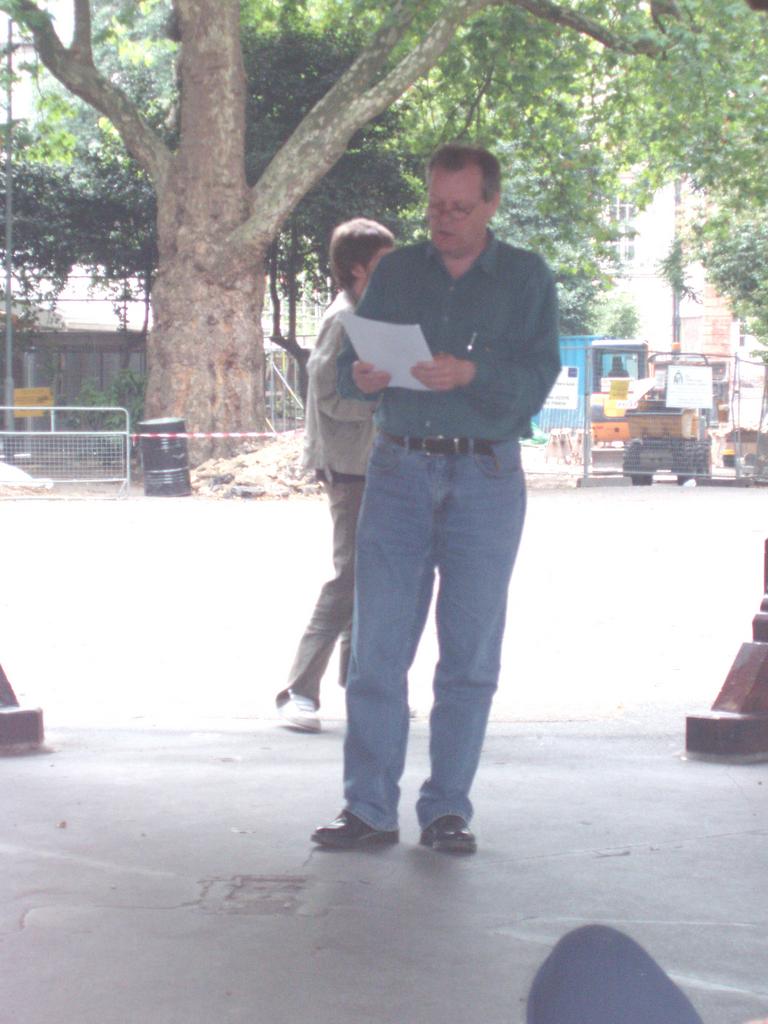 Robert Sheppard reading at The Poetry Buzz
(Stephen Farrell Sheppard in the background)
Next month, a feature on the fate of women poets in the British Poetry Revival and Linguistically Innovative Poetry in Britain. For more of this history please see my The Poetry of Saying, advertised on Page 478.
Page 480
Performance Writing
Iain Sinclair’s anthology Conductors of Chaos (referred to as CC in the text) which I talked about last month, also reflects the growth of a specific ‘performance writing’. Not to be confused with the populist performance poetry to be found in most cities and towns (a distant descendent of the British Beats of the 1960s), this emergent practice developed out of the performance contexts of British poetry in the 1970s and 1980s analysed above. It found a temporary institutional home at Dartington College of the Arts, in Devon. Aaron Williamson, for a while a research fellow there, was witnessed in performance by Susan de Muth of the Independent in 1995:
When he bursts through the glass doors, it is like an explosion of noise. People step back, tread on each others’ toes, stumble; we’re assaulted by the violent cacophony of his roaring, screaming, jibbering, weeping and moaning.
Indeed ‘Cacophonies’ is the title of one sequence excerpted in Conductors Of Chaos. The poems are exacting explorations of the condition of profound deafness.
Stamping so that the floorboards resound, Williamson strikes a balletic pose and suddenly, from the echoes of this aural anarchy, brings forth a serene and lucid stream of poetry. The feedback from his wayward hearing aid produces an eerie accompaniment which could be the music of the spheres. Some people cry. The experience is overwhelming.
When Williamson says, ‘The words themselves, the modes of saying, are as significant as meaning,’ he is opening up his practice to ‘a more physical currency of accord’ that would try to avoid thematizing the text by re-casting it in a more performative mode. On the page the ‘Cacophony’ is a text of misheard ‘confused loads’, of corrections (‘yes that one’), and the existentially chilling, ‘you’ve lost me’ of the deaf. (CC, pp. 481-82) The text stutters, tongue-tied, breaks up language, lards the interstices between words with other words, word-parts and anagram, uses enjambement to prise open lexical items and suggests performance in its notation, in a manner reminiscent of Maggie O’Sullivan’s work. (Note: this should be centre-margined.)
Continu-
uses contingent on con-
-tract, facts tussle ’twist centre and
everywidewhere ELSEWISE
or ‘role’, or ‘participant’
‘lore’, ‘rawstate’, ‘poor’
litigant, COMP
-pet-eat-height-or, MANAGERing – birthing
as U-Factor (CC, p. 482)
The nature of identity, of the ‘U’, and the ‘participating hazards’ of identifying with a centre that seems defined by laws rather than roles and lores is contrasted to the ‘everywidewhere’ of elsewhere. Between these extremes, the facts, like the text in performance, tussles.
The similarly centred lines of ‘Stranger’ by cris cheek look so fixed upon the pages of Conductors of Chaos, that it is a surprise to hear performance variations on his own Skin Upon Skin studio CD, also released in 1996. Indeed one can hear the process of word transformation, as ‘tactic’ becomes ‘tic tac’ in the passage below, and one can then see how ‘stranger’ became ‘stringer’ in the printed text. Oral improvisation, transcription, computer screen design, and subsequent performance, are the acknowledged stages of creation. Yet it is also a meditation upon estrangement and alienation, focussing at times on the island of Madagascar, sometimes on its own processes and orderings. The recasting of Felicia Hemans’ famous lines of maritime catastrophe is only one of the most obvious verbal transformations, one which introduces the theme of nomadic movement:
The toy stood on the turning Wreck
Of climax and Closure.
To distract from a diversionary
Because to sequence the modern and get it ‘right’ in that
Sequence is not Necessarily order, right?
To distract from a diversionary modern tic tac
Or there isn’t time for letters and you can’t afford to phone – country road
- Going home. (CC, p.35)
(This text is centre-margined in the original.) Vocal techniques – breathing and throat sounds (reminiscent of the sound poetry of Henri Chopin), half-singing, full song (as in the lines from a country song above) – are heard against an intermittent chant and violin drone. The intonation patterns are not those of ordinary speech. Such effects are improvised from the text (or some variant) and range between the mimetic (the quoted song) and the random (sudden dips of tone or squeaky falsettos). The ‘text’ is also its performance and its subsequent transformations. The risk is that it might be performed or re-inscribed in less, as well as more, interesting ways, that climax and closure might not become integrated. But the text itself poses a question that (given its serial transformation) is oddly rhetorical among such transitions. (Again, this should be centre-margined.)
‘Now – is poetry then
a process of arresting
or of Moving?’ (CC, p. 36)
If we equate arrest with the Levinasian said and movement with the saying, which is in effect the argument of my The Poetry of Saying, this poetry opts for the constant promise of re-invention imposed by the transformations. But the poetry of moving must embrace the arrest (which is only a rest) in the material text upon the page, and even as sound traces on the CD.
Caroline Bergvall delivered a keynote paper at a 1996 conference concerning performance, at Dartington College, when she was the director of the performance writing programme. The questions she asks about the ‘concerted excavation of the intradisciplinarity of much textual work’ push the possible boundaries of what might be considered performance beyond the two examples above:
Is it not Performance Writing to site some text in a space or on a wall or on electronic boards?... Is it not Performance Writing to treat spoken writing as part of a sound composition .... to inscribe words on a canvas, spray them on a wall, layer text into photographs or carve them into wood, steel or other solids...? to use text as part of a body-related piece...? to bleed a word into flesh ... ? Is it not Performance Writing to generate text for the page...?
This is a stance that acknowledges that writing itself is performance, which is at once liberating and limiting for the question remains: what will not be performance? If everything is, what value and specificity can the category have? To include under this rubric, writing ‘activated for and through a stage, for and through a site, a time-frame, a performer’s body, the body of a voice or the body of a page’ authorizes experimentation in dozens of ways out from writing, but simultaneously directs attention to a kind of total artifice that emphasizes the materiality of any aspect of language and its propagation, since
everything about a piece of work is active and carries meaning. Any treatment, any font, any blank, any punctuation, any intonation, any choice of materials, any blob, however seemingly peripheral to the work, is part of the work, carries it, opens it up, closes it in, determines it.
Williamson, cheek and Bergvall herself have explored performing with musicians and dancers, but also have investigated site-specific installation work, and cheek has been exploring hybrid forms of writing. Brian Catling, for example, is also a sculptor, performer and book artist.
Sinclair’s anthology showcases Bergvall’s splendidly funny, typographically extravagant, post-porn (‘leg over’) (CC, p. 6) piece for two ‘kissers’: (‘come legs over legs suck armpits with tongue/come legs over neck press belly on butt’) (CC, p.7 ). The accompanying marginal gloss reads: ‘on remembering one's past suddenly’. (CC, p. 7) It is this bodily memory of sexual experience that informs what Drew Milne has called her ‘queer poetics’. The text (it is not easy to see what performance would unravel from the page) ends:
muscle-constructions do the archaeology of sex in one hundred and twenty situations [the text is entitled In Situ] and ah ah where you have just come from disperses in the growing background: so I’ll ask you once again what do you remember of what you know. (CC, p. 10)
*
Iain Sinclair’s anthology Conductors of Chaos (referred to as CC in the text) which I talked about last month, also reflects the growth of a specific ‘performance writing’. Not to be confused with the populist performance poetry to be found in most cities and towns (a distant descendent of the British Beats of the 1960s), this emergent practice developed out of the performance contexts of British poetry in the 1970s and 1980s analysed above. It found a temporary institutional home at Dartington College of the Arts, in Devon. Aaron Williamson, for a while a research fellow there, was witnessed in performance by Susan de Muth of the Independent in 1995:
When he bursts through the glass doors, it is like an explosion of noise. People step back, tread on each others’ toes, stumble; we’re assaulted by the violent cacophony of his roaring, screaming, jibbering, weeping and moaning.
Indeed ‘Cacophonies’ is the title of one sequence excerpted in Conductors Of Chaos. The poems are exacting explorations of the condition of profound deafness.
Stamping so that the floorboards resound, Williamson strikes a balletic pose and suddenly, from the echoes of this aural anarchy, brings forth a serene and lucid stream of poetry. The feedback from his wayward hearing aid produces an eerie accompaniment which could be the music of the spheres. Some people cry. The experience is overwhelming.
When Williamson says, ‘The words themselves, the modes of saying, are as significant as meaning,’ he is opening up his practice to ‘a more physical currency of accord’ that would try to avoid thematizing the text by re-casting it in a more performative mode. On the page the ‘Cacophony’ is a text of misheard ‘confused loads’, of corrections (‘yes that one’), and the existentially chilling, ‘you’ve lost me’ of the deaf. (CC, pp. 481-82) The text stutters, tongue-tied, breaks up language, lards the interstices between words with other words, word-parts and anagram, uses enjambement to prise open lexical items and suggests performance in its notation, in a manner reminiscent of Maggie O’Sullivan’s work. (Note: this should be centre-margined.)
Continu-
uses contingent on con-
-tract, facts tussle ’twist centre and
everywidewhere ELSEWISE
or ‘role’, or ‘participant’
‘lore’, ‘rawstate’, ‘poor’
litigant, COMP
-pet-eat-height-or, MANAGERing – birthing
as U-Factor (CC, p. 482)
The nature of identity, of the ‘U’, and the ‘participating hazards’ of identifying with a centre that seems defined by laws rather than roles and lores is contrasted to the ‘everywidewhere’ of elsewhere. Between these extremes, the facts, like the text in performance, tussles.
The similarly centred lines of ‘Stranger’ by cris cheek look so fixed upon the pages of Conductors of Chaos, that it is a surprise to hear performance variations on his own Skin Upon Skin studio CD, also released in 1996. Indeed one can hear the process of word transformation, as ‘tactic’ becomes ‘tic tac’ in the passage below, and one can then see how ‘stranger’ became ‘stringer’ in the printed text. Oral improvisation, transcription, computer screen design, and subsequent performance, are the acknowledged stages of creation. Yet it is also a meditation upon estrangement and alienation, focussing at times on the island of Madagascar, sometimes on its own processes and orderings. The recasting of Felicia Hemans’ famous lines of maritime catastrophe is only one of the most obvious verbal transformations, one which introduces the theme of nomadic movement:
The toy stood on the turning Wreck
Of climax and Closure.
To distract from a diversionary
Because to sequence the modern and get it ‘right’ in that
Sequence is not Necessarily order, right?
To distract from a diversionary modern tic tac
Or there isn’t time for letters and you can’t afford to phone – country road
- Going home. (CC, p.35)
(This text is centre-margined in the original.) Vocal techniques – breathing and throat sounds (reminiscent of the sound poetry of Henri Chopin), half-singing, full song (as in the lines from a country song above) – are heard against an intermittent chant and violin drone. The intonation patterns are not those of ordinary speech. Such effects are improvised from the text (or some variant) and range between the mimetic (the quoted song) and the random (sudden dips of tone or squeaky falsettos). The ‘text’ is also its performance and its subsequent transformations. The risk is that it might be performed or re-inscribed in less, as well as more, interesting ways, that climax and closure might not become integrated. But the text itself poses a question that (given its serial transformation) is oddly rhetorical among such transitions. (Again, this should be centre-margined.)
‘Now – is poetry then
a process of arresting
or of Moving?’ (CC, p. 36)
If we equate arrest with the Levinasian said and movement with the saying, which is in effect the argument of my The Poetry of Saying, this poetry opts for the constant promise of re-invention imposed by the transformations. But the poetry of moving must embrace the arrest (which is only a rest) in the material text upon the page, and even as sound traces on the CD.
Caroline Bergvall delivered a keynote paper at a 1996 conference concerning performance, at Dartington College, when she was the director of the performance writing programme. The questions she asks about the ‘concerted excavation of the intradisciplinarity of much textual work’ push the possible boundaries of what might be considered performance beyond the two examples above:
Is it not Performance Writing to site some text in a space or on a wall or on electronic boards?... Is it not Performance Writing to treat spoken writing as part of a sound composition .... to inscribe words on a canvas, spray them on a wall, layer text into photographs or carve them into wood, steel or other solids...? to use text as part of a body-related piece...? to bleed a word into flesh ... ? Is it not Performance Writing to generate text for the page...?
This is a stance that acknowledges that writing itself is performance, which is at once liberating and limiting for the question remains: what will not be performance? If everything is, what value and specificity can the category have? To include under this rubric, writing ‘activated for and through a stage, for and through a site, a time-frame, a performer’s body, the body of a voice or the body of a page’ authorizes experimentation in dozens of ways out from writing, but simultaneously directs attention to a kind of total artifice that emphasizes the materiality of any aspect of language and its propagation, since
everything about a piece of work is active and carries meaning. Any treatment, any font, any blank, any punctuation, any intonation, any choice of materials, any blob, however seemingly peripheral to the work, is part of the work, carries it, opens it up, closes it in, determines it.
Williamson, cheek and Bergvall herself have explored performing with musicians and dancers, but also have investigated site-specific installation work, and cheek has been exploring hybrid forms of writing. Brian Catling, for example, is also a sculptor, performer and book artist.
Sinclair’s anthology showcases Bergvall’s splendidly funny, typographically extravagant, post-porn (‘leg over’) (CC, p. 6) piece for two ‘kissers’: (‘come legs over legs suck armpits with tongue/come legs over neck press belly on butt’) (CC, p.7 ). The accompanying marginal gloss reads: ‘on remembering one's past suddenly’. (CC, p. 7) It is this bodily memory of sexual experience that informs what Drew Milne has called her ‘queer poetics’. The text (it is not easy to see what performance would unravel from the page) ends:
muscle-constructions do the archaeology of sex in one hundred and twenty situations [the text is entitled In Situ] and ah ah where you have just come from disperses in the growing background: so I’ll ask you once again what do you remember of what you know. (CC, p. 10)
*
Next month, a feature on the fate of women poets in the British Poetry Revival and Linguistically Innovative Poetry in Britain. For more of this history please see my The Poetry of Saying, advertised on Page 478.
Page 480
Tuesday, September 13, 2005
Jeff Hilson: from Bird Bird
 Jeff Hilson reading at The Poetry Buzz
From Bird Bird
Troglodytes Troglodytes (wren)
Must work without the wren their shiny coats there their fat small hands. They once were kind. Once they all faced the same way and sang. Once. Doubtful bird you have seen. The word that the wren said: “shoes!” A wren doesn’t cost any money. There! There! Dipping in Northern Europe. The story of its longer wings from England. Must buy ham. This will not be liked much either. Under the tractor I shoved it in her hard but each take was spoiled by the king wren. Tit parties in winter, small loose parties erupting westwards sometimes high up. Golden England. Down and down Newington Butts caught moths with the smaller birds, again wren-like. Wren as host, magpie as host, above whose clashing hands, business-like, now a wren costs a few pence.
Gallinago Gallinago (snipe)
Why I am not a snipe. I went to Scotland, needles too, as it was so so cold. Say “falls.” Dear & I hope it was to Scotland I went to not & to Cornwall as they are quite a few apart. Bill hooked sorry about that & left. Bill turned down & left. Bill shorter. Bill somewhat shorter. A much shorter bill. Short straight bill turned up & left, jangling of a bunch of keys, bell-like, which was then all over, brief. And I can’t stop song, no, no, songs we can’t agree who even scored. No white no white (which she said she did, right through) which makes this the last story. Dear as well, when I go down sorry. And his little wife climbed, beautiful about these men.
Apus Apus (swift)
Easily told around the houses and they went this way looking like quick and brown, the same as before only going. Going to a roding valley there to feel for the wrong bee. A fish carried forward in the hand, to soothe. There in time to motley. The head to lead to the circle. They fell down rhyming, lightly come, like a man at things in a wood. A poetry ring recent and wet. The point is outside and in, though scarcely so. Like scarcely weeping, or scarcely so. From town to form, from place to position. Or grazing on each other they work the suburb to a thin.
Crex Crex (corncrake)
Cinch him up that crake. Dragging his sleeves in the river he dropped all his spit there. “This mire is tiny like the rose family. I am park’d out of mine ridges by too much spelling. I was ever made up. I will be lately round and round you with mine action, unfrozen.” B-r-a-i-r-d. Braird. What it walks on at night, false false thing which is why it must first be driven. The collected works of crakes begins on the greasy border. Page 1 (unseen), page 2, page 3 and so on unseen and unseen until the page where it says gobak gobak which it never says like it never says cark cark or is like any small dog. Then seen by all the container drivers who spread out for a few royal pence. How is all the dry birds stayed on your hands, their slim forms?
Puffinus Puffinus (manx shearwater)
Used to stitch back her boat of no record and she got the French inches late. When we gave up reading for scraping. Her own precious boat now dansand mery but she never rode it in nowhere. No legs so threw her some after. Now she come before the mackerel. She-feathered she says to track the fall-laws so what you can pick up. A single word (it is present-day), not curves, knots, the end. My rare men, soldiers, sailors, the king one. The lean and poor. Her boring opposites, she needs a definitely operator and some new rounds, some new names, not ring not cortina.
Regulus Regulus (goldcrest)
They all come in backward of the oak. So. Here is leafless Ray, have a knife with him, good luck Ray, turn your coins. Out of the black to hear him first call it money. His tears that was named after him, sit and see, I spied it. And the birds left off the green they will have to. That one fair rides away as the cause of summer. Get over it. Now they are gathered as bees in the hedge. Birds it seems are then crossing. A third is in the field. We call him the third bird. You could put a quid on him too. So. Leafless Ray he passed over his note free and are your eyes are blue.
Perdix Perdix (partridge)
& could annexe tarn st but fuck go so careful – 1 owl choir near the house this way. Saw that owl again, not to walk with, not in the south. We lie down in the yellow-flowered purslane, tarsus and primary, wingbar and nape. We right click and display our grammar. We the last avant-garde or whatever. The one about November November and how it’s June and I lost my horseshoe or gained it or whatever. Gained it, light enough for what I have to do with all these filters and starters, so lyric-like in the ditch bank, in the oil pit, in the forest in, though less so less so often less so.
Phoenicurus Phoenicurus (redstart)
It’s May and I’m found out turned into a pie! Fallen from a pipe into a pie! It’s as easy as pieces when you are unimportant, annoying to be fallen off again into the pink. Unstressed me, I am something nonne! Woke too to a tipsy-dance, feathers on in the wall, of the wall. Is difficult to poem today, to force the figure of the berry in the late bee hole, so worn in the movement, so worn in the tipsy-dance. Your dancing why your askin? Why this is all a right error! Mine starte they say is mine ende (but that’s a sidelong, a half-a-face, on the ‘o’ – rare-ripe he is shaped and heavy into it like rolling over the brake path)
Vanullus Vanullus (lapwing)
O little fan I wouldn’t start but start. “Hoo hoo” to the owl (thou, o owl). His reply: “You are half-a-fish, head and back, and mute. I am a dish here. Only my silver threads is coming on. They do so. I am afraid of the bones of fish.” His reply: “O Jones.” His reply: “That I run with a shell through the streets.” His reply: “weep weep.” His reply: “Look how I am the same as pussy.” His reply: “This went on for hours, and on the wing too.” Broken he is see a round talker, all feint, drawing you off. Give him the shakes, ask him about the leads, about there, the shakes. He never heard our conference.
Jeff Hilson’s previous work includes Stretchers (Writers Forum). He teaches writing at Roehampton University.
Page 479
Thursday, September 01, 2005
Robert Sheppard: The Poetry of Saying
The Poetry of Saying: British Poetry and its Discontents 1950-2000
The Poetry of Saying presents a history and social development of alternative forms of British poetry, still little examined or dismissed, set against the context of the development of the Movement Orthodoxy, those writers who followed and attenuated the tradition of Philip Larkin, even as Larkin’s cultural capital fell. Ranging from the quiet work of Lee Harwood to the avant-gardism of Bob Cobbing, from the major works of Roy Fisher to the still developing sonic and semantic experiments of Maggie O’Sullivan, from the linguistically innovative work of Allen Fisher to the indeterminate works of Adrian Clarke, and covering a number of other writers in the historical chapters, including Prynne, Sinclair and Bill Griffiths, this work is theorised in terms of a poetry of saying, which aims to keep interpretations maximally open. This theoretical perspective, which is balanced against the historicising element, uses Bakhtin and Levinas as its touchstones, and reaches its highest pitch with relation to the work of Tom Raworth, which it argues is ethically open through its textual strategies. Sheppard himself says of The Poetry of Saying: ‘This book has been many years in the making, the critical counter-word to my development as a poet. It includes nearly everything I want to say about British Poetry in the second half of the twentieth century.’ It is the author’s critical magnum opus.
Contents:
Introduction: Technique: Dialogue: Saying
Chapter One: The Movement Poets and the Movement Orthodoxy in the 1950s and 1960s
Chapter Two: The British Poetry Revival 1960-1978
Chapter Three: Starting to Make the World: The Poetry of Roy Fisher
Chapter Four: Keeping the Doors Open: The Poetry of Lee Harwood
Chapter Five: The Persistence of the Movement Orthodoxy in the 1980s and 1990s
Chapter Six: Linguistically Innovative Poetry 1978-2000
Chapter Seven: What Was To One Side or Not Real: The Poetry of Tom Raworth
Chapter Eight: Creative Linkage in the Work of Allen Fisher, Adrian Clarke and Ulli Freer
Chapter Nine: The Ballet of the Speech Organs: The Poetry of Bob Cobbing
Chapter Ten: Be come, Be spoke, Be eared: The Poetics of Transformation and Embodied Utterance in the work of Maggie O’Sullivan
Published now by Liverpool University Press at £50 hardback. Unfortunately this is long O/P (2014)
isbn 0853238197
See further details available at:
www.liverpool-unipress.co.uk/html/publication.asp?idProduct=3630
BUT there is a new (2015) e-version at
www.liverpool.universitypressscholarship.com
Some excerpts from Chapters two and six are serialised as The History of the Other on Pages blogzine already, with more to follow, including passages omitted from the book for reasons of space. They start here.
Read Cliff Yates' review of the book here:
https://cliffyates.wordpress.com/other-writing/the-poetry-of-saying
Page 478
The Poetry of Saying presents a history and social development of alternative forms of British poetry, still little examined or dismissed, set against the context of the development of the Movement Orthodoxy, those writers who followed and attenuated the tradition of Philip Larkin, even as Larkin’s cultural capital fell. Ranging from the quiet work of Lee Harwood to the avant-gardism of Bob Cobbing, from the major works of Roy Fisher to the still developing sonic and semantic experiments of Maggie O’Sullivan, from the linguistically innovative work of Allen Fisher to the indeterminate works of Adrian Clarke, and covering a number of other writers in the historical chapters, including Prynne, Sinclair and Bill Griffiths, this work is theorised in terms of a poetry of saying, which aims to keep interpretations maximally open. This theoretical perspective, which is balanced against the historicising element, uses Bakhtin and Levinas as its touchstones, and reaches its highest pitch with relation to the work of Tom Raworth, which it argues is ethically open through its textual strategies. Sheppard himself says of The Poetry of Saying: ‘This book has been many years in the making, the critical counter-word to my development as a poet. It includes nearly everything I want to say about British Poetry in the second half of the twentieth century.’ It is the author’s critical magnum opus.
Contents:
Introduction: Technique: Dialogue: Saying
Chapter One: The Movement Poets and the Movement Orthodoxy in the 1950s and 1960s
Chapter Two: The British Poetry Revival 1960-1978
Chapter Three: Starting to Make the World: The Poetry of Roy Fisher
Chapter Four: Keeping the Doors Open: The Poetry of Lee Harwood
Chapter Five: The Persistence of the Movement Orthodoxy in the 1980s and 1990s
Chapter Six: Linguistically Innovative Poetry 1978-2000
Chapter Seven: What Was To One Side or Not Real: The Poetry of Tom Raworth
Chapter Eight: Creative Linkage in the Work of Allen Fisher, Adrian Clarke and Ulli Freer
Chapter Nine: The Ballet of the Speech Organs: The Poetry of Bob Cobbing
Chapter Ten: Be come, Be spoke, Be eared: The Poetics of Transformation and Embodied Utterance in the work of Maggie O’Sullivan
Published now by Liverpool University Press at £50 hardback. Unfortunately this is long O/P (2014)
isbn 0853238197
See further details available at:
www.liverpool-unipress.co.uk/html/publication.asp?idProduct=3630
BUT there is a new (2015) e-version at
www.liverpool.universitypressscholarship.com
Some excerpts from Chapters two and six are serialised as The History of the Other on Pages blogzine already, with more to follow, including passages omitted from the book for reasons of space. They start here.
Read Cliff Yates' review of the book here:
https://cliffyates.wordpress.com/other-writing/the-poetry-of-saying
Page 478
Tuesday, August 23, 2005
Lawrence Upton: Two texts

Lawrence Upton at the Poetry Buzz
Coldharbour Portraits
# 1
Face of a sheep. Full face, head on and close up, becoming clouds, already fluff and without substance. White beard thick black pullover. One ear ring from an invisible ear. The other ear is a small darkness.
# 2
Of Mephistopheles, I think. Goatee chin divides a dress shirt. Ears decorative. The sounds they hear are rolls of velvet. Eyes fibre optic, through the snow, raising the temperature.
# 3
From the rear. Someone is taking him. From the rear, out of frame. Samuel Taylor Coleridge into Elvis Presley into a black-faced ram. Diorama threesome. A quiff of a raincloud puffs out of a powdered wig of dandruff. A big blockboard of haircut. The rest is painted black with a roller.
# 4
Despatch rider one way, chimpanzee the other. Two heads stuck into jelly. One skull. One life.
# 5
Earphones are the largest element. Sphere of the skull glimmers more than half transparent. Light from the west. It is daytime in the back of his head. I wonder what he's listening to. Hair short. Possibility of a beard.
# 6
All there was once has burnt up. His face is in woolly ashes. Jowls and a porous nasal cavity. Chin a frozen waterfall. Clouds in the eyes.
# 7
Her Royal Highness is accompanied by a rabbit. The rabbit is convincingly drawn. The Royal She is all hair and implication. Two ears stick up like a rude salute.
from Pictures, Cartoon Strips
A blind monkey is tapping his way, brick by brick, over a garden wall. A policeman in overalls is standing below, watching, with his wife standing beside him. From out of their backs, electric cables run to a temporary junction box on the back of a delivery lorry.
The policeman stands a little forward of his wife and is more in the street light, while overhead the sun glows in a plain blue sky; and his cheeks are clearly broken by jagged streaks of tumbling water. He is covered by small streams; across his forehead, in outline, two monkeys groom each other on a river bank.
From the left, where there is poor illumination, despite the violent sun, come men with similar faces.
From the right, walks one man, obviously sighted, carrying a camera which he does not seem prepared to use.
A small jet just clears the end of the wall, as it cuts through a portion of the picture. Beneath it, a disconsolate man seeks to use a public telephone.
One window in the street is open. Inside are visible a bed; a mirror, tilted at an awkward angle; and a small caged bird attacking its own reflection.
Lawrence Upton is a poet who works in many forms. These two texts he read at the Poetry Buzz, but they only represent one aspect of his work. I have a bulging file of small booklets, large booklets, proverb-posters, folded sheets, birthday cards, etc, not to mention his collaborative works with Bob Cobbing (they are in a separate file). See also his Reality Street volume Wire Sculptures. 'Coldharbour Portraits' was published in endNote # 2 (Canada - edited Beaulieu) & On word 1 (edited Cobbing) 'Pictures/Cartoon Strips' is due out in a book of that title from Sound and Language.
Page 477
Saturday, August 13, 2005
The Poetry Buzz: Pictures of Pages authors
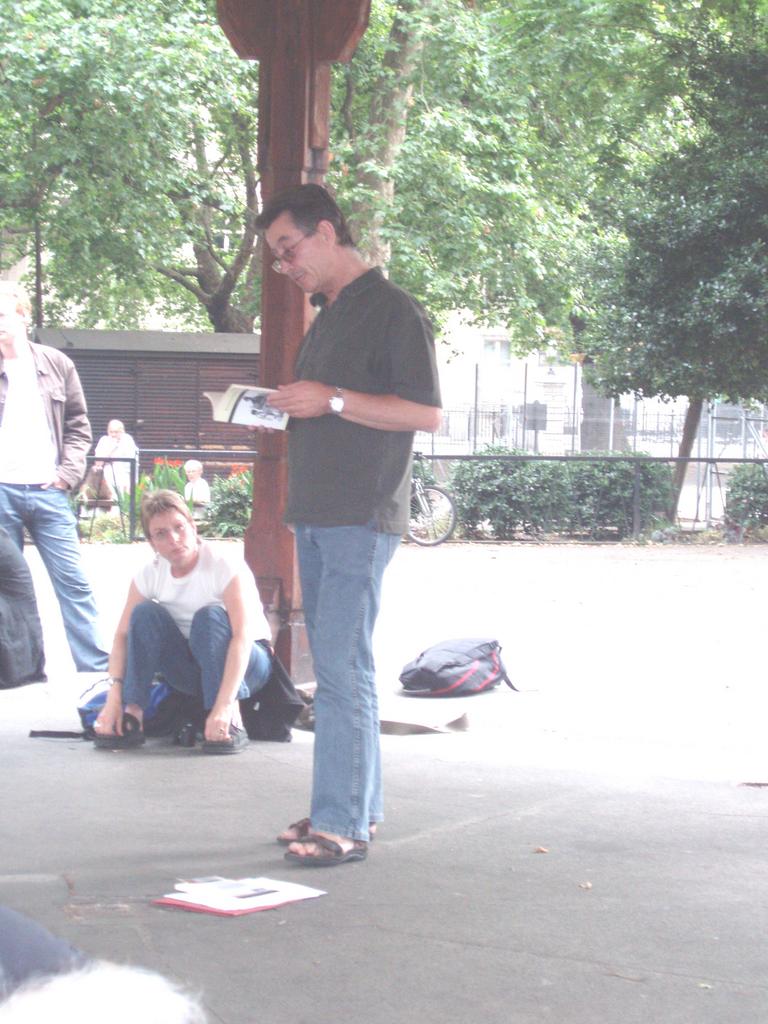 John Seed reading
See Page 452 (February 2005's archive)
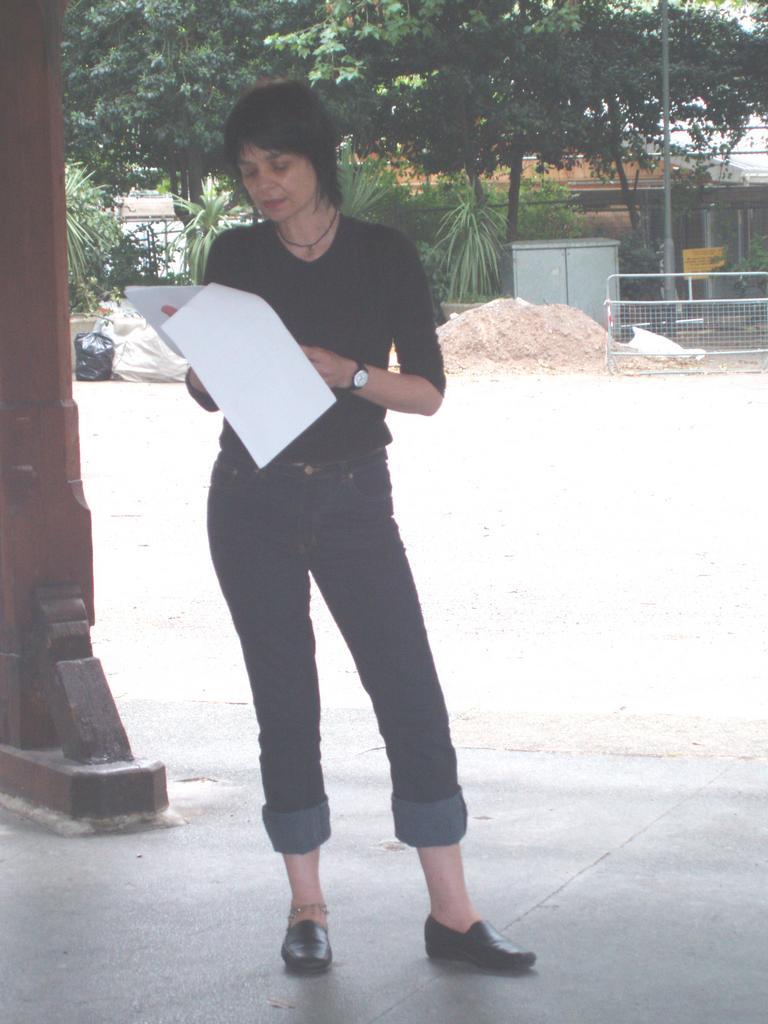 Patricia Farrell reading
See Page 475 (scroll down to the last posting)

See Page 464 (May 2005's archive)

Read Paul A Green's account of the Buzz. From about this point in the photo he was our inspirational DJ.
Page 476
Thursday, August 11, 2005
Patricia Farrell: Tomorrow's Attack Objects Talk


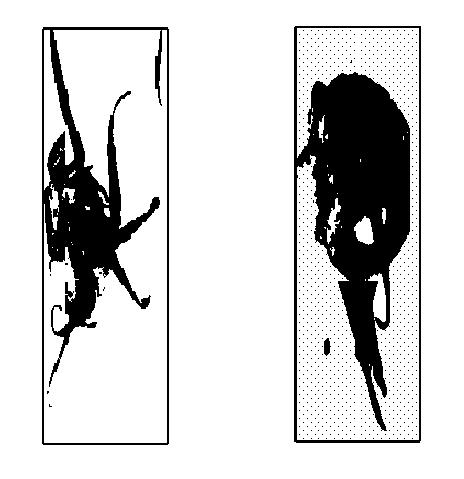
 Patrcia Farrell's latest text and image publication is The Zechstein Sea (Ship of Fools, 2005), which is availble for £3 (post free) from Ship of Fools, 78 Nicander Road, Liverpool, L18 1HZ. Read a textual work Whose Signature is Hard to Decipher published in Stride magazine. She recently read on the Poetry Buzz day.
Page 475
Saturday, August 06, 2005
Robert Sheppard: The History of the Other, part six
Cambridge: Towards a Community of Risk
Keith Tuma declared in 1998, that 'London writers are sometimes supposed to be at odds with writers affiliated with another cultural centre, Cambridge. Such tensions ... were no doubt exacerbated by an issue of the magazine Angel Exhaust containing ... editor Andrew Duncan’s essay ‘The Cambridge Leisure Centre: Traits’ ......’
Another North American commentator, Charles Bernstein, co-editor of L=A=N=G=U=A=G=E magazine, noticed in 1994 a split between London’s Linguistically Innovative Poetry and a Cambridge poetry which he negatively characterized as ‘renovations (or refashionings) of lyrical and pastoral (or postpastoral) forms’, and noted that ‘a particular range of aesthetic procedures seems to be propped up by a patrician decorum and Oxbridge authoritativeness that barely covers over the thematic renunciation of these values’.
Duncan’s article attempted taxonomy of the Cambridge tribe as yet another ‘lit room’ for ‘the ambient medium of society’. Duncan discerns three factors, the first being the pervasive influence of Prynne. Ben Watson has written that the annual Cambridge Conference of Contemporary Poetry (which began in 1991), ‘was founded by Prynnians, but (Prynne)’s such a crucial figure to the attenders, he himself cannot attend (as Ian Patterson, one of Prynne’s proselytisers put it, “he’s made himself the Pope, so now he can’t be there.”)’. Secondly, Duncan notes, the ‘reputation of the group is for hermetic complexity’; certainly Prynne’s poetry is difficult and allusive, mannered and gestural in a way that may be imitated, but there is a contrary tendency to follow the example of Peter Riley.
Duncan thirdly detects ‘a remarkable density of serious Marxist politics’ (yet he also acknowledges ‘an undocumented strand of Far Right thought in another groupuscule’); he has in mind the younger generation of theorists and poets, such as the ‘Material Esthetix’ of Watson, or the thinking of Drew Milne.
Milne was editor of the influential magazine Parataxis between 1992 and 1996, a journal whose subtitle, ‘modernism and modern writing’ announced its resistance to postmodernism and suggested the Adornoesque high modernist line of its critical content. In the third issue, in 1993, Milne’s article ‘Agoraphobia, and the embarrassment of manifestos: notes towards a community of risk’ sought ‘to ventriloquize a utopian collective’, ‘a community of writing which liberates its possible readers’, and a poetics of ‘the residual and emergent avant-gardes of contemporary poetry’. He identifies conditions which militate against the collective. He attacks the exclusivity of the Cambridge poetry scene; Duncan suggests that the ‘coterie smugness of the poets’, which Bernstein sees as aesthetically self-defeating, is a remedy against the ‘encircling chill’ of the atmosphere of Cambridge University. ‘An embarrassment with direct statement’, both in poetry and poetics, combines, for Milne, with ‘hostility to traditional literary criticism and literary theory’, the refusal to theorize that Adair had noted; Adair and Milne (in their different ways) were both poets who fought this tendency in their own creative and critical work. The ‘embarrassment of manifestos’ is a clear plea for the development of poetics. Milne’s argument pays scant attention to the development of this discourse in the London grouping, and he has been a resistant but perceptive critic of language poetry theory; his focus is Cambridge, yet he expresses his annoyance at both Peter Riley and Denise Riley for denying the term ‘Cambridge poetry’:
The fear of labels is an endemic and edenic aspect of poetry, and the non-identity of such communities, perhaps best described as the Cambridge axis, indicates the need for a poetics of community, a poetics which, if successful, would have considerable and more general political value.
Apart from nostalgia for the stridency and intimacy of The English Intelligencer of the 1960s, mentioned in an earlier installment, he finds little to fulfil his wishes in 1993, though Parataxis itself preserved some form of community. Indeed one result of perceived insularity is the detailed way Cambridge poets critique one another. Like the writings of the American language poets these are no mutual back-slapping exercises. This contrasts with the paucity of critical writing in the London grouping, despite the examples of Fisher and Adair.
Probably the most extraordinary Cambridge activity, though, is Rod Mengham’s small press Equipage which has, with great frequency, brought out pamphlets, often from the now wide age range, of Cambridge poets, from Prynne and Chaloner, to Wilkinson and Drew Milne, to the active young editor of Quid, Keston Sutherland, but also of outsiders, such as Allen Fisher and Ulli Freer. By 2000 he had published over 60 pamphlets.
Throughout the late 1980s and 1990s, Iain Sinclair was clearly collecting this series, and when he was commissioned to edit an anthology, this ‘mass of instant-printed pamphlets that pile up around my desk’ was readily to hand, and furnished many of his selections.
Sinclair edited Conductors of Chaos in 1996. (References marked CC in the text refer directly to the anthology.) As Poetry Consultant at Paladin, after John Muckle, he had attempted to obtain the same visibility for marginal poets that he has achieved himself, chiefly as a novelist. However it is odd that his introduction should not mention The New British Poetry, particularly since much of his introduction is exhausted critiquing ‘the absolute betrayal of the programme they presume to promote’ of the ‘ice-floe of meaningless anthologies’ that have appeared since the 1960s. (CC, p. xiii) He correctly suggests that, after Michael Horovitz’ Children of Albion, they had become an institution for ‘the suppression of a more radical and heterodox body of work’. (CC, p. xv)
My characterizations of the little press scene lack the panache and imaginative gloss provided by Sinclair's introduction. The gifts that have justly made Sinclair an acclaimed novelist, the depiction of a gritty hyperreality, an arcane and conspiratorial world, as evinced in White Chappel, Scarlet Tracings (1987) and Dining on Stones reviewed on Page 456, index March on the right), are deployed to create a vampiric world of poetic parasitism and backbiting. Its special-needs citizen[s] ... correspond compulsively and at length, dispatching multiple photocopies of their poison-pen squibs to the relevant small-press editors. A private world: their reports, scratched on glass, are of events that happen elsewhere, outside, beyond their sphere of influence.’ (CC, pp. xviii-xviii)
The introduction is unfortunately entitled ‘Infamous and Invisible’ but the mythic infamy only contributes to the continued invisibility. Boldly subtitled ‘A Manifesto for Those Who Do not Believe in Such Things’, Sinclair’s introduction presumes to speak for his 36 various poets (or ‘pick-’n’-mix shambles of has-beens, headcases and emerging chancers’ as he prefers). (CC, p. xiii) As a manifesto it is lacking; Sinclair has no theory of textual complexity, no appeals to a poetics, other than asserting the work’s right to be difficult: ‘The work I value is that which seems most remote, alienated, fractured. I don’t claim to “understand” it but I like having it around.’ (CC, p. xvii) His assertion that ‘these apes from the attic ... are the ones that have been locked away, those who rather enjoy it’, seems perverse given the involvement of many of the contributors in publishing and performing ventures, such as Brian Catling, whose performance The Blindings at the Serpentine Galleries in 1994, consisted of him reading for 8 hours a day for the length of the show. (CC, p. xvii)
It is, however, this sort of performance work that Sinclair has in mind when he admits ‘that something, at last, is happening out there: crusty revenants conspiring with uppity newcomers’. (CC, p. xviii) The anthology is mainly a mixture of these new performance writers and work of the Cambridge axis, along with established writers, such as Harwood, Allen Fisher and Griffiths (and some New Apocalypse and modernist poets of the past).
JH Prynne is represented by one of his baffling texts of the 1990s, ‘Her Weasels Wild Returning’; its seven sections of 24 lines suggest the measures of time itself, whilst focussing, not on an ‘I’, however fractured, but on an obsessively tracked ‘she, she, she, and only she’, almost quoting one of Coleridge’s complaints to Asra. (CC, p. 351) Whereas earlier work had used specific specialized discourses, such as geology, this text seems to connote simultaneously the language and worlds of consumerism, and scarcity, physical attack, even rape, in a knot of reference that, following Veronica Forrest-Thomson, might be called an ‘image-complex’, which leads to the condition of ‘suspended naturalization’. The connotations that radiate from the word ‘slashed’, invites the sceptical judgement that follows:
Her step pervades
the slashed shelf life here to utter startled bleeding, that
can’t be right, loaded entry starvation gives over at last
these particulate verticals. (CC, p. 351)
The text intertwines its discourses so that on different readings different connections seem prominent. The loading bays of supermarkets which promise starvation may indeed ‘give over’ to other readings in which ‘particulate verticals’ may suggest rainfall, scientific discourse, or return the reader to supermarket shelves, or even the shelf upon which ‘she’ is left. Even then there is the suspicion that ‘that can’t be right’, semantically or morally. The influence of this dense multiple referentiality can be detected in the works of John Wilkinson and Drew Milne. In one example of the harsh mutual-critiquing of the Cambridge poets, Drew Milne usefully defines Wilkinson's differences from Prynne in terms of semantic containment and dispersal.
Whereas Prynne's work often seems constrained by the authority of an almost literal, stoic fidelity to relations between cognition and semantics, Wilkinson's work is more restless ... in a perpetually renewing struggle for recognition which is reluctant to eschew the possibility of a freer subjectivity.
Part of this restless struggle can be seen in ‘Cabling the Suburbs’ from Conductors of Chaos; the title alludes to the installation of underground communication cables connecting a domestic margin to an absent centre.
The valleys echoed cathedral with mechanical
azaleas, roseate petals smudged down the pathways,
cones were set out, varicose cables trenched
off the head station, little magnetic workers
trudge down their powerful lines blowing & refute. (CC, p. 468)
Although there are some visual images here (varicose, for example), ‘Wilkinson's work affords many such uncanny encounters with our polluted life-world, drawing out figures of lyric form from a distress which is at once social and political,’ as Milne says. The mechanical azaleas, the magnetic workers are not simply the metal cable being laid, but have become autonomous metaphors. The lyricism of this is indeed conducted through figurative devices, a semantic dispersal that Wilkinson characterizes as ‘metastatic’. This is a way of describing a dispersal of linguistic elements, that are also subjective counters, throughout the body of the poem (metastasis literally describes the spreading of cancer cells) through ‘a set of linked and transforming entities, which can be syntactical gestures, vowel and consonant patterning, imagistic or discursive modes’.
The metaphors take over the power of narrative and argument without becoming either, the struggle for recognition of its subjective agency and efficacy. A state of stillborn economics where riots are emphatically at home, offers the ‘Birth stagflation riots in the nest in their nest’ of the poem’s opening, with its strange repetition that reminds us that ‘they’ own the nest. (CC, p. 468) This improvisatory method of composition, a series of transformations and dispersals, brings it closer to the practice of Allen Fisher and others than the resultant hard surface might suggest. Interestingly, Wilkinson takes up Milne’s term risk to discuss his method ‘at the micro-level…’
Risk in poetry is found where the accepted word would join the poem in an unanticipated way to the world .... It’s hard sometimes to know the difference between risk and defence. If I vandalize a lucid but banal passage am I taking a risk (with a reader’s willingness to follow)...?
Perhaps the passage I quote above originally contained the banality of the empirical but was editorially ‘vandalized’ out of easeful lucidity. The a-syntactical and unanticipated ‘& refute’ refutes the visual images of workmen digging that lie behind the metaphors. By the time the poem ends the suburban has become a desert; identity is dispersed and desperate, multiple yet collectively narcissistic:
Reprobates they cry, then a devolved cost rifle
pans out as We. We where the child pinkish like
from an exhaust, We passing for collective in
multiplex repeat but through carbon foil, we
whether we like it or not, wringing the crusts. (CC, p. 469)
A series of metastatic figures works alongside the first person plural here: the exhaust, the carbon, reminders of the ecological vandalism that supports the multiplex, the social emerging from the lyrical trajectory.
While Milne sees the political shining through the lyric resources, Wilkinson sees the opposite in Milne. In his introduction to Milne’s Conductors of Chaos selection, he writes, ‘Milne’s use of poetry as a critical instrument is not reduction of its lyrical potency.’ (CC, p. 253) Repetition is more controlled for Milne: each of the 12 15 line poems of his sequence begins with the word ‘Clamour...’ and the effect is not of dispersal but of confinement. The title ‘Foul Papers’ is focussed for the reader by a characteristic epigraph from Hegel: ‘Reading the morning paper is the realist’s morning prayer’, but Milne seeks to deconstruct what he finds; the text is a reading through the Daily Clamour of newsprint:
a flurry of front page glorie
and nemesis time on the footsie,
when ten thousand chickens died, we’re told,
in a fire started on purpose. (CC, p, 255)
The ‘we’re told’ is not parenthetical but chillingly central: the paper’s ‘foul’ news punning away the ‘fowl’ news, and the casual, even flirty, abbreviation of the Financial Times Share Index (FTSI), whose index involves the nemesis of the financial loss of such news. The juxtapositions here reflect the juxtaposition that news itself offers. The section finishes:
though
I suppose it’s the marine in me
says go if the hearing continues. (CC, p. 255)
This would be funny if it were not the sudden intrusion of an individualized militarism that can threaten and act against the impositions of a legal proceeding, such as a public ‘hearing’, inquiry or inquest.
While the poem is polyphonic (‘Voices rather than voice, then, and as writing’ as Milne writes elsewhere,) the gesture requires an Adornoesque belief in the resistance inherent in the autonomy of the art object, but Milne rejects the emptiness of Ackroyd’s theories of autonomy, and the utopian ease of Marcuse. (Did I mention I visited Marcuse’s grave in Berlin? No? I must stop butting in.) Yet the text hovers around a skeletal argument in its elaborate punning: ‘word without bend/in a maze of blight’ (world without end in a blaze of light) (CC, p. 257) that is constantly refunctioning the ‘wisdom’ of the cliché, a borrowing that is precisely ‘debit where debit is due’. (CC, p. 254). There is a savage indignation that instructs us at its end to ‘stand toxic, tall and tousled, as we/go forth coldly into the dark page’, (CC, p. 259) which is a call to use poetry as a critical instrument upon the real, which, despite the worked surface, recalls Adair’s anti-Thatcherite bus stop resistance examined in part five of this history.
Peter Riley represents the lyrical, even pastoral, side of Cambridge poetry in his long poem Alstonefield. (The whole is available now from Carcanet.) Whether his work amounts to the ‘renovations’ detected by Bernstein, he courts the evocation of a fragile pastoral balanced against the modern world, exequy against decay, Blake’s echoing green echoed again in an image of community that harbours sinister secrecy:
But a pastoral substantive, where the story
gathers to a close the community accedes to what
‘must be’ in secret delight. Here the maidens
dance on the darkening green to the end of day
a torse in history that rights itself by
candle lanterns, as the soul is timed to
exequies. Bow to it and cross the glowing river
on a wooden footbridge into urban decay. (CC, p. 409-410)
But the torse of the past can also involve the textual materials of another of Riley’s projects, Excavations, which collages the writings of JR Mortimer on his exhaustive and actual excavations of burial mounds, with Tudor songs, to present a reconfiguration of our knowledges of what lies under urban decay:
hollows in the earth, the secrets of our hearts declaimed from ridge to ridge as white tumuli, writing the edge of belonging on a winter arch. (CC, p. 405)
These conductions of order, rather than chaos, this writing of such an edge in Excavations brings the text closer to the historical found poetry of Bill Griffiths or to Linguistically Innovative Poetry than its author would acknowledge. Tom Lowenstein calls the first two parts, published as Distant Points, by Reality Street,
a recalcitrant, somewhat rebarbative text. Dislocated and restless, the eye forks over the paragraphs in search of connections that make sense, greedy for the threads, veins, intercalations offering a route through the labyrinths of discord. And is this not the nature of excavation?
Yes it is, we might say. Next month: Performance Writing.
Page 474
Keith Tuma declared in 1998, that 'London writers are sometimes supposed to be at odds with writers affiliated with another cultural centre, Cambridge. Such tensions ... were no doubt exacerbated by an issue of the magazine Angel Exhaust containing ... editor Andrew Duncan’s essay ‘The Cambridge Leisure Centre: Traits’ ......’
Another North American commentator, Charles Bernstein, co-editor of L=A=N=G=U=A=G=E magazine, noticed in 1994 a split between London’s Linguistically Innovative Poetry and a Cambridge poetry which he negatively characterized as ‘renovations (or refashionings) of lyrical and pastoral (or postpastoral) forms’, and noted that ‘a particular range of aesthetic procedures seems to be propped up by a patrician decorum and Oxbridge authoritativeness that barely covers over the thematic renunciation of these values’.
Duncan’s article attempted taxonomy of the Cambridge tribe as yet another ‘lit room’ for ‘the ambient medium of society’. Duncan discerns three factors, the first being the pervasive influence of Prynne. Ben Watson has written that the annual Cambridge Conference of Contemporary Poetry (which began in 1991), ‘was founded by Prynnians, but (Prynne)’s such a crucial figure to the attenders, he himself cannot attend (as Ian Patterson, one of Prynne’s proselytisers put it, “he’s made himself the Pope, so now he can’t be there.”)’. Secondly, Duncan notes, the ‘reputation of the group is for hermetic complexity’; certainly Prynne’s poetry is difficult and allusive, mannered and gestural in a way that may be imitated, but there is a contrary tendency to follow the example of Peter Riley.
Duncan thirdly detects ‘a remarkable density of serious Marxist politics’ (yet he also acknowledges ‘an undocumented strand of Far Right thought in another groupuscule’); he has in mind the younger generation of theorists and poets, such as the ‘Material Esthetix’ of Watson, or the thinking of Drew Milne.
Milne was editor of the influential magazine Parataxis between 1992 and 1996, a journal whose subtitle, ‘modernism and modern writing’ announced its resistance to postmodernism and suggested the Adornoesque high modernist line of its critical content. In the third issue, in 1993, Milne’s article ‘Agoraphobia, and the embarrassment of manifestos: notes towards a community of risk’ sought ‘to ventriloquize a utopian collective’, ‘a community of writing which liberates its possible readers’, and a poetics of ‘the residual and emergent avant-gardes of contemporary poetry’. He identifies conditions which militate against the collective. He attacks the exclusivity of the Cambridge poetry scene; Duncan suggests that the ‘coterie smugness of the poets’, which Bernstein sees as aesthetically self-defeating, is a remedy against the ‘encircling chill’ of the atmosphere of Cambridge University. ‘An embarrassment with direct statement’, both in poetry and poetics, combines, for Milne, with ‘hostility to traditional literary criticism and literary theory’, the refusal to theorize that Adair had noted; Adair and Milne (in their different ways) were both poets who fought this tendency in their own creative and critical work. The ‘embarrassment of manifestos’ is a clear plea for the development of poetics. Milne’s argument pays scant attention to the development of this discourse in the London grouping, and he has been a resistant but perceptive critic of language poetry theory; his focus is Cambridge, yet he expresses his annoyance at both Peter Riley and Denise Riley for denying the term ‘Cambridge poetry’:
The fear of labels is an endemic and edenic aspect of poetry, and the non-identity of such communities, perhaps best described as the Cambridge axis, indicates the need for a poetics of community, a poetics which, if successful, would have considerable and more general political value.
Apart from nostalgia for the stridency and intimacy of The English Intelligencer of the 1960s, mentioned in an earlier installment, he finds little to fulfil his wishes in 1993, though Parataxis itself preserved some form of community. Indeed one result of perceived insularity is the detailed way Cambridge poets critique one another. Like the writings of the American language poets these are no mutual back-slapping exercises. This contrasts with the paucity of critical writing in the London grouping, despite the examples of Fisher and Adair.
Probably the most extraordinary Cambridge activity, though, is Rod Mengham’s small press Equipage which has, with great frequency, brought out pamphlets, often from the now wide age range, of Cambridge poets, from Prynne and Chaloner, to Wilkinson and Drew Milne, to the active young editor of Quid, Keston Sutherland, but also of outsiders, such as Allen Fisher and Ulli Freer. By 2000 he had published over 60 pamphlets.
Throughout the late 1980s and 1990s, Iain Sinclair was clearly collecting this series, and when he was commissioned to edit an anthology, this ‘mass of instant-printed pamphlets that pile up around my desk’ was readily to hand, and furnished many of his selections.
Sinclair edited Conductors of Chaos in 1996. (References marked CC in the text refer directly to the anthology.) As Poetry Consultant at Paladin, after John Muckle, he had attempted to obtain the same visibility for marginal poets that he has achieved himself, chiefly as a novelist. However it is odd that his introduction should not mention The New British Poetry, particularly since much of his introduction is exhausted critiquing ‘the absolute betrayal of the programme they presume to promote’ of the ‘ice-floe of meaningless anthologies’ that have appeared since the 1960s. (CC, p. xiii) He correctly suggests that, after Michael Horovitz’ Children of Albion, they had become an institution for ‘the suppression of a more radical and heterodox body of work’. (CC, p. xv)
My characterizations of the little press scene lack the panache and imaginative gloss provided by Sinclair's introduction. The gifts that have justly made Sinclair an acclaimed novelist, the depiction of a gritty hyperreality, an arcane and conspiratorial world, as evinced in White Chappel, Scarlet Tracings (1987) and Dining on Stones reviewed on Page 456, index March on the right), are deployed to create a vampiric world of poetic parasitism and backbiting. Its special-needs citizen[s] ... correspond compulsively and at length, dispatching multiple photocopies of their poison-pen squibs to the relevant small-press editors. A private world: their reports, scratched on glass, are of events that happen elsewhere, outside, beyond their sphere of influence.’ (CC, pp. xviii-xviii)
The introduction is unfortunately entitled ‘Infamous and Invisible’ but the mythic infamy only contributes to the continued invisibility. Boldly subtitled ‘A Manifesto for Those Who Do not Believe in Such Things’, Sinclair’s introduction presumes to speak for his 36 various poets (or ‘pick-’n’-mix shambles of has-beens, headcases and emerging chancers’ as he prefers). (CC, p. xiii) As a manifesto it is lacking; Sinclair has no theory of textual complexity, no appeals to a poetics, other than asserting the work’s right to be difficult: ‘The work I value is that which seems most remote, alienated, fractured. I don’t claim to “understand” it but I like having it around.’ (CC, p. xvii) His assertion that ‘these apes from the attic ... are the ones that have been locked away, those who rather enjoy it’, seems perverse given the involvement of many of the contributors in publishing and performing ventures, such as Brian Catling, whose performance The Blindings at the Serpentine Galleries in 1994, consisted of him reading for 8 hours a day for the length of the show. (CC, p. xvii)
It is, however, this sort of performance work that Sinclair has in mind when he admits ‘that something, at last, is happening out there: crusty revenants conspiring with uppity newcomers’. (CC, p. xviii) The anthology is mainly a mixture of these new performance writers and work of the Cambridge axis, along with established writers, such as Harwood, Allen Fisher and Griffiths (and some New Apocalypse and modernist poets of the past).
JH Prynne is represented by one of his baffling texts of the 1990s, ‘Her Weasels Wild Returning’; its seven sections of 24 lines suggest the measures of time itself, whilst focussing, not on an ‘I’, however fractured, but on an obsessively tracked ‘she, she, she, and only she’, almost quoting one of Coleridge’s complaints to Asra. (CC, p. 351) Whereas earlier work had used specific specialized discourses, such as geology, this text seems to connote simultaneously the language and worlds of consumerism, and scarcity, physical attack, even rape, in a knot of reference that, following Veronica Forrest-Thomson, might be called an ‘image-complex’, which leads to the condition of ‘suspended naturalization’. The connotations that radiate from the word ‘slashed’, invites the sceptical judgement that follows:
Her step pervades
the slashed shelf life here to utter startled bleeding, that
can’t be right, loaded entry starvation gives over at last
these particulate verticals. (CC, p. 351)
The text intertwines its discourses so that on different readings different connections seem prominent. The loading bays of supermarkets which promise starvation may indeed ‘give over’ to other readings in which ‘particulate verticals’ may suggest rainfall, scientific discourse, or return the reader to supermarket shelves, or even the shelf upon which ‘she’ is left. Even then there is the suspicion that ‘that can’t be right’, semantically or morally. The influence of this dense multiple referentiality can be detected in the works of John Wilkinson and Drew Milne. In one example of the harsh mutual-critiquing of the Cambridge poets, Drew Milne usefully defines Wilkinson's differences from Prynne in terms of semantic containment and dispersal.
Whereas Prynne's work often seems constrained by the authority of an almost literal, stoic fidelity to relations between cognition and semantics, Wilkinson's work is more restless ... in a perpetually renewing struggle for recognition which is reluctant to eschew the possibility of a freer subjectivity.
Part of this restless struggle can be seen in ‘Cabling the Suburbs’ from Conductors of Chaos; the title alludes to the installation of underground communication cables connecting a domestic margin to an absent centre.
The valleys echoed cathedral with mechanical
azaleas, roseate petals smudged down the pathways,
cones were set out, varicose cables trenched
off the head station, little magnetic workers
trudge down their powerful lines blowing & refute. (CC, p. 468)
Although there are some visual images here (varicose, for example), ‘Wilkinson's work affords many such uncanny encounters with our polluted life-world, drawing out figures of lyric form from a distress which is at once social and political,’ as Milne says. The mechanical azaleas, the magnetic workers are not simply the metal cable being laid, but have become autonomous metaphors. The lyricism of this is indeed conducted through figurative devices, a semantic dispersal that Wilkinson characterizes as ‘metastatic’. This is a way of describing a dispersal of linguistic elements, that are also subjective counters, throughout the body of the poem (metastasis literally describes the spreading of cancer cells) through ‘a set of linked and transforming entities, which can be syntactical gestures, vowel and consonant patterning, imagistic or discursive modes’.
The metaphors take over the power of narrative and argument without becoming either, the struggle for recognition of its subjective agency and efficacy. A state of stillborn economics where riots are emphatically at home, offers the ‘Birth stagflation riots in the nest in their nest’ of the poem’s opening, with its strange repetition that reminds us that ‘they’ own the nest. (CC, p. 468) This improvisatory method of composition, a series of transformations and dispersals, brings it closer to the practice of Allen Fisher and others than the resultant hard surface might suggest. Interestingly, Wilkinson takes up Milne’s term risk to discuss his method ‘at the micro-level…’
Risk in poetry is found where the accepted word would join the poem in an unanticipated way to the world .... It’s hard sometimes to know the difference between risk and defence. If I vandalize a lucid but banal passage am I taking a risk (with a reader’s willingness to follow)...?
Perhaps the passage I quote above originally contained the banality of the empirical but was editorially ‘vandalized’ out of easeful lucidity. The a-syntactical and unanticipated ‘& refute’ refutes the visual images of workmen digging that lie behind the metaphors. By the time the poem ends the suburban has become a desert; identity is dispersed and desperate, multiple yet collectively narcissistic:
Reprobates they cry, then a devolved cost rifle
pans out as We. We where the child pinkish like
from an exhaust, We passing for collective in
multiplex repeat but through carbon foil, we
whether we like it or not, wringing the crusts. (CC, p. 469)
A series of metastatic figures works alongside the first person plural here: the exhaust, the carbon, reminders of the ecological vandalism that supports the multiplex, the social emerging from the lyrical trajectory.
While Milne sees the political shining through the lyric resources, Wilkinson sees the opposite in Milne. In his introduction to Milne’s Conductors of Chaos selection, he writes, ‘Milne’s use of poetry as a critical instrument is not reduction of its lyrical potency.’ (CC, p. 253) Repetition is more controlled for Milne: each of the 12 15 line poems of his sequence begins with the word ‘Clamour...’ and the effect is not of dispersal but of confinement. The title ‘Foul Papers’ is focussed for the reader by a characteristic epigraph from Hegel: ‘Reading the morning paper is the realist’s morning prayer’, but Milne seeks to deconstruct what he finds; the text is a reading through the Daily Clamour of newsprint:
a flurry of front page glorie
and nemesis time on the footsie,
when ten thousand chickens died, we’re told,
in a fire started on purpose. (CC, p, 255)
The ‘we’re told’ is not parenthetical but chillingly central: the paper’s ‘foul’ news punning away the ‘fowl’ news, and the casual, even flirty, abbreviation of the Financial Times Share Index (FTSI), whose index involves the nemesis of the financial loss of such news. The juxtapositions here reflect the juxtaposition that news itself offers. The section finishes:
though
I suppose it’s the marine in me
says go if the hearing continues. (CC, p. 255)
This would be funny if it were not the sudden intrusion of an individualized militarism that can threaten and act against the impositions of a legal proceeding, such as a public ‘hearing’, inquiry or inquest.
While the poem is polyphonic (‘Voices rather than voice, then, and as writing’ as Milne writes elsewhere,) the gesture requires an Adornoesque belief in the resistance inherent in the autonomy of the art object, but Milne rejects the emptiness of Ackroyd’s theories of autonomy, and the utopian ease of Marcuse. (Did I mention I visited Marcuse’s grave in Berlin? No? I must stop butting in.) Yet the text hovers around a skeletal argument in its elaborate punning: ‘word without bend/in a maze of blight’ (world without end in a blaze of light) (CC, p. 257) that is constantly refunctioning the ‘wisdom’ of the cliché, a borrowing that is precisely ‘debit where debit is due’. (CC, p. 254). There is a savage indignation that instructs us at its end to ‘stand toxic, tall and tousled, as we/go forth coldly into the dark page’, (CC, p. 259) which is a call to use poetry as a critical instrument upon the real, which, despite the worked surface, recalls Adair’s anti-Thatcherite bus stop resistance examined in part five of this history.
Peter Riley represents the lyrical, even pastoral, side of Cambridge poetry in his long poem Alstonefield. (The whole is available now from Carcanet.) Whether his work amounts to the ‘renovations’ detected by Bernstein, he courts the evocation of a fragile pastoral balanced against the modern world, exequy against decay, Blake’s echoing green echoed again in an image of community that harbours sinister secrecy:
But a pastoral substantive, where the story
gathers to a close the community accedes to what
‘must be’ in secret delight. Here the maidens
dance on the darkening green to the end of day
a torse in history that rights itself by
candle lanterns, as the soul is timed to
exequies. Bow to it and cross the glowing river
on a wooden footbridge into urban decay. (CC, p. 409-410)
But the torse of the past can also involve the textual materials of another of Riley’s projects, Excavations, which collages the writings of JR Mortimer on his exhaustive and actual excavations of burial mounds, with Tudor songs, to present a reconfiguration of our knowledges of what lies under urban decay:
hollows in the earth, the secrets of our hearts declaimed from ridge to ridge as white tumuli, writing the edge of belonging on a winter arch. (CC, p. 405)
These conductions of order, rather than chaos, this writing of such an edge in Excavations brings the text closer to the historical found poetry of Bill Griffiths or to Linguistically Innovative Poetry than its author would acknowledge. Tom Lowenstein calls the first two parts, published as Distant Points, by Reality Street,
a recalcitrant, somewhat rebarbative text. Dislocated and restless, the eye forks over the paragraphs in search of connections that make sense, greedy for the threads, veins, intercalations offering a route through the labyrinths of discord. And is this not the nature of excavation?
Yes it is, we might say. Next month: Performance Writing.
Page 474
Tuesday, July 26, 2005
Index July 2005 (plus one more Buzz picture)
One more image from the Buzz: Alien Fissure reading at Lincoln's Inns Field.href="http://photos1.blogger.com/blogger/6552/827/1600/Buzz%20026.jpg">
(Just click onto the appropriate month under Archive on the right; an index for that month will appear at the top of each)
July 2005
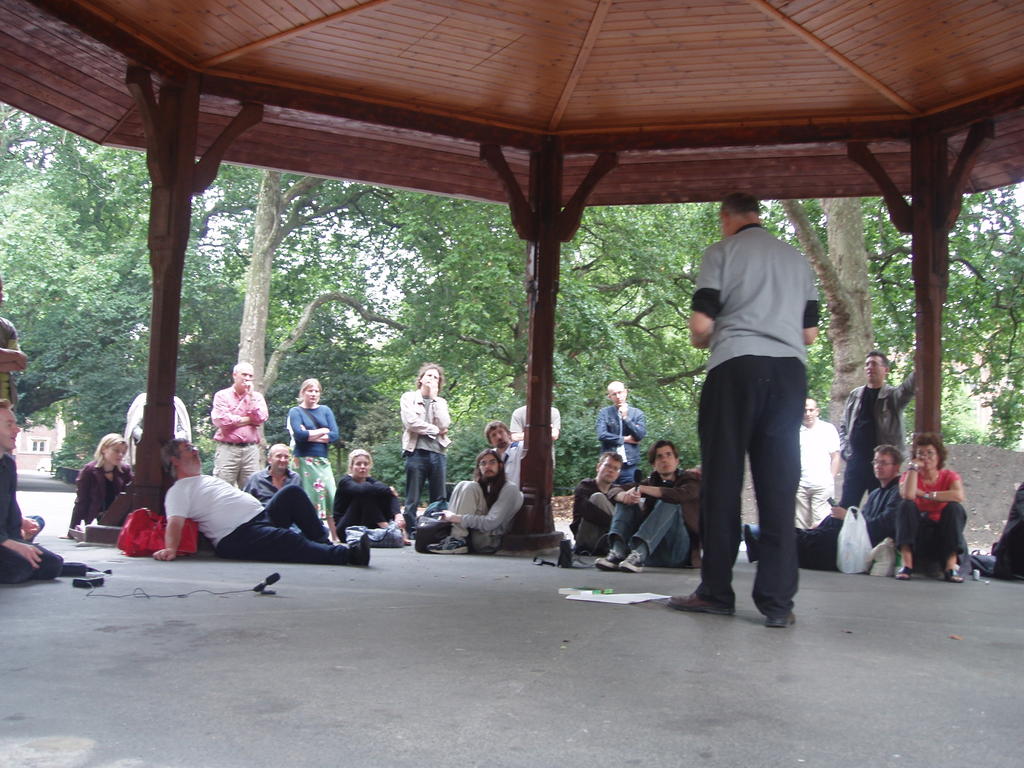
(Just click onto the appropriate month under Archive on the right; an index for that month will appear at the top of each)
July 2005
473: The Poetry Buzz (images! new technology!)
472: Robert Sheppard: The Anti-Orpheus/Rattling the Bones
471: Scott Thurston: Sounding Scheme
470: Robert Hampson: Synthetic Feed
469: Robert Sheppard: A History of the Other, part five
June 2005
Too busy
May 2005
468: Adrian Clarke: from MUZZLE
467: Marianne Morris: from Easter Poems
466: Robert Sheppard: Looking Back at Place and Open Field Poetics
465: Robert Sheppard: A History of the Other: Part four
464: Ken Edwards: from BARDO
April 2005
463: Robert Sheppard: TEXTintoTEXT
462: Robert Sheppard: A History of the Other: Part three
461: Neon Highway Interview with Robert Sheppard
460: Alice Lenkiewicz: Poems from Maxine
March 2005
459: Robert Sheppard: Cobbing: Two Sequences
458: Robert Sheppard: Bob Cobbing and Concrete Poetry
457: Bob Cobbing: Exhibition, Performances and Links
456: Robert Sheppard: You Need Hands: Iain Sinclair’s Dining on Stones
455: Tony Trehy: Coprophilia
454: Ian Davidson: Too Long
453: Robert Sheppard: A History of the Other: Part two.
February 2005
446: Robert Sheppard: Editorial to the Third Series/Afterword to Pages, the Second Series (moved out of sequence)
452: John Seed: from Pictures from Mayhew
451: Dee McMahon: Three Poems
450: Robert Sheppard: New Memories: Allen Fisher’s Gravity as a Consequence of Shape
449: Allen Fisher: Mezz Merround
448 Rupert Loydell: ‘Entangled’ (for Allen Fisher)
447: Robert Sheppard: A History of the Other: Part one.
© the authors, 2005
Sunday, July 24, 2005
The Poetry Buzz : a bus ride with/and for Allen Fisher
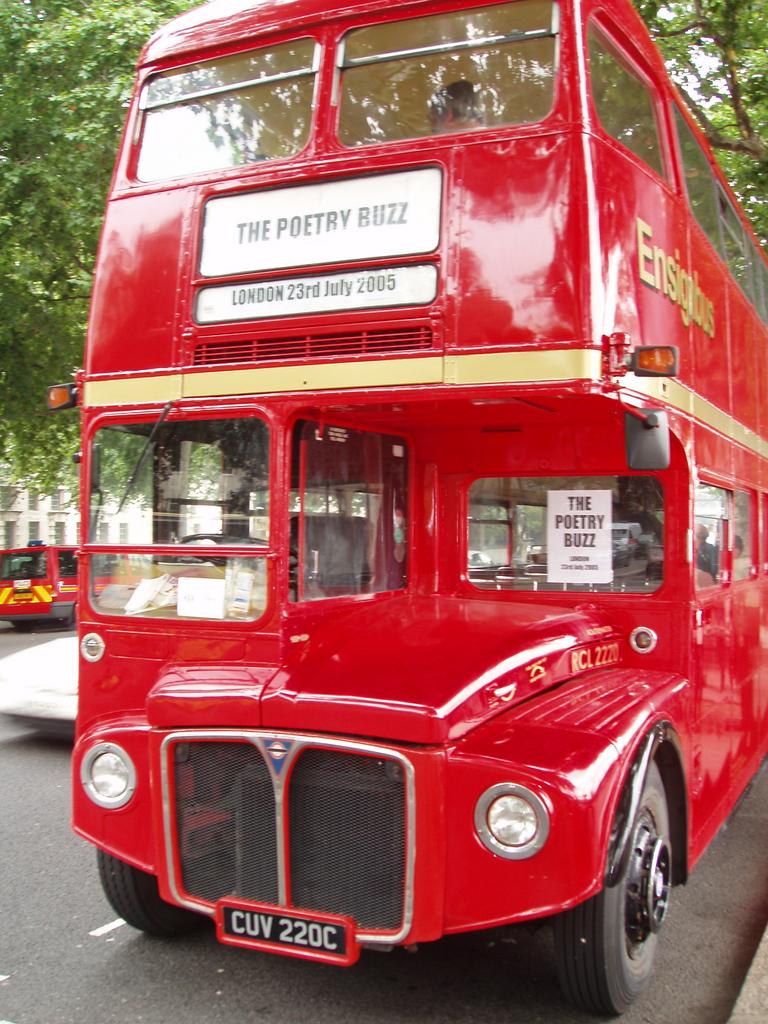
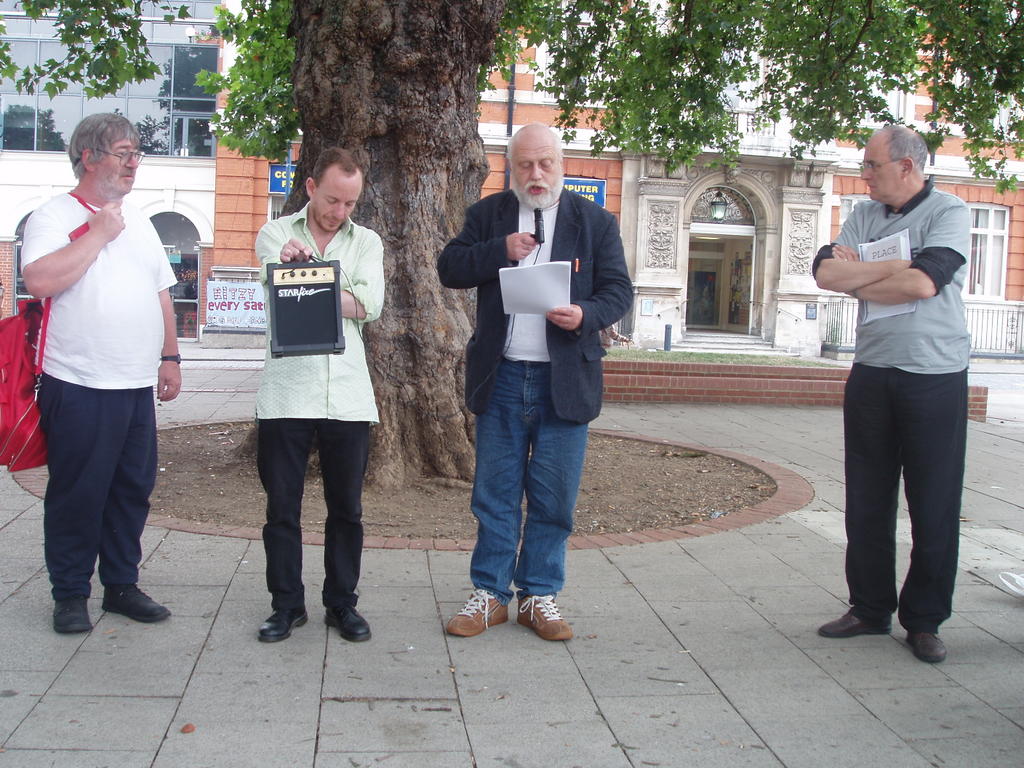


The Poetry Buzz was an event to celebrate the publication of three big books by Allen Fisher: Place (Reality Street), Gravity (Salt) and Entanglement (The Gig). (See Pages 448-9; 446 465- 469 for work by/on Allen Fisher) . It consisted of a ride around many of the sites metnioned in his work. Part poetry reading, part carnival, part magical mystery tour. Framed by photos of the bus, from top to bottom, I've posted here:
Bill Griffiths reading in Brixton Plaza (one of the three stops along the way), while Allen Fisher stands to the right, and Lawrence Upton stood to the left. Rob Hollway (along with Paige Mitchell, the organiser of the day) manfully holds the amp up for Bill.
Harry Gilonis as the uniformed conductor of our chaos collecting the fares.
Allen Fisher reading in Spring Gardens, Vauxhall, the second of the stops (the third being Lincoln's Inn Fields) sporting his new name on a t shirt designed by Dell Olsen.
Page 473
Wednesday, July 20, 2005
Robert Sheppard: The Anti-Orpheus/Rattling the Bones
The following is an update of the introduction to The Anti-Orpheus, delivered at the Great Writing 2005 conference at the University of Portsmouth on 11 June.
Between 1989 and 2000 I worked on a long project of interconnected poems called Twentieth Century Blues that has been published, so far, in parts, but is due to be published in its entirety in September 2006 by Salt . After this long work I undertook what politicians like to call 'a period of reflection'. Indeed, it had been my practice throughout the project to produce – sometimes for publication, sometimes not – works of poetics that are indeed parts of the project itself. So it seemed natural to consciously write poetics towards what I might do next.
At the same time I was completing a long history of alternative British poetries, The Poetry of Saying. Its central thesis is that there is a poetry of saying that opposes itself to a poetry of the said; but that the modes of openness and indeterminacy in the saying have to be embodied finally in the closedness and determinacy of the said. This ethical distinction is derived from the work of the philosopher Levinas, and it was inevitable that this work should influence my poetics.
Also simultaneously with this was my own pedagogic commitment to poetics as a mode of speculation for students of creative writing at Edge Hill. A previous presentation to Great Writing 2002, collected now in the pamphlet The Necessity of Poetics, argues that poetics involves speculatively casting into the future. Poetics is a discipline, though a flexible one, but more importantly: it is a discourse, though an intermittent, mercurial one. It is a way of letting writers question what they think they know, a way of allowing creative writing dialogue with itself, beyond the monologic of commentary or reflection. It often surfaces in hybrid forms or in the creative work itself.
Poetics exists for oneself and for others, to produce, "a permission to continue". Poetics is a speculative discourse, not a descriptive one.
I believe all creative writing students (and more so the higher the level of their work), and not just producers of innovative forms, should be encouraged to produce such work, but rather than arguing this again today, I want to perform one of my pieces of speculation. It is worth noting that, looking back, some of this has been very productive for me, other parts not so. Or not yet.
I offer this work as an example, not as a model.
I then read The Anti-Orpheus: a notebook, which is available as a downloadable e-book from Shearsman Books.
Here's a general page (you can see all of my Shearsman books here too): Sheppard, Robert (shearsman.com)
There is a link to The Anti-Orpheus there (if the one below doesn’t work for you).
Here’s a new direct link to the piece: https://irp-cdn.multiscreensite.com/12e499a6/files/uploaded/Sheppard_anti-orpheus.pdf
Between 1989 and 2000 I worked on a long project of interconnected poems called Twentieth Century Blues that has been published, so far, in parts, but is due to be published in its entirety in September 2006 by Salt . After this long work I undertook what politicians like to call 'a period of reflection'. Indeed, it had been my practice throughout the project to produce – sometimes for publication, sometimes not – works of poetics that are indeed parts of the project itself. So it seemed natural to consciously write poetics towards what I might do next.
At the same time I was completing a long history of alternative British poetries, The Poetry of Saying. Its central thesis is that there is a poetry of saying that opposes itself to a poetry of the said; but that the modes of openness and indeterminacy in the saying have to be embodied finally in the closedness and determinacy of the said. This ethical distinction is derived from the work of the philosopher Levinas, and it was inevitable that this work should influence my poetics.
Also simultaneously with this was my own pedagogic commitment to poetics as a mode of speculation for students of creative writing at Edge Hill. A previous presentation to Great Writing 2002, collected now in the pamphlet The Necessity of Poetics, argues that poetics involves speculatively casting into the future. Poetics is a discipline, though a flexible one, but more importantly: it is a discourse, though an intermittent, mercurial one. It is a way of letting writers question what they think they know, a way of allowing creative writing dialogue with itself, beyond the monologic of commentary or reflection. It often surfaces in hybrid forms or in the creative work itself.
Poetics exists for oneself and for others, to produce, "a permission to continue". Poetics is a speculative discourse, not a descriptive one.
I believe all creative writing students (and more so the higher the level of their work), and not just producers of innovative forms, should be encouraged to produce such work, but rather than arguing this again today, I want to perform one of my pieces of speculation. It is worth noting that, looking back, some of this has been very productive for me, other parts not so. Or not yet.
I offer this work as an example, not as a model.
I then read The Anti-Orpheus: a notebook, which is available as a downloadable e-book from Shearsman Books.
Now moved to: Sheppard, Robert (shearsman.com)
There is a link to The Anti-Orpheus there (if the one below doesn’t work for you).
Here’s a direct link to the piece: https://irp-cdn.multiscreensite.com/12e499a6/files/uploaded/Sheppard_anti-orpheus.pdf
A further piece of hybrid work, Rattling the Bones for Adrian Clarke has recently been published by Softblow. Recnet work by Adrian (and links) may be found on Page 468.
Page 472
A further piece of hybrid work, Rattling the Bones for Adrian Clarke has recently been published by Softblow. Recnet work by Adrian (and links) may be found on Page 468.
Page 472
Monday, July 18, 2005
Scott Thurston: Sounding Scheme
for a top dormant
clay spike
lends statue cleared
booted
plinth vacated on
tease toe
left on aware heart
board
cleaned off, the folly
began my round nuances
of fear in the midst of
fast walking feud you
behind
a turn to warn and retreat
out of the glade
not with standing anything but a
sabretache
is the crucial
misjudged print at exact congruent
augmented third
null. or raided
shift
logic prepares coated butts
dull hits lites
I get
but not over around
or on it
anything but dated fantasy
on the corner
held cigarette as
darting morsel
in swagger in the back
of that disadvantaged
neighbourhood smoke screen
the photo pressed cardboard bio
lending deft glances to
lithe swifts
to decay the visible
what is the necessary page
of produce that lends
the right air
that speaks what you always
knew and wanted to
convinces
before touch could intervene
the strategic spill of
distance
your brave purchasing ours
but lacking in the later
reading
stayed too long which probably how
hell finished to like your smile
and ill-advised flattering kick
shamed me to it platform dispersal
and fast perspectives reek of the
lived world far behind it
sound tiles one by one for the
formative digital increase the
hot new resolution
lifts numbingly in prehensile gauze
top-stripping out the séance baize
fluctuations of light and gravy flung
before the hearth
treat pencil scratchings to the big
burger fest of well-spokenness on
a dart ghost
heathen and strung out slung strumming
to take a tub-thump full on held
under kicks
of a force
to be reckoned with
of course on fit full stating
to curb turned curdles into riot
stations you battle where
shiny defences shield tapers
behind the lines as well as
before and afore cut tell deal
in alphanumeric clusters of steaming
wells of rice packs numbed
forefinger forfeit to the
ever-steadying increase of violence
on the pages
shielding for what coaxed offerings
dried in the gulch of awards
ranged to top targets
protection hardly adequate to the pursuit
with hounds rounds and pounds of pollution
you back into pack your surround sound
turf trials timed to perform in reckless
control indexed to success links cuffed
about fallen manners and left graces
shocked to stocked topped devices
full of the magical steaming goo that blasts
your flue beyond rhetorical mass delusion
preparing to weigh the unsolved
action on solid grounds
bound to run
on and off neat evasions rid
paste epithets suddenly
revealed
reel
not timed but instantly effective
the trace of furnishings stylings
mouldings of the appearance
to take advantages laden with gifts
aflow with coke spectacles and
disciples lent penance to occupy
activity as earnings
HID exemplary distension
contended assimilable results
trained sights seen
the letter of support
treasured in an odd combative way
for business relative to pore
sunny open band
sunk a torch beam
again
you and yours light slight right
to rest bereft of tenderness
in a cynical sound scheme
to recuperate is the hardest
satisfaction remunerated excavated
rescue digs on the sullen sites
to pull out the post lowering ground
a cheat to empty space of possession
through a tribute to shifty old crafts
built to last too fast to meet
cruel refusals outside the case
of hardened display affection
their tolerances scheme approached
me with an offer as tempting as
salient of recent compressions
and recriminations over ill
concealed consolatory compensation
for sudden
removals
look up the house excuse
directionary fumblings licking
up pole
a fan base cooling
not should be to wreck
tack to the north
to bring trajectories closer
via storage rings
roundabouts
& queens
Scott Thurston's publications include Turns (with Robert Sheppard (Shipof Fools/Radiator, 2004), State(s)walk(s) (Writers Forum, 1994) andPoems Nov 89 - Jun 91 (Writers Forum, 1991). He currently teaches English Literature and Creative Writing at The University of Salford. Hold: Poems 1994-2004 is due out from Shearsman in 2006. Read some more recent poems: Rescale and other pieces on Great Works. Read a fascinating work of poetics entitled Accreted Statements (and on poetics see my next posting). Read Thurston's review of Miles Champion's Three Bell Zero from Readings and his review of Geraldine Monk's Noctavigations. There is now an article on his work on Readings by Joe Brooker.
Page 471
clay spike
lends statue cleared
booted
plinth vacated on
tease toe
left on aware heart
board
cleaned off, the folly
began my round nuances
of fear in the midst of
fast walking feud you
behind
a turn to warn and retreat
out of the glade
not with standing anything but a
sabretache
is the crucial
misjudged print at exact congruent
augmented third
null. or raided
shift
logic prepares coated butts
dull hits lites
I get
but not over around
or on it
anything but dated fantasy
on the corner
held cigarette as
darting morsel
in swagger in the back
of that disadvantaged
neighbourhood smoke screen
the photo pressed cardboard bio
lending deft glances to
lithe swifts
to decay the visible
what is the necessary page
of produce that lends
the right air
that speaks what you always
knew and wanted to
convinces
before touch could intervene
the strategic spill of
distance
your brave purchasing ours
but lacking in the later
reading
stayed too long which probably how
hell finished to like your smile
and ill-advised flattering kick
shamed me to it platform dispersal
and fast perspectives reek of the
lived world far behind it
sound tiles one by one for the
formative digital increase the
hot new resolution
lifts numbingly in prehensile gauze
top-stripping out the séance baize
fluctuations of light and gravy flung
before the hearth
treat pencil scratchings to the big
burger fest of well-spokenness on
a dart ghost
heathen and strung out slung strumming
to take a tub-thump full on held
under kicks
of a force
to be reckoned with
of course on fit full stating
to curb turned curdles into riot
stations you battle where
shiny defences shield tapers
behind the lines as well as
before and afore cut tell deal
in alphanumeric clusters of steaming
wells of rice packs numbed
forefinger forfeit to the
ever-steadying increase of violence
on the pages
shielding for what coaxed offerings
dried in the gulch of awards
ranged to top targets
protection hardly adequate to the pursuit
with hounds rounds and pounds of pollution
you back into pack your surround sound
turf trials timed to perform in reckless
control indexed to success links cuffed
about fallen manners and left graces
shocked to stocked topped devices
full of the magical steaming goo that blasts
your flue beyond rhetorical mass delusion
preparing to weigh the unsolved
action on solid grounds
bound to run
on and off neat evasions rid
paste epithets suddenly
revealed
reel
not timed but instantly effective
the trace of furnishings stylings
mouldings of the appearance
to take advantages laden with gifts
aflow with coke spectacles and
disciples lent penance to occupy
activity as earnings
HID exemplary distension
contended assimilable results
trained sights seen
the letter of support
treasured in an odd combative way
for business relative to pore
sunny open band
sunk a torch beam
again
you and yours light slight right
to rest bereft of tenderness
in a cynical sound scheme
to recuperate is the hardest
satisfaction remunerated excavated
rescue digs on the sullen sites
to pull out the post lowering ground
a cheat to empty space of possession
through a tribute to shifty old crafts
built to last too fast to meet
cruel refusals outside the case
of hardened display affection
their tolerances scheme approached
me with an offer as tempting as
salient of recent compressions
and recriminations over ill
concealed consolatory compensation
for sudden
removals
look up the house excuse
directionary fumblings licking
up pole
a fan base cooling
not should be to wreck
tack to the north
to bring trajectories closer
via storage rings
roundabouts
& queens
Scott Thurston's publications include Turns (with Robert Sheppard (Shipof Fools/Radiator, 2004), State(s)walk(s) (Writers Forum, 1994) andPoems Nov 89 - Jun 91 (Writers Forum, 1991). He currently teaches English Literature and Creative Writing at The University of Salford. Hold: Poems 1994-2004 is due out from Shearsman in 2006. Read some more recent poems: Rescale and other pieces on Great Works. Read a fascinating work of poetics entitled Accreted Statements (and on poetics see my next posting). Read Thurston's review of Miles Champion's Three Bell Zero from Readings and his review of Geraldine Monk's Noctavigations. There is now an article on his work on Readings by Joe Brooker.
Page 471
Wednesday, July 13, 2005
Robert Hampson: synthetic feed
4 cris cheek
accounts diverge
to continue
missing you already
a thousand miles
(not exactly)
that pause, that gesture
that half-begunwas it expensive
there was no opposition
changing names
to protect confidentiality
shift patterns
write the night
when I was younger
delivering papers
ten white & ten manila
we can’t afford it
working round the house
we need to talk
5 years (was it)
envelopes for Melanie
another survival
that was the scary part
all the responsibility
of the finance
the negotiable freedoms
of double-page spreads
(to be continued)
sulphur occurs
catch the drift
destroying the evidence
as good as a mile
not exactly
text & textiles
missing sentences
tell your fortune
what was lost
names changed
for domestic purposes
coming home
through variable weather
every girl was blonde
we didn’t get the message
legal documents
continually reconfigured
crated up & loaded
was it expressive
5 summers
in her white hat
match in hand
that was the scary part
all that effort
to chill dissent
registration scrawled
on the driver’s visor
starts a new page
Robert Hampson has at least two books of poetry out: Assembled Fugitives (from Stride), and Seaport, an account of Liverpool that has attracted some interest locally. See also his work with Robert Sheppard, Liverpool Hugs and Kisses here. He is also a Conrad scholar and a critic of contemporary poetry.
Page 470
______________________________
______________________________
Tuesday, July 05, 2005
Robert Sheppard: The History of the Other part five: Linguistically Innovative Poetry and Small Rooms in London
During the 1990s the clumsy term ‘Linguistically Innovative Poetry’ began to be used of much of the alternative British work of the era. It encompasses a poetic of increased indeterminacy and discontinuity, the use of techniques of disruption and of creative linkage, though its differences with the creative work of the British Poetry Revival do not constitute an absolute break. However, the increased willingness of emerging poets to operate theoretically, in terms of post-structuralist and other theory, to even expound poetics more coherently, was in marked contrast to an earlier lack of such discourse. Ultimately, the definition of ‘linguistically innovative’ is not to be found in the terms of its name. If anything, it is a term to constellate overlapping practices in the British alternative poetries from the 1980s onwards, which operated under less propitious conditions than its predecessors.
‘Linguistically Innovative Poetry’ had humble origins in the March 1988 issue of this magazine during its first series. Using the phrase to specify work ‘for which we haven’t yet a satisfactory name’, it was the way poet and critic Gilbert Adair described the kinds of British poetry he believed had been ‘operating since 1977’ in ‘fragmentation and incoherence’. The choice of date is decisive; it marks the Arts Council's takeover of the Poetry Society and the atomizing of the community of British Poetry Revival writers. Adair, possibly looking at it with a London bias and from the perspective of one who had not been a member of the British Poetry Revival, declared that there had been a ‘public invisibility of the poetry’ and ‘ditto of a theorizing discourse’.
Adair’s identification of the post 1977 (post-Poetry Society) conditions of the poetry include ‘decreasing publishing opportunities; wide gaps in continuations of public ... discussions’, and, looking towards the Movement Orthodoxy and the broader literary world, ‘a one-way “dialogue” with oppositions that largely expunge us from more public discussion, ... movement in a less visible, less real poetic community’. This contrasts with Eric Mottram's already discussed survey ‘The British Poetry Revival 1960-1975’, which celebrates reputations, achievements and opportunities. Yet as republished in Hampson and Barry’s volume New British Poetries in 1993, it carries an appendix, dated 1978, which narrates the end of the Poetry Society adventure. (This doesn’t, of course, mean that the narrative of the Poetry Society adventure is at all over; there is a book already written on this subject, I’m reliably informed.) This was the ‘fragmented and incoherent’ backdrop to the despair of the early 1980s, one echoed by Allen Fisher's identification, in the introduction to his 1985 Necessary Business essay, of those years as ‘a period of entrenchment and awe ... speaking in a considerably small room’. Politically, a bumbling 1970s social democracy had been replaced by a right wing ideology that wanted to change human consciousness, and nearly succeeded, ‘a culture fascinated with change, ruthless curtailment of job reliabilities, share-owning, and the legitimating professionalism’, as Adair put it in language redolent of common anti-Thatcher rhetoric of the era. (I notice that in a recent interview I say that she did change consciousness; at least she changed mine.)
The gesture of the 1988 anthology The New British Poetry to separate a section of British Poetry Revival work edited by Eric Mottram, entitled ‘A Treacherous Assault on British Poetry’, from the section ‘Some Younger Poets’, simultaneously acknowledges the proximity and difference of the two strands. Yet Ken Edwards, the editor of the latter section, notes both the sense of a revolution having been lost in the late 1970s, and the sense that his poets
have the previous generation’s work to refer to: a body of specifically British but non-parochial writing that has remained, thanks to the small presses, available and alive. Many of the poets at the younger end of this selection have started by discovering the work of Prynne, Mottram, Raworth, Harwood, Cobbing or RoyFisher
before American or European works.
Cris cheek recalled these troubled years, and again, taking a specific London perspective, noted:
Rapid deterioration began. For the best part of a decade from 1980 there was only really occasional Kings’ readings (put on by Eric Mottram), the Sub Voicive series curated by Gilbert Adair, and Bob Cobbing’s Writers Forum workshops. Allen Fisher ran workshops at Goldsmiths’ College which generated a focus and produced the Robert Sheppard, Adrian Clarke axis, and there were occasional programmes such as the RASP session in South London put together by Reality Studios and Spanner [the presses of Ken Edwards and Allen Fisher respectively]. But really the scene, which had been a steaming scene, went flat.
While cheek saw these years as an interregnum between the British Poetry Revival and the rise of ‘performance writing’ (to be analysed a couple of months time), I believe that these London based activities (and I was a participant, as the above suggests) were important for consolidating Linguistically Innovative Poetry, and were not as flat as cheek suggests. (And what an axis of ‘evol’ we were!) The scene was notable for including poets who had either not been bruised by the affairs of the 1970s, or who recognized that the entryism of the Poetry Society could only have ever been temporary. Cheek ignores a vigorous though admittedly smaller nexus of magazines than there had been in the 1970s; Hampson and Barry itemize the following:
Rod Mengham and John Wilkinson’s Equofinality, Tony Baker’s Figs, Martin Stannard’s joe soap’s canoe, John Welch’s The Many Review, Tony Frazer, Ian Robinson and Robert Vas Dias’s Ninth Decade, Robert Sheppard’s Pages, Ken Edwards’ Reality Studios, Paul Green’s Spectacular Diseases, and Ric Caddel’s Staple Diet.
To which may be added, for the 1990s: Drew Milne’s Parataxis, Anthony Mellors’ (and Andrew Lawson’s) Fragmente; a revitalized And, edited by Adrian Clarke and by Bob Cobbing (who had edited its first issue in 1954); Angel Exhaust (edited mainly by Andrew Duncan, but with serial co-editors including Adrian Clarke, Scott Thurston and Simon Smith, and recently revived,2005); Object Permanence, edited in Glasgow by Robin Purves and Peter Manson; Tony Frazer’s Shearsman and Ian Robinson’s Oasis, both slim regular magazines after their collaborative effort. Even slimmer but more regular (though short-lived) was Tom Raworth’s In Folio, which miniaturized the little magazine to a single folded A5 card, which was sometimes published daily! The fugitive nature of this last publication should remind us of the rebellious and contentious nature of small press publishing.
King’s Readings (based at Mottram’s college, where he became professor of American Literature) ran between the late 1970s and the mid 1980s, dovetailing on alternate Tuesdays with Gilbert Adair’s and Patricia Farrell’s Sub Voicive readings which began in 1980 and continued under different convenors. Adair was a research student of Mottram’s, but Sub Voicive was developing a new set of poets. There was a tendency for the British Poetry Revival poets to read at King’s, for example: Allen Fisher, Wendy Mulford, Cobbing and the not to be forgotten late Paul Evans, all of whom were in the ‘Treacherous Assault’ section of The New British Poetry, whereas Edwards’ ‘Some Younger Poets’ – for example, Maggie O’Sullivan, Geraldine Monk, Kelvin Corcoran, Gavin Selerie, and Edwards himself, tended to read at Sub Voicive. While both were literally ‘small rooms’, King’s Readings took place in an austere lecture theatre, whereas Sub Voicive was located in a series of hired rooms above pubs. It could be argued that the smaller audiences at Sub Voicive fostered a stronger community of writers, and newcomers were given a chance to read; often they took the opportunity to extend reading into performance. Writing in 1991, Adrian Clarke and myself stated that many Sub Voicive poets
have at one time performed their texts rather than simply read them, whether this has involved tapes, music, multiple voices, elements of drama and performance art, the creation of environments or the use of visual art.
Clare Buck describes The New British Poetry as ‘the first (anthology) to map the challenges in the 1970s and 1980s to the myth of a new postwar cultural consensus’. It was general edited by John Muckle, who himself read his fiction and poetry at Sub Voicive (Check out The Cresta Run from Galloping Dog and Cyclomotors as well as the new Shearsman book of poems). Muckle saw the opportunity to produce an anthology containing the alternative British poetries: black, feminist and two generations of experimental writers. The strict division of the work in representative sections reflected a moment when there was no crossover between poetry ‘scenes’ and no critical work to make such links.
While Mottram, as a former editor of the Poetry Review, was an obvious choice to edit a section of British Poetry Revival work, Edwards was selected because he was by the mid 1980s editing what was the most important magazine publishing Linguistically Innovative Poetry, Reality Studios. Beginning in 1978 as a few stapled sheets, distributed with another magazine, Hampson and Barry’s Alembic, it developed into a perfect bound paperback magazine with a print run of 500. The last volume appeared in 1988.
Reality Studios was important as a vehicle for poetics. The May-June 1980 issue, entitled ‘the death of a referent?’ was the first attempt to introduce the most recent American avant garde, the language poets, to a British audience. Edwards himself explained the poetry in a typically British politicized way as ‘reacting effectively to cultural/political enforcements ... by exposing the mechanisms whereby language is employed to naturalize historical determinations’. The use of the term ‘naturalization’ suggests that Edwards was attempting to rearticulate language theory using Forrest-Thomson’s British poetics, a move which predates Charles Bernstein’s own recasting of the theory by nearly a decade.
In the final issue of Reality Studios, Gilbert Adair reviews language poet Bruce Andrews’ poetry, and writes with a political edge that matches Edwards, but with an attention to Andrews’ awareness of language as an element of social control: ‘The proliferation of Andrews’ writing’ (and Adair names a group of both US and British writers who share this sense of proliferation, and it seems reasonable to assume this poetics for his own work)
is, it seems, a capitulation to the overproduction of message, commodity and rhythm in the consumerist urban environment, which nevertheless resists that by coupling quantity with the quality of each linguistic unit. It apes but contests the shit machine.
That a younger London writer was assimilating language poetry, and speaking of it in terms borrowed from Deleuze and Guattari to describe what they would call a ‘machinic’ mode of literary production, is emblematic of a dual interest around the mid 1980s in the theory of language poetry and the more radical edges of critical theory.
The British connection with language poetry seems obvious because ‘Linguistically Innovative Poetry’ could be a synonym for this term. But Bruce Andrews, in his introduction to the anthology Floating Capital: new poets from London (1991), demands we should forget national differences and speak of ‘this more inclusive field of so-called English language writing’, which shows the ‘same barriers being dismantled’. However much this is desirable, I have always expended my critical energies (perhaps at the expense of my academic career) on the specificities of the British context. (A new book is brewing, I can feel it in my postmodern waters!)
It has become common to remark the influence of the Vietnam War on the Post-War baby boom generation of North American language poets. Questions of ‘ideology, discourse, social rules, & epistemological paradigms or opacity or “sense”’ raised by Bruce Andrews’ academic work on US foreign policy found a place in his poetics. Protest at this War had been present in British Poetry Revival work but1980s Thatcherite Britain afforded a different situation. A foreign policy dominated by a fortuitous war in the South Atlantic and by a frantic last minute cold war before the Berlin Wall fell, was combined at least with an anti-nuclear official opposition in parliament, however unelectable. Outside of parliament inspirational protest, such as the Women’s Peace Camp at the American nuclear base at Greenham Common, bred a grim optimism in direct action. To be engaged in leftist politics in Britain in the 1980s was not the act of despair it was in 1970s America. The enemy and the evil were identifiable in all their absurd manifestations, as Tom Raworth noted in the poem West Wind, which might be thought typical of the combative political work of the 1980s, with its attacks on a ‘colourless nation/sucking on grief’. Linguistic innovation still held to the utopian resistance to the reality principle.
When Adrian Clarke and I edited the anthology Floating Capital in 1991, this anger formed its political background, although the aesthetic aim was to bring ‘linguistically innovative work’ into focus, and to foreground its utopian resistance.27 Its opening section contained the work of two poets, Bob Cobbing and Allen Fisher.
We celebrated Cobbing’s ‘exemplary journey of discovery and innovation’, the inspiration of Writers Forum and New River Project publications and performances. The project met in a large railway shed, the headquarters of the London Musicians’ Collective, whose members trickled over into some of the performances: the free jazz singer Phil Minton performed with Clive Fencott, and worked with Cobbing (as did David Toop and Paul Burwell, and – later - Lol Coxhill, from the same experimental grouping). The Interface issue of Reality Studios 6 (1984) featured visual poetries and non-linear poetries, much of it showcased in performance for one or more voice at venues like the New River (and SubVoicive). This included a framed set of still images from Maggie O’ Sullivan, and pages from Gilbert Adair’s Frog Box, a work later published by Writers Forum as a box of pages, most of which combine text and design, in which ‘frog’ acts as a kind of empty sign in a process of aping and contesting the shit machine. Fencott and Steve Moore’s The Manual of the Permanent Waver, a visual performance text generated by computer program from phrases of a hairdressing manual of the 1930s, is an early example of cyberpoetics. (This is just a slice of life cut through a particular publication, of course.) One of the first poems from Allen Fisher’s Gravity project, ‘African Twist’, appeared too, parts of which Fisher read to slides of his own paintings at Sub Voicive.
‘Allen Fisher is ... prolific and extraordinary,’ Clarke and I wrote of our second chosen poet, adding that the ‘extensive project called GRAVITY AS A CONSEQUENCE OF SHAPE ... has been of some importance to a number of writers reaching maturity in the mid 80s.’ Our introduction pointed to one differentiation with British Poetry Revival work, made visible in the shift in Fisher’s poetry and poetics, from the notional poetry of place to the creative linkages of the Gravity as a Consequence of Shape project. The appearance of this project
both confirmed and accelerated a shift away from ideals prevalent in the 60s and 70s in favour of approaches that attend more closely to the paving slabs than to ‘open field’ poetics ... and the ... deadening ... obsession with ‘place’.
Clarke and I affirmed a Lyotardian postmodern poetics, with its ‘willingness to deal with the materials that are readily to hand or impose themselves in the act of writing’. Fisher’s interview-essay Necessary Business is crucial in its attempt to articulate a poetics of a new pertinence that emphasizes activating readers through habit-breaking unpredictability and plurivocal structures. It was the best example of the theorizing discourse that Adair had demanded:
Allen Fisher calls attention to art as ‘necessary business’.... Cutting across formations categorized as discrete, ‘discontinuity’ is so only if it makes other relations; or else it is mimesis of actual informational chaos.
The work of Adair and Edwards in Floating Capital may be contrasted in terms of technique. In Edwards’ texts from Drumming and Poems (1982), a collection which prefigures many of the developments of the 1980s, ‘Notation and narrative are combined with experiments with chance procedures, phrasal permutations ... sudden changes of direction ... [they] produce a ... disrupted, unsettled poetic surface’. The effects of creative linkage, achieved through collage techniques, such as cut up, are surreal.
2 pints of lager
was laughing in your sleep,
flutes of your bones
picking the ball out of the back of the net,
introduces us to the dream-world of the ‘down & out’ who addresses ‘the Daily Mail lady’ on the ‘Poster, Walworth Rd, winter ’80’ of its title: ‘In autumn you bathe in oatmeal’.
Adair is more theoretical in his text Hot Licks (1987), more likely to court informational chaos in the service of his analysis, to both ape and contest the social reality, to create discontinuity so that new connections may be made in its creative linkage. Yet what is striking is the same political anger; the reader, too, is out on the streets, courting the sinister hidden order amongst the social discontinuities:
it’s a bus queue
too drunk to form up
chamber of tongue
eyes hold from holes hold
held by a fury body-lens
militarisation of entire culture
joy of plague reasons mob interior
de-educate contain the unoccupiable for use
police the wastes
Paul Virilio waits for the night bus, it seems, as the mob internalizes its own repression, as hopelessly as the down and out peering at a society that attempts to totalize control insidiously through its billboards. These poems, in different ways, replicate the constrained paranoia of the left during the Thatcher years, as well as demonstrating the technical resources of London’s Linguistically Innovative Poetry of those years.
Page 469
‘Linguistically Innovative Poetry’ had humble origins in the March 1988 issue of this magazine during its first series. Using the phrase to specify work ‘for which we haven’t yet a satisfactory name’, it was the way poet and critic Gilbert Adair described the kinds of British poetry he believed had been ‘operating since 1977’ in ‘fragmentation and incoherence’. The choice of date is decisive; it marks the Arts Council's takeover of the Poetry Society and the atomizing of the community of British Poetry Revival writers. Adair, possibly looking at it with a London bias and from the perspective of one who had not been a member of the British Poetry Revival, declared that there had been a ‘public invisibility of the poetry’ and ‘ditto of a theorizing discourse’.
Adair’s identification of the post 1977 (post-Poetry Society) conditions of the poetry include ‘decreasing publishing opportunities; wide gaps in continuations of public ... discussions’, and, looking towards the Movement Orthodoxy and the broader literary world, ‘a one-way “dialogue” with oppositions that largely expunge us from more public discussion, ... movement in a less visible, less real poetic community’. This contrasts with Eric Mottram's already discussed survey ‘The British Poetry Revival 1960-1975’, which celebrates reputations, achievements and opportunities. Yet as republished in Hampson and Barry’s volume New British Poetries in 1993, it carries an appendix, dated 1978, which narrates the end of the Poetry Society adventure. (This doesn’t, of course, mean that the narrative of the Poetry Society adventure is at all over; there is a book already written on this subject, I’m reliably informed.) This was the ‘fragmented and incoherent’ backdrop to the despair of the early 1980s, one echoed by Allen Fisher's identification, in the introduction to his 1985 Necessary Business essay, of those years as ‘a period of entrenchment and awe ... speaking in a considerably small room’. Politically, a bumbling 1970s social democracy had been replaced by a right wing ideology that wanted to change human consciousness, and nearly succeeded, ‘a culture fascinated with change, ruthless curtailment of job reliabilities, share-owning, and the legitimating professionalism’, as Adair put it in language redolent of common anti-Thatcher rhetoric of the era. (I notice that in a recent interview I say that she did change consciousness; at least she changed mine.)
The gesture of the 1988 anthology The New British Poetry to separate a section of British Poetry Revival work edited by Eric Mottram, entitled ‘A Treacherous Assault on British Poetry’, from the section ‘Some Younger Poets’, simultaneously acknowledges the proximity and difference of the two strands. Yet Ken Edwards, the editor of the latter section, notes both the sense of a revolution having been lost in the late 1970s, and the sense that his poets
have the previous generation’s work to refer to: a body of specifically British but non-parochial writing that has remained, thanks to the small presses, available and alive. Many of the poets at the younger end of this selection have started by discovering the work of Prynne, Mottram, Raworth, Harwood, Cobbing or RoyFisher
before American or European works.
Cris cheek recalled these troubled years, and again, taking a specific London perspective, noted:
Rapid deterioration began. For the best part of a decade from 1980 there was only really occasional Kings’ readings (put on by Eric Mottram), the Sub Voicive series curated by Gilbert Adair, and Bob Cobbing’s Writers Forum workshops. Allen Fisher ran workshops at Goldsmiths’ College which generated a focus and produced the Robert Sheppard, Adrian Clarke axis, and there were occasional programmes such as the RASP session in South London put together by Reality Studios and Spanner [the presses of Ken Edwards and Allen Fisher respectively]. But really the scene, which had been a steaming scene, went flat.
While cheek saw these years as an interregnum between the British Poetry Revival and the rise of ‘performance writing’ (to be analysed a couple of months time), I believe that these London based activities (and I was a participant, as the above suggests) were important for consolidating Linguistically Innovative Poetry, and were not as flat as cheek suggests. (And what an axis of ‘evol’ we were!) The scene was notable for including poets who had either not been bruised by the affairs of the 1970s, or who recognized that the entryism of the Poetry Society could only have ever been temporary. Cheek ignores a vigorous though admittedly smaller nexus of magazines than there had been in the 1970s; Hampson and Barry itemize the following:
Rod Mengham and John Wilkinson’s Equofinality, Tony Baker’s Figs, Martin Stannard’s joe soap’s canoe, John Welch’s The Many Review, Tony Frazer, Ian Robinson and Robert Vas Dias’s Ninth Decade, Robert Sheppard’s Pages, Ken Edwards’ Reality Studios, Paul Green’s Spectacular Diseases, and Ric Caddel’s Staple Diet.
To which may be added, for the 1990s: Drew Milne’s Parataxis, Anthony Mellors’ (and Andrew Lawson’s) Fragmente; a revitalized And, edited by Adrian Clarke and by Bob Cobbing (who had edited its first issue in 1954); Angel Exhaust (edited mainly by Andrew Duncan, but with serial co-editors including Adrian Clarke, Scott Thurston and Simon Smith, and recently revived,2005); Object Permanence, edited in Glasgow by Robin Purves and Peter Manson; Tony Frazer’s Shearsman and Ian Robinson’s Oasis, both slim regular magazines after their collaborative effort. Even slimmer but more regular (though short-lived) was Tom Raworth’s In Folio, which miniaturized the little magazine to a single folded A5 card, which was sometimes published daily! The fugitive nature of this last publication should remind us of the rebellious and contentious nature of small press publishing.
King’s Readings (based at Mottram’s college, where he became professor of American Literature) ran between the late 1970s and the mid 1980s, dovetailing on alternate Tuesdays with Gilbert Adair’s and Patricia Farrell’s Sub Voicive readings which began in 1980 and continued under different convenors. Adair was a research student of Mottram’s, but Sub Voicive was developing a new set of poets. There was a tendency for the British Poetry Revival poets to read at King’s, for example: Allen Fisher, Wendy Mulford, Cobbing and the not to be forgotten late Paul Evans, all of whom were in the ‘Treacherous Assault’ section of The New British Poetry, whereas Edwards’ ‘Some Younger Poets’ – for example, Maggie O’Sullivan, Geraldine Monk, Kelvin Corcoran, Gavin Selerie, and Edwards himself, tended to read at Sub Voicive. While both were literally ‘small rooms’, King’s Readings took place in an austere lecture theatre, whereas Sub Voicive was located in a series of hired rooms above pubs. It could be argued that the smaller audiences at Sub Voicive fostered a stronger community of writers, and newcomers were given a chance to read; often they took the opportunity to extend reading into performance. Writing in 1991, Adrian Clarke and myself stated that many Sub Voicive poets
have at one time performed their texts rather than simply read them, whether this has involved tapes, music, multiple voices, elements of drama and performance art, the creation of environments or the use of visual art.
Clare Buck describes The New British Poetry as ‘the first (anthology) to map the challenges in the 1970s and 1980s to the myth of a new postwar cultural consensus’. It was general edited by John Muckle, who himself read his fiction and poetry at Sub Voicive (Check out The Cresta Run from Galloping Dog and Cyclomotors as well as the new Shearsman book of poems). Muckle saw the opportunity to produce an anthology containing the alternative British poetries: black, feminist and two generations of experimental writers. The strict division of the work in representative sections reflected a moment when there was no crossover between poetry ‘scenes’ and no critical work to make such links.
While Mottram, as a former editor of the Poetry Review, was an obvious choice to edit a section of British Poetry Revival work, Edwards was selected because he was by the mid 1980s editing what was the most important magazine publishing Linguistically Innovative Poetry, Reality Studios. Beginning in 1978 as a few stapled sheets, distributed with another magazine, Hampson and Barry’s Alembic, it developed into a perfect bound paperback magazine with a print run of 500. The last volume appeared in 1988.
Reality Studios was important as a vehicle for poetics. The May-June 1980 issue, entitled ‘the death of a referent?’ was the first attempt to introduce the most recent American avant garde, the language poets, to a British audience. Edwards himself explained the poetry in a typically British politicized way as ‘reacting effectively to cultural/political enforcements ... by exposing the mechanisms whereby language is employed to naturalize historical determinations’. The use of the term ‘naturalization’ suggests that Edwards was attempting to rearticulate language theory using Forrest-Thomson’s British poetics, a move which predates Charles Bernstein’s own recasting of the theory by nearly a decade.
In the final issue of Reality Studios, Gilbert Adair reviews language poet Bruce Andrews’ poetry, and writes with a political edge that matches Edwards, but with an attention to Andrews’ awareness of language as an element of social control: ‘The proliferation of Andrews’ writing’ (and Adair names a group of both US and British writers who share this sense of proliferation, and it seems reasonable to assume this poetics for his own work)
is, it seems, a capitulation to the overproduction of message, commodity and rhythm in the consumerist urban environment, which nevertheless resists that by coupling quantity with the quality of each linguistic unit. It apes but contests the shit machine.
That a younger London writer was assimilating language poetry, and speaking of it in terms borrowed from Deleuze and Guattari to describe what they would call a ‘machinic’ mode of literary production, is emblematic of a dual interest around the mid 1980s in the theory of language poetry and the more radical edges of critical theory.
The British connection with language poetry seems obvious because ‘Linguistically Innovative Poetry’ could be a synonym for this term. But Bruce Andrews, in his introduction to the anthology Floating Capital: new poets from London (1991), demands we should forget national differences and speak of ‘this more inclusive field of so-called English language writing’, which shows the ‘same barriers being dismantled’. However much this is desirable, I have always expended my critical energies (perhaps at the expense of my academic career) on the specificities of the British context. (A new book is brewing, I can feel it in my postmodern waters!)
It has become common to remark the influence of the Vietnam War on the Post-War baby boom generation of North American language poets. Questions of ‘ideology, discourse, social rules, & epistemological paradigms or opacity or “sense”’ raised by Bruce Andrews’ academic work on US foreign policy found a place in his poetics. Protest at this War had been present in British Poetry Revival work but1980s Thatcherite Britain afforded a different situation. A foreign policy dominated by a fortuitous war in the South Atlantic and by a frantic last minute cold war before the Berlin Wall fell, was combined at least with an anti-nuclear official opposition in parliament, however unelectable. Outside of parliament inspirational protest, such as the Women’s Peace Camp at the American nuclear base at Greenham Common, bred a grim optimism in direct action. To be engaged in leftist politics in Britain in the 1980s was not the act of despair it was in 1970s America. The enemy and the evil were identifiable in all their absurd manifestations, as Tom Raworth noted in the poem West Wind, which might be thought typical of the combative political work of the 1980s, with its attacks on a ‘colourless nation/sucking on grief’. Linguistic innovation still held to the utopian resistance to the reality principle.
When Adrian Clarke and I edited the anthology Floating Capital in 1991, this anger formed its political background, although the aesthetic aim was to bring ‘linguistically innovative work’ into focus, and to foreground its utopian resistance.27 Its opening section contained the work of two poets, Bob Cobbing and Allen Fisher.
We celebrated Cobbing’s ‘exemplary journey of discovery and innovation’, the inspiration of Writers Forum and New River Project publications and performances. The project met in a large railway shed, the headquarters of the London Musicians’ Collective, whose members trickled over into some of the performances: the free jazz singer Phil Minton performed with Clive Fencott, and worked with Cobbing (as did David Toop and Paul Burwell, and – later - Lol Coxhill, from the same experimental grouping). The Interface issue of Reality Studios 6 (1984) featured visual poetries and non-linear poetries, much of it showcased in performance for one or more voice at venues like the New River (and SubVoicive). This included a framed set of still images from Maggie O’ Sullivan, and pages from Gilbert Adair’s Frog Box, a work later published by Writers Forum as a box of pages, most of which combine text and design, in which ‘frog’ acts as a kind of empty sign in a process of aping and contesting the shit machine. Fencott and Steve Moore’s The Manual of the Permanent Waver, a visual performance text generated by computer program from phrases of a hairdressing manual of the 1930s, is an early example of cyberpoetics. (This is just a slice of life cut through a particular publication, of course.) One of the first poems from Allen Fisher’s Gravity project, ‘African Twist’, appeared too, parts of which Fisher read to slides of his own paintings at Sub Voicive.
‘Allen Fisher is ... prolific and extraordinary,’ Clarke and I wrote of our second chosen poet, adding that the ‘extensive project called GRAVITY AS A CONSEQUENCE OF SHAPE ... has been of some importance to a number of writers reaching maturity in the mid 80s.’ Our introduction pointed to one differentiation with British Poetry Revival work, made visible in the shift in Fisher’s poetry and poetics, from the notional poetry of place to the creative linkages of the Gravity as a Consequence of Shape project. The appearance of this project
both confirmed and accelerated a shift away from ideals prevalent in the 60s and 70s in favour of approaches that attend more closely to the paving slabs than to ‘open field’ poetics ... and the ... deadening ... obsession with ‘place’.
Clarke and I affirmed a Lyotardian postmodern poetics, with its ‘willingness to deal with the materials that are readily to hand or impose themselves in the act of writing’. Fisher’s interview-essay Necessary Business is crucial in its attempt to articulate a poetics of a new pertinence that emphasizes activating readers through habit-breaking unpredictability and plurivocal structures. It was the best example of the theorizing discourse that Adair had demanded:
Allen Fisher calls attention to art as ‘necessary business’.... Cutting across formations categorized as discrete, ‘discontinuity’ is so only if it makes other relations; or else it is mimesis of actual informational chaos.
The work of Adair and Edwards in Floating Capital may be contrasted in terms of technique. In Edwards’ texts from Drumming and Poems (1982), a collection which prefigures many of the developments of the 1980s, ‘Notation and narrative are combined with experiments with chance procedures, phrasal permutations ... sudden changes of direction ... [they] produce a ... disrupted, unsettled poetic surface’. The effects of creative linkage, achieved through collage techniques, such as cut up, are surreal.
2 pints of lager
was laughing in your sleep,
flutes of your bones
picking the ball out of the back of the net,
introduces us to the dream-world of the ‘down & out’ who addresses ‘the Daily Mail lady’ on the ‘Poster, Walworth Rd, winter ’80’ of its title: ‘In autumn you bathe in oatmeal’.
Adair is more theoretical in his text Hot Licks (1987), more likely to court informational chaos in the service of his analysis, to both ape and contest the social reality, to create discontinuity so that new connections may be made in its creative linkage. Yet what is striking is the same political anger; the reader, too, is out on the streets, courting the sinister hidden order amongst the social discontinuities:
it’s a bus queue
too drunk to form up
chamber of tongue
eyes hold from holes hold
held by a fury body-lens
militarisation of entire culture
joy of plague reasons mob interior
de-educate contain the unoccupiable for use
police the wastes
Paul Virilio waits for the night bus, it seems, as the mob internalizes its own repression, as hopelessly as the down and out peering at a society that attempts to totalize control insidiously through its billboards. These poems, in different ways, replicate the constrained paranoia of the left during the Thatcher years, as well as demonstrating the technical resources of London’s Linguistically Innovative Poetry of those years.
Page 469
Subscribe to:
Posts (Atom)