Friday, May 19, 2006

Robert Sheppard: Everything Connects: The Social Poetics of Iain Sinclair


part of a draft paper delivered to the Edge Hill University English Department’s Research Day on 15 May 2006
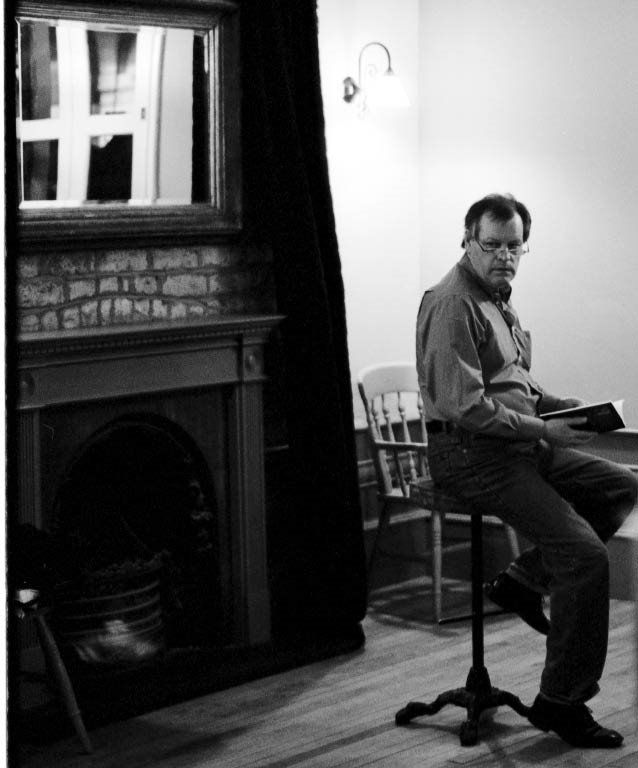
(photo of Iain Sinclair at Edge Hill, copyright Tim Power)

Iain Sinclair’s predilection for drawing divinatory lines on maps, in part, dictates his approach towards cultural formation and its poetics. In his 1975 poem Lud Heat, willed ley lines supposedly generate a wealth of supposedly occult materials for Sinclair to carefully counterpoint with local realist accounts. While he is careful to emphasize that his materials – including his map - act only as provisional confirmation of one another, of patterns of connection, the reader is marshalled by a relentless rhetoric of assimilation to accept that his chosen geographical sites are funnels of power for the gods, diffusing their influence through the ‘heat’ of named writers who once dwelt there. In later documentary, such as Lights Out for the Territory (1997) Sinclair’s walks across London are partly quests for the ‘reforgotten’ cultural workers of the capital – neglected London novelists as well as avant-garde poets. The pedestrian circumnavigation of the M25 that is the narrative occasion of London Orbital (2002) has not just the disappearance of the Millennium Dome as its miraculous aim, but the re-appearance of artists it finds along its route, such as the impoverished ‘visionary’ poet Bill Griffiths in his houseboat at Uxbridge, or Barry MacSweeney, who is presented as a modern ‘ranter’. Sinclair trudges the sites of the English Revolution and asks, ‘Was it legitimate to read that decade of samizdat publication (1965-75), poetry wars, readings above pubs or in disestablished chapels, as in any way analogous to the outpourings of the Dissenters (Levellers, Diggers, Ranters) in the years of the English Civil War …?’ (Answers on a postcard, please.)

Such authority Sinclair claims here derives from the connections he makes between the poets, between eras, and – crucially – between places (Uxbridge and the Diggers’ St George’s Hill are both visited in London Orbital). The disestablished chapels rhetorically function as the temporary location for the appearance of the British Poetry Revival’s festivities, but suggest a physically existing continuity with radical non-conformism. Peter Barry recognizes the danger, even in Lud Heat, of this rampant associationism, but also acknowledges Sinclair’s scepticism toward his own systems: ‘This overdetermined universe would quickly become unbearably claustrophobic, and perhaps ultimately silly, in the hands of any other writer.’

Sinclair ‘inscribing his own mental biro-lines on the tarmac, and then excavating and linking up the marked spots’, as Barry puts it, is the unifying activity of his intratextual oeuvre, in its multiple intertextuality. However, those wishing to create an exclusively avant-garde ‘tradition’ – say, a blostered-up version of the British Poetry Revival from which Sinclair emerged into the mainstream - will be disappointed to discover the stalking ground of Winston Churchill as well as JG Ballard’s bolthole en route in London Orbital, and in Edge of the Orison (2005) such artists are ignored in favour of John Clare and the family tree of Sinclair’s wife, which had fortuitously taken root in the vicinity of Clare’s long incarceration. The lines Sinclair draws explicitly complicate or refute existing lines of ‘influence’; they scribble over the maps of affiliations and allegiances, official and unofficial. They delete as well as connect.

The novel Landor’s Tower (2001) evokes the central metaphor for these eclectic acts of creative linkage. Alfred Watkins’ theory of the ley line, as outlined in his 1925 book The Old Straight Track, was popular in the 1970s when Sinclair appropriated its method in Lud Heat. Watkins argues (falsely) that the ancient sites of England and Wales are aligned with one another in a network of straight routes of communication called ley lines, which are also aligned with the movement of the sun. Watkins’ evidence, however dubious, is archaeological, and is suggestively presented in the form of maps with the straight tracks drawn upon them, not unlike the hieratic London map of Lud Heat. Sinclair’s description of the invention of ley lines is crucial to understanding his psychogeological and cultural poetics: Watkins ‘original revelation', is that 'everything connects and, in making those connections, streams of energy are activated’.

The poetics of modernist juxtaposition has been approvingly evoked, and utilized, by Sinclair: ‘Multi-voiced, lyric seizures countered by drifts of unadorned fact, naked source material spliced into domesticated trivia, anecdotes, borrowings, found footage.' This checklist, voiced by Sinclair’s avatar Norton, in Landor’s Tower, is describing a work like Ezra Pound's Cantos, but it would serve as well as a thumbnail sketch of Sinclair's own collage Lud Heat. Pound's technique of modernist juxtaposition and the ideogrammic method of the Cantos can be read as a literary equivalent of the ley line. Pound states that the juxtaposition of elements without syntactic linkage, by simple contiguous arrangement (if you like, by drawing lines between them) creates new combinations. However, the basis for this emerged from philology as suggestive but as suspect as Watkins’ archaeology. The alignment of the four Chinese ideograms for ‘rose’, ‘iron rust’, ‘cherry’ and ‘flamingo’, Pound attempts to demonstrate, combine to create the single ideogram for ‘red’. New meaning, like montage in film, is constructed from the juxtaposition of previously discrete concrete elements.

Sinclair’s cultural poetics operates on the premise that ‘the official map of the culture, at any time, would always fail to include vital features. Too many good writers are left out of the canon’. If the cultural explorer cannot trust received cultural mappings, the only way to establish a working map is empirically, to walk out into the culture (literally in Sinclair’s case) and gather what the walking reveals, to go beyond the official map to find the cultural operators who are off the radar, either because the radar is faulty, or the cultural mandarins are lazy and dismissive. The narratives of the walks in Lights Out for the Territory or London Orbital become bejewelled with significance, and spark with potential cultural connections, like Pound’s ideogrammic nodes, dotted ley lines for the reader to follow outwards. If enough connecting lines are ruled across what the sociologist Pierre Bourdieu calls the field of literary and cultural production (in his own spatial metaphor), and if the work can make connections between these vital nodes of local or repressed cultural activity, then the ghostly template of an alternative culture may become visible. This attempt to connect areas of the restricted economy of the literary field disrupts what Bourdieu calls the position-taking of artists within the field, in order to align their dispositions in a new way, by force as it were. ‘The space of literary or artistic position-takings … is inseparable from the space of literary or artistic positions defined by possession of a determinate quantity of specific capital (recognition) and, at the same time, by occupation of a determinate position in the structure of the distribution of this specific capital.’ Sinclair tries to ignore the larger forces at play in the field of culture as a whole. The (relative) autonomy of the literary field is high in avant-garde practice, replete as it is with inwardly-regarding accumulation of cultural capital, as Bourdeiu explains.


The more autonomous the field becomes, the more favourable the symbolic power balance is to the most autonomous producers and the more clear-cut is the division between the field of restricted production, in which the producers produce for other producers, and the field of large-scale production, which is symbolically excluded and discredited.

Sinclair’s elevation - or consecration, to use Bourdieu’s vocabulary - of Derek Raymond as the epitome of extreme and mesmerising pulp fiction, as well as Bill Griffiths as exemplar of the consecrated avant-garde, attempts to negate the dominant world of Booker Prize- sustained literary fiction and the culturally validated Sunday paper reviewing poet. Robert Bond argues that ‘Sinclair represents the contemporary poet or artist working without regard for his own self-preservation.’ Outside the field of large-scale social power, Raymond and Griffiths are sustained in different parts of the field of restricted production, both supported only by the cultural capital of their cultic energies, their ‘heat’, in Sinclair’s persistent metaphor, and constellated with one another, in a Poundian node, only by the ironic consecration of Sinclair’s prose.

It is fascinating to hear Sinclair operating occasionally within Bourdieu’s field of large scale production, rather than at the interface between larger scale and restricted, which is where I surmise his critique to be currently positioned (if I were to succumb to the charm of one of Bourdieu’s diagrams). His attempt on BBC Radio 4’s flagship Today programme in February 2004 to change the positioning of the work of the British Poetry Revival poet JH Prynne in the larger culture by de-consecrating the work of the canonised Philip Larkin was a peculiar failure of effect, even though he ‘played his advocacy pretty straight’ in my public email estimation of the time. The interviewer, operating as the normative cultural evaluator, the voice of commonsense, simply poohed-poohed his expression of the unthinkable. (Bourdieu theorises such acts of de-consecration as part of the normal shifting power-games of the literary fields, but has no theoretical machinery to deal with the intractability of the Movement Orthodoxy.)
Sinclair’s cultural poetics reveal a brave but risky strategy. Like all empiricism it is the slave of what is discoverable, and what Sinclair finds first are his artist-friends and immediate associates, and JH Prynne was one of the earliest and most extraordinary. Prynne has had the bitter-sweet distinction of appearing twice, as Skofeld in Suicide Bridge (1979), and as Simon Undark in Radon Daughters (1994) and Landor’s Tower. When the connections are forced – David Rodinsky, the Whitechapel hermit pushed hard against Harold Pinter the apostle of silence, for example, in Rodinsky’s Room (1999) – the results can become wilful, even desperate. In Edge of the Orison, where the bourgeois distraction of genealogy intertwines with a search for traces of Samuel Beckett and for his unfortunate lover, Lucia Joyce, incarcerated like John Clare, the revealed linkage does not repay the effort (although Sinclair does avoid some of his more repetitive tropes). For Sinclair, though, there can be no alternative method; the risks of being wrong or irrelevant are outweighed by the almost utopian connectivity of the imagination.
concurring with its constructions.

When Sinclair, in 2002 or 3, was asked by Kevin Jackson, ‘Are you a materialist or not?’ Sinclair replied, ‘Not. Not at all, no. Far from….I’m absolutely one of those mad Welsh preachers who believes that … deliver the speech and you’ll change someone’s life.’ This hesitant refusal, with its affirmation of a divinatory power of utterance, does remind us that to read Sinclair sympathetically, to respond to his magnetic notions, one must often maintain a critical resistance to its pull. As in reading Blake or Yeats, it is important to take the unpalatable with the palatable, since it is arguably through such strange perspectives that we can judge ourselves, and our values, as we engage with the powerful otherness of these texts. ‘While affirming the other as other … I encounter the limits of my own powers to think and to judge, my capacities as a rational agent,’ as Derek Attridge puts it in his brilliant The Singularity of Literature. Additionally, Sinclair’s texts, to use one of his own metaphors, operate as windows for readers’ imaginations rather than as mirrors for their self-regard. Robert Bond recovers a distant, even desperate, socio-economic politics from this, despite Sinclair’s evident resistance to materialist formulations, and one which reinforces Sinclair’s focus on the restricted field of culture. Sinclair, he says, ‘needs to assert the imagination as a force which, if exercised freely, creates products that are not easily assimilable within an economy organized around interested exchange. He also wants to assert the potential of the imagination … to stand in an oppositional relationship to the political status quo.’

Nevertheless it is important to balance the weaknesses and strengths of Sinclair’s unique perspectives, particularly as they relate to the cultural poetics that is at its most explicit in the non-fiction, but is everywhere in Sinclair’s vast intratextual project. The strengths lie in the way the cultural scene is charted first hand, as far as that is humanly possible, which may not be very far, as Sinclair’s Radio 4 appearance suggests. It is the unofficial guide, with as few of the pre-existent social valuations inherent in any field of cultural production, as possible.

The weaknesses lie in the project’s reliance upon such contingency, personal experience, the mystical and the numinous, and its eschewal of (overt) theoretical or sociological positions. One of the few riches of cultural capital that avant-gardists exchange is their writerly poetics. When, in the introduction to Conductors of Chaos, Sinclair celebrates the sheer facticity of small press publications – ‘you don’t need to read them, just handle them: feel the sticky heat creep up through your fingers’ – it is difficult not to believe that we are in the presence of a fetishist, reconciled at last with his diminished materialism, but he pays little attention to that other materiality, of literary practice itself on the treasured pages, other than the remark that ‘If these things are “difficult”, they have earned that right’. Sinclair is aware of the irony of his own fame as a writer publishing in the literary mainstream being the generous vehicle of consecration for more marginal figures. However much Sinclair’s cultural poetics can attempt to rescue the re-forgotten from obscurity, he is not adept as an interpreter of the technical poetics of textual obscurity, of that work of the British Poetry Revival. In a real way he could be described as an enthusiast. Bond identifies the centre of ‘Sinclair’s notion of enthusiasm as the compulsion to exercise the imagination without regard for the exigency of self-preservation’. Yet this is an economy Sinclair himself is partly liberated from, by his mainstream status as the chronicler of these others, as Bond also suggests. Despite this positioning, Sinclair’s critique often operates at the interface of the fields of restricted production and large-scale production. As he registers the avant-garde cultural capital of what Bourdieu calls ‘a generalised game of “loser wins”, on a systematic inversion’ of mainstream values, and projects that image against (or onto) the mainstream, the strategy risks the danger of reversing the inversion, as it were, of de-consecrating his chosen elect. Bereft of aesthetic value – their textual poetics unexplained – but replete with mythological potential, they can be dismissed simply as interesting people – characters - Sinclair has met along the way, rather than as exemplary artist figures who also ‘stand in oppositional relationship to the political status quo’.


Page 500
Wow!

One of the reasons I’ve been slow with posting pages on Pages is that I thought I should emit an editorial to celebrate Page 500, but I haven’t.

Other pieces on Sinclair may be found through the archive 489: Robert Sheppard: Iain Sinclair’s Lud Heat, (access that here

Lud Heat is once again available here

My book Iain Sinclair may be bought here. Or Here: Iain Sinclair | Liverpool University Press

My account of Dining on Stones is featured here

My critical volume When Bad Times made for Good Poetry has some further thoughts on Iain Sinclair's work. 

Suicide Bridge is also back in print and may be bought here:  Suicide Bridge – Skylight Press This reprints my 1980 review of the book as an afterword!

Here is an account of Iain Sinclair celebrating Malcolm Lowry in Liverpool in 2014.

Here is Iain Sinclair's poem 'Patrick Hamilton' on Pages.

Monday, April 17, 2006

Robert Sheppard: Hymns to the God in which My Typewriter Believes


My latest volume Hymns to the God in which my Typewriter Believes is
out now from Stride. It may be ordered direct from Stride or from Salt (where other books of mine may be purchased). (2018: long out of print, some of the poems are reprinted in History or Sleep: Selected Poems: see here:


These poems – the first to appear after Twentieth Century Blues was completed - riff on and off other works of art. They mostly fall into a category of work I dubbed ‘text and commentary’ during their composition, mostly between 2001-3. By this I meant that, although such works were responses to, writings through, alongside, against, out of, other works of art (on the whole), they were intended to be read independently as well as in relation to. They were as textual as much as they were intertextual. (See Pages 463: Robert Sheppard: TEXTintoTEXT for an account of this process.)

The materials selected – many of them by European artists – are unexpected new cultural referents: from the visual works of Charlotte Saloman to Hugo Dachinger, from particular drafts and poems by Anne Sexton and Veronica Forrest-Thomson. For example, ‘Parody and Pastoral’ (which was first published in Jacket) makes use of Veronica Forrest-Thomson’s poem ‘Pastoral’, in On the Periphery (Street Editions, Cambridge, 1976); see also her Poetic Artifice (Manchester University Press, Manchester, 1978), Chapter Five, ‘Pastoral and parody’, pp. 112-63, which reprints the poem on page 125.

The technique continues with surreal ‘translations’ of Sephardic songs to investigations of the ode and the anti-poem. Familiar themes emerge in these borrowed contexts, from the Holocaust to September 11. The voice is quieter, but, serious or jocular, the visual opportunities of page-space part of the poems’ exacting design. My favourite quote about my work is this one, from John Muckle: ‘Sheppard is a rhizomiste. This means he has found a form for his epic Twentieth Century Blues project that could sprout off in any direction without warning, like a potato; and it does. ‘Like a Potato’ (review of Nuttall, Loydell, Sheppard, Welch, Hawkins) Poetry Review, Volume 94, No. 4, Winter 2004/5, pp. 93-99, at 93-6.

I’ve recently launched this book at three readings. The first, shown in the photographs, was a joint launch in Liverpool with Scott Thurston (of his Hold published by Shearsman Books ) on 16th March (See also Pages 471: Scott Thurston: Sounding Scheme for texts and links.) The photographs feature Scott and I conferring by the windows; me waiting to read, and a picture of the audience, with Stephen Farrell Sheppard, Alice Lenkiewicz and Andrew Taylor clearly visible.

The second was with Ailsa Cox (my Creative Writing colleague at Edge Hill (soon to be) University) on 22nd March, at which she launched her short fiction Like Ice, Like Fire, available from Leaf Press . (See also Peggy’s Blue Skylight, our blogzine, and news of the previous Edge Hill launch we both launched books at.)

The third was with Peter Manson on 7th April as part of the Crossing the Line series in London. See his website, "Freebase Accordion".

The photographs are by Peter Griffiths, whose work may also be seen online at http://www.flickr.com/photos/64792774@N00/ including further images of our reading, and images of other readings, including those by Allen Fisher and Alan Halsey (who I would also like to thank for the excellent cover image for Hymns to the God).

And thanks, too, to Rupert Loydell for publishing this book.

Page 499

Sunday, March 26, 2006

498: Bill Griffiths (Ghost Story 6): The Law-Speaker

THE LAW-SPEAKER

Law and order was being talked up into quite an issue about this time. Unemployment was up, and robberies, cheating, drinking and sundry crimes flourished. The apparent impudence of some of the offences, and the slowness of response from the police only made it worse. The determination to do something grew. In fact, it was the ideal opportunity to canvas for increased police powers, increased police independence, increased police pay and pensions. Accountability was a concept from the past. Action was needed, and people were being telled as much, in the most unlikely ways, and in the most unexpected contexts. And by almost any political party you cared to name.

*

For example, that autumn, I attended, by chance, a local residents meeting that featured (unbeknownst to me) a talk on crime from a police officer. Myself, I had wanted to ask questions about homes being demolished, but that, I was telled, would have to wait: there was more important business first, before it would be decided if I could speak or not. Setting the agenda is the privilege of elected officers, after all. And on this occasion the main item was going to be something special, the show-piece of the local force, etc.

A policeman was addressing the meeting. Friendly his tone, but his matter (I could not help noticing) seemed aimed to play on the apprehension and even the fear of crime, as something he (a professional) was willing to admit he shared with them (the public, the victims, the generally law-abiding though not necessarily without their own little foibles that he would neither condone nor regard as serious). (I guess he meant little foibles like domestic violence, double-parking and the like. But Councillors set the moral tone of the area, so we can leave all that side of it to them.) No, the common trouble they all faced was burglary: them as proper house-owning citizens of Dawdle-Zone with their TVs and videos, their cars and garage freezers; the police as not being able to catch the villains or trace the stolen property.

Crime is a form of self-employment, after all, and they all knew (he pointed out) what the self-employed were like. Shop-keepers, especially those corner-shop laddos from god-knows what desert clime. (Groans of sympathy.) Car-boot-sale villains. (More groans.) Door-to-door salesmen and phone-calling double-glaziers. (Groans and laughs.) All after something. At your expense. At society’s expense. When respectable folk like yourselves paid the business rate on your shops and factories, you deserved a bit of help discouraging these elements from helping themselves, just breaking the law in their regardless fashion.

Now a bit of self-help is what is needed to combat them (he insisted). And fortunately burglar-proof locks were on sale and display at his very elbow from some lay figure he had brought along. A personable young lady, with all manner of alarms, chub locks, padlocks, circuits and systems. Costs a bit, of course, but what price peace of mind? They would all get an opportunity to look and buy during the interval. (Interval? How long was he going to go on for?)

It seemed he had only started on his main theme: the unalloyed evil of crime and the criminal, and the proper means of its discouragement. The shadowy, uncatchable thugs, younger and younger, that devoted their lives to wrecking decent homes and upsetting normal society. Quite early, he had dropped a neutral reference to the return of the death penalty, of the ‘some might think...’ kind. When there were murmurs of approval from his audience he took the hint, and was soon condemning ‘the lenient prison system,’ and in the end almost playfully regretting we did not accept the concept of mutilating offenders as practised in Muslim countries, gaining outright emphatic approval from his listeners the more deadly and outrageous his suggestions.

Had I come upon the scene of a Black Mass or some secret Coven of Mutilators? No. I shook my senses clear and looked again around me: it was just the same democratic gathering of local residents as encouraged and steered by decent Councillors and supported by proper Council grants. The same householders, pigeon-fanciers, freedom of extreme speech fans and family members as before, only kindled to bonfire heat at the thought of revenge - on whom? On some mythical class of offenders against honest genetic standards? Against their own sons, their neighbours or their neighbours’ children? For who can say who will say what when the figureheads of normality and propriety turn awkward? There is only the sheep-warm urge to follow them on any dead path they care to nominate, and at the present police power was on the up and participation in the State limited to playing the role of anonymous (possibly rewarded) informants. Posters asking for help to identify the ‘Anti-Social’ were now a feature of everyday life.

Still, she made a good sale of chains and locks, this gentle female lay partner of his. The audience were only too glad to show their appreciation in a practical way. And an hour or more had passed before we even reached the point where we were invited to leave the room, so the propriety of our presenting the case against community demolition could be considered. After all, discussing a Council plan, let alone admitting opposition to one, was a risky sort of business not lightly to be embarked on. We retired to the snooker room of the club, awaiting a decision, when a god-almighty scream came from the carpark just outside the window. We threw back the blinds; citizens rushed from the main room into the open to view the horror.

*

Well, I can only apologise. It seems I was wrong. The forces of evil are indeed everywhere around us and more powerful in this world than any Cathar heretic ever dared imagine in wild-dream scenario. I can hardly bear to describe the unholy scene we beheld. The policeman’s car was parked outside, and the policeman in it, revving his motor, and yelling, and banging his fists on the dashboard, and then getting out and smashing his own windscreen with the steering-lock, in terrible motor-rage. For in the light now flooding from the windows and doors of the club, we could see, as he had surely guessed himself by now, that all four wheels had been neatly removed, and the car propped up on its axles with a few spare bricks.

At that point his car-alarm went off with ear-splitting majesty.


{Dawdon Residents Association; the visit of a chief constable to Sunderland}


That’s all from Bill’s Ghost Stories. Appropriately, British Summer Time began today and it rained, but light remained until at least 7.00 here in Liverpool. Bill’s story should remind us that the forces of darkness don’t need darkness, anyway. But they've helped us through the dark days of the Winter.
Page 498

Wednesday, February 22, 2006

Bill Griffiths (Ghost Story 5): Needfire

Ganny sat i’ th’ corner, caad as owt.

Meg cam ower ti show ‘er hor latest drawin’. It woz a pickchor ov an egg, on end, beginnin’ ti brick, an’ a large muscle-man emergin’, leastways hiz heed an’ airm.

Ganny chuckled. It myed hor think o’ the renewal o’ strength – that she needed partickler, hor, at hor age. Meg woz an aud-farrant bairn, she thot, not like hor scatty-brained Mam. She puu’d th’ rug tighter roond hor, an’ leuked toward th’ winder – the fire seemed to gie nae heat, and the sun little leet the day, which meant –

‘How, Ganny,’ sed Albie as he waaked in, huggin’ a canny bundle o’ peat wi’ him. Albie woz Ellen’s man, her daughter, but most times she felt closer to him nor hor. It woz a matter o’ respeck – that gorl had nyen, nae mense at aal!

‘Heor’s some peat’ll keep us waam, eh?’

‘Ye’ve nut ti hoy ower-much on, it’ll aal be te redee later, ye knaa.’

‘Oh, aye. Ye’ll hev ti ax Ellen aboot that noo,’ he sed, gently.

They exchanged a gliff o’ th’ ee.

‘Is it fire-neet?’ axed Meg.

‘Why noo, Mowsie, whee telt thoo?’ said her Dad, ‘Naebody, on’y Aa’m aad enuf ti hilp, Aa am!’

‘Thor’ll be nae clartin’-on the neet; thee Mam’ll nut stand fer it.’

‘Clartin’-on!’ sed Ganny, sounding reet scunner’d. ‘Th’ bairn’ll dee better fer ye than that Ellen. Nae mense at aal!’

‘Noo then, Ganny, ye knaa what Ellen thinks o’ aal this superstishun. It’s hor hyem noo – it’s aal wors – an she’s wark enuf wi’oot us makkin’ mare.’

Ganny changed th’ subjeck. ‘Hev ye sarra the hens, wor Meg?’ Mebbies she leuked fer a werd wi’ Albie in private.

But – ‘Aye. An’ ye knaa, Ganny, the clockers wor aal huddled in a heap, it woz that caad.’

‘Aye caad it is,’ the aud wife agreed.

‘Aa’ll seun hev th’ fire fettled,’ sed Albie, gerring on his knees to kittle the gleamin’ peat. ‘The fire’ll nut born reet, nut the day. Thor’ll be nae heat fra that airt.’

Albie filled th’ kettle an’ set in on the fire.

‘A cuppa’s what ye need. What we aal need. It’s that bitter, ootbye. Are ye nut frozzen, wor Mowsie?’

Mowsie rubbed her hands afore the fire; answer enuf.

‘En Ellen’ll be fetchin’ the supper, jus’ noo…’
Ganny felt her consarn risin’ wi’ this hyemly crack – cud they nut see the fire’d nut tak, the femmer yeller leet o’ th’ deh, aal wrang, aal wrang…

She storred horsell ti’ mak a bonny protest, when Ellen waak’d in.

‘Lo luv’ said Albie, gie’in hor a kiss. ‘Caad ootbye?’

‘As if ye need ask! Meg, where’s your warm socks an’ jumper? Ganny, will you not come nearer the fire?’

She set a pile of shoppin’ doon on th’ kitchen counter, an’ began riddin’ things th’ way she liked them.

‘Mowsie, fetch thee gansy,’ prompted her Dad.

‘Is the tea not mashed yet?’ axed Ellen, openin’ packages an’ stowin’ them aal-wheers.

‘Ah dunno,’ said Albie, ‘it dizzent seem ti want ti’ boil…’

‘It’ll nut,’ commented Ganny, seein’ an openin’. ‘Ellen…’

‘Not now, Granma. I’ve the sausages to defrost.’ Mebbies she knew weel enuf what Ganny would start on aboot, se she myed great business o’ puu’in’ apart the frozzen sticks o’ sausage an’ arrangin’ them i’ the microwave. Then thor woz frozzen beans ti tackle. ‘Albie, haven’t ye finished with the fire yet?’

Thor wos nae gas laid on wheer they lived, se the fire hed ti dee its share o’ ceukin’. Ellen’d nut hev a kitchen range; she hed nae tyest fer aud-farrant ways.

But eftor a bit she hed to admit defeat. ‘These sausages are nut even thawed,’ she said, sittin’ doon wi’ a sigh. ‘Maybe it’s time we moved to somewhere civilised…’

The farm was Ellen’s by reet, but nyen o’ them thot she really wanted rid ov it. It woz a canny livin’, i’ th’ sommer!

‘Aye, an’ gerra farm in Jamaica,’ sed Albie, funnin’.

‘Bishop Aucklan’s canny,’ ventured Ganny.

‘Aye,’ sed Ellen; ‘it’s not your fault were stuck here. If we could only get planning permission for the land…’

‘It’ll sarve fer years yet,’ Albie reassured hor. ‘an’ then Meg’ll graa up an’ finnd a fine young man that’ll dee aal me wark fer us, an’ Aa’ll com n sit i’ th’ neuk wi’ Ganny.’

‘An’ what about me?’ protested Ellen.

‘Whey, ye’ll hev sailed te New York an’ started a consultancy bus’ness.’

‘They do have aeroplanes, now.’

‘An’ ye’ll send us a poke o’ peat nows an’ thens, te show ye’ve nut forgetten us.’

‘I’ll send you tickets to join me, you mad thing. If I could…’
It seemed th’ caad woz getten intiv iverything. The kettle’d nut raise steam, so they settled for waamin’ up some milk an myed a crowdie wi’ breed-crumbs n oatmeal.

It was later that Ganny started getting’ restless, yance Meg hed went ti bed.

“What is it mother?” axed Ellen, not unkindly.

“Me sticks, me sticks,” the aud wife seemed to mutter, then pu’in hersell tegither: “Ellen, hinny, Aa knaa thee an me dizzent agree ower aud matters, but ye mun fetch me sticks fer the need-fire, less’n ye’ll dee the job theesell.”

“Oh mother – you shouldn’t be worrying yourself over these silly superstitions. The sun’ll come up tomorrow. Spring-time’ll return just like always. And a bonny mess we’ll find ourselves in, what with Bush invading Iraq!”

“Bugger President Bush! Aa’m taakin’ of what’s serious, gorl. The sun gans weak; the fire losses its heat – it alwez diz, this back-end o’ th’ year. Even yor ‘lectric’s nae orthly use. That’ hoo it is. An’ alwez it needs wor help, that’s for what we rekindle the fire, to fetch it back again, to strength. Ye mun put the fire oot, an’ hilp me get riddy to start it again. Please.”

“You should be in a museum, really!”

“Oh Albie, insense her ov it, will ye?”

Albie, catched in the middle, picked his werds careful-like. “Weel, me fadder elwiz re-lit the fire aboot this time, but Aa wez nivvor tewed te dee it mesell.”

“Ellen, hinny, humour me – it canna dee ony haam.”

“Why I think it should – at your age! The cold’ld kill you, if we let the fire out. Albie, cannot we mend that electric fire? It’s the cold giving her these fancies. Why, I’m cold myself, just talking about it.”

Albie muttered summat aboot nut bein’ ower good wi’ ‘lectrix. In the end, they fetched extra blankets – fer Ganny wez ower aud to clamber up stairs these days – and myed hor bed as near the fire as they dared.

And wi’ a kiss from Ellen and a hug from Albie, they clamb up ti bed, an’ left the aud wife in th’ on’y heated room i’ th’ hoose.


Ganny could not sleep. A year back, she would’ve handled the matter horsell’, nae problem. But it hed been a sorry year fer hor, an noo she could hardlies waak wivoot hilp. But sit up and get up she did. Forst, she fussed at the fire, nudgin’ the top peat away with the poker, then brikkin up the glowy bits underneath. It’d seun gan oot, that way.

Then wi’ a match, she lit hor candle – poor leet that it woz – an’ myed hor way slaa-ly ower te the kist i’ th’ neuk. Thor she fand hor matrix, hor spindle, an hor bow. The bow torned the spindle in the matrix, te kindle – what? She looked aroond fer cottonwool or the like, but fand nyen. Pyeper hankies ‘ld dee. An wi scissors she cut bits oot o’ hor hankychief. Mare smaa sticks she needed, but myed dee wi’ cereal packets an newspapers.

By when it woz that caad, she woz tempted ti gan strite back ti bed. It woz a shyem Meg wazzint let hilp her; or Ellen horsell. Mebbies a match would be bettor nor aal this carry-on – but ye cud nut be ower-careful when it cam ti matters ov import, like.

Se she settled horsell bi the hearth, takkin time to twist the bow just-se roond the spindle. Weeny bits o’ pyeper she set roond the matrix, an lange twists fer when th’ flame catched. anither piece wood capped the spindle, an it woz time to wark th’ need-fire. But hor elbers woz awful bad, an she felt that dwalmy as she set the bow movin’, she dooted she’d not manage.

Aal she cud dee woz cry oot as she fell ower, torpled aza stot.


It woz Albie hord hor caal oot.

He wakkened Ellen, an tegither they cam doon ti check.

They lifted Ganny back onti the bed, but she wazzint breathin’.

“Oh Mam,” cried Ellen, “ye’d not be telled!”

Meg cam doon, wakkened be the stour. “Is Ganny aareet?” she axed, but Ellen’s sobbing telled hor otherwise.

Poor Ganny!

Meg took up the spindle, an began ti lake wi’ it, roond n roond.

The silly soond o’ wood on wood roused Ellen. “Don’t fool about!” she thundered, an’ clickin’ up the spindle, brokk it in twee haaves, an cast it on the deed fire.

Mowsie Meg gasped.

Thor woz nowt she cud dee ti save them eftor that.


Phew. If that hasn’t completely chilled you, then there is one further Ghost Story from Bill Griffiths next month.


Page 497

Wednesday, February 15, 2006

Kai Fierle-Hedrick : Some Poems and a Reading

KAI FIERLE-HEDRICK

is a mixed media writer interested in locational/interdisciplinary/collaborative practices. Since 2003-4, when she earned an MPhil in Architecture & the Moving Image from Cambridge University, she has mainly been exploring combinations of text and digital media. Documentation of her work is available on her website. Bad Press published a pamphlet.


Bombazine

this body pulls armfuls of shade less lashes, each blue iris —
in its small privacy haggles terror for a gut plot
less combat, more hope diseased

gone bed-ridden & fugitive, peers oblique
through curtains to grieve
a surfeit logic so moving no news
could cave to sleep — which is to say each collar bone
sternum, spine aches through sans rest

to bank slaughter like care, mass or pittance
there can be no helmet for this

too many, too soon precious bits, sky-blown scraps
& slabs of pink flung wide as queer
silage for a public eye once uneager to water
when angst spawns empathy, a quivered light


London, UK; July 2005


still 11


and impervious to seams this
feat of entirety
that this season I am

so beatific and
bound by air become chords
of soft molecules

their thronged pause sticky
as the pant of hours; this, how
[in the lethargy

of an exhaled lung]
a gal breaks light with gestures
meant for spring


Auto-portrait with news and text


this petite waiver, sly and tabloid, fuels digression from
and into the articulation of a true space, its mass
gray / I've handled colour as man should behave,
with trained and sensitive eyes
/ lot of politics grabs
front-page status [site, mock context], a papal election
made pretty blurb, made print / you can recognize this
double behaviour
/ how I love that Albers loves
red, our want of sincerity or ode / of colour
a mother, stabbed, displaces popes — another day,
the pope returns, a jewel in his hat, its would-be good
[i.e., net worth] retracting zilch / and from all this you may
conclude that I consider ethics and aesthetics as one


* italics signify lines pulled from an interview with Josef Albers conducted by Katherine Kuh


Postscript, Cafe Ouky Douky


Manipulation in particular seems to play a significant role as a strategy of dealing
with the world and assumed reality. [...] Manipulations and deceptions become guidelines
in a pursuit of communication and a proper place — but first of all — they are instruments
to investigate never-too-near-approached phenomenon of truth.

* Adam Budnek, for the 2005 International Biennale of Contemporary Art in Prague


the contemporary interior here short-circuits
alienation sums Prague as this woman or
that woman browsing packaged hours i.e., tram times
to plot arrivals how this man quotes tourism
as asymmetric opportunity their lives in ochre
chapped by the same, pale city or costume
change a time of day, say 6pm, undressing
its turnover with the command to ponder
regularlity substance some moving thing
or metronome their conversation, rhythm poaching
the page like other countries, interrupting
as spectacle made norm by the universal
of cafe culture junctured, caffeinated, common
grounds, the rhythm of human digits drilling
and dwelling swigging, twiddling their high-
strung ways as a taut boredom the preferred
mantra an elastic gainsaying i.e., how she overhears
'I was just traipsin' streets when...' and waxes
meaningful falls prey to another sham
mayhem as stained glass lamps bearing fruit
indeed might break her foreign prerogative
to evade even cross-cultural ruts by any
means the vital act to fictionalise the local
as events let loose the abstract, fatten
narrative, exaggerate, befuddle, fuck up
the line we love this, she and I, for its schizophrenic
stealth we, double-time, risk ethics through
meddling spurn talk as ornament and aim
for the blunt and dusted buildings, their striations
and back-lighting by proxy mark observation as a misfit
stalker interlopers as postcards by Durex quoting
condoms as flying saucers the clatter of wind-chimes
of panes of glass reflective proving our patronage
or my tiger of a t-shirt and foreign cheek bones
bunk presence as witness a sigh of bloody
eureka and scribbling nicks the place


Page 496

Tuesday, January 31, 2006

Bill Griffiths (Ghost Story 4): On Friday Morn

She was quite good, professionally speaking. She could take an average rumour, a bit of council flap-about, and make it sound quite convincing. After all, that was what was important wasn’t it? – not the pretend-cult of the pseudo and academic objective, the twisty-trail of flippant truth, but the ability to promote the issues, bestow the unspoken attention that assisted the flight of the political arrow. How else was she expected to access material at all? Dead-pan and objective, financial advantage, personal vendetta and tiny alert were handled with the same apparently harmless gloss. It meant a leasing of the soul, perhaps, but how else should one thrive?

It seemed an infallible recipe for a long career.

Ah yes, here she is, tipping and tapping away on a major project that will reveal a historic co-operation between Parish, Police and Property Developers: in which they will all – basically – swop premises, release land, make (who would even notice the assumption?) a better environment for everyone to live in. It takes talent.

“Aa nivvor was inclined te wryte p’rose ona Fryda morn, messel,” said a bass voice, over her shoulder.

A round-headed councillor had come through the gap in the counter to spy on her. Or so she supposed. Either they came to share information, or to extract it.

“I didn’t know you wrote.”

He was a link that could be (had been) useful, a sort of yesterday asset, or she would have ordered him straight back into the public quarter. Doubtless he had the same liberal view of her function, or he would not have approached.

“Oh aye, in the Yunyon en thet. Reports, letters, wor newsletters, press releases. But we wor telled nut te dee that wark ova Fryda morn. Unlucky, they allus sed.”

She smiled. Unlucky, to her, meant not getting a news story finished on time.

“Sounds more like slacking than superstition. Or did you work twice as hard of a Friday afternoon?”

Well, she wouldn’t be telled, that was obvious. Probably thought computers cancelled the laws of luck.

“Fryda post-noon? Na, we spent that in the betty-shop.”

Ha! He really was a dinosaur. What could she say? Euro-grants weren’t won in betting shops, that was for sure. She ignored him.

“That yor piece on the polliss HQ?”

She absently nodded. He could contribute or go and tew someone else.

“Any thing new to add?”

She was a hard women, he thought. No time for polite talk at all. Well, let her do without.

“Na,” he said, and shifted his weight onto the other buttock.


…looks set to succeed. The present accommodation is recognised as too far from… a more compact, central operation, said a spokesman… but historical… ideal… firmly intends… and if all goes according to plan, the Council are asking for… sometime this year… an imaginative solution… the police are looking to vacate… we look forward to… the community will be involved in… more in our next issue…
And lots of photos. That was the popular touch. Loans from the Developers of suitable images would certainly back their case. Looks good. The pen-sketch future. They’ll be voting in the streets to get the policy approved. She picked up the phone to check… There was a terrible whistling sound on the line. ‘Yaaarrgh!’ – she distanced the handset. A shadow flicked over the street window, leaving her looking grey and shabby for a moment. A snatch of song filtered in from the street. …and the ship not far from land!
She had heard that song before. Something to do with Friday, she guessed. Was it that dodo of a councillor come back? But no one entered the street-shop premises of this sub-
station journalesque. Just one of those passing impressions. “It was,” she reflected, “a good idea to know when to be silent.”

How many historic buildings had fall’n victim to the wreckers’ slam without even a mention? – without so much as a prayer over their dismantled carcasses! Some things must not stand in the way of progress. A plaque – she ruminated – on the side of the telephone box where the great gothic hospital once stood; a shrubbery to mark the spot where that sweet old dene had succumbed to housing encroachment. No, not in her brief. Her editor backed her on that one: leave the campaigns to the environmentalists, he advised. No need for us to get involved.

She was uncertain whether he was being consciously ironic or not in suggesting this. He might not know, to be fair, what everyone else knew, that the local environmental society was run by current and retired County Council employees, whose silence on aggravating topics was a miracle of tact. Ah, silence, that wonderful word (she reflected) – as another raucous line or two filtered in from the street…

…then three times round… then three times round went she…
Might almost be me twirling around in my chair, she thought, as she super-sped another remarkable article to the head office in Kidderluck through the internet. She stuck her head out of the door. Reassuringly, the new executive select houses stood shiny and brave on the brow over the dene, like Red Indians on the skyline, waiting to charge down on the cowering misery of the valley wagon-train. As it were. Always inspiration in Nature, she reflected.

…and sank to the bottom of the sea, the sea, the sea…
Who was that singing? She could see no one who could possibly be the minstrel. Not that old lady, wondering hopelessly round searching for some long-gone launderette. Not the egg-taggle of youths at the far corner, without a tash or bass voice between them. Cabin-boys, she mused grimly, as she imagined them sucked into a vortex of screaming water. Just then, the secretary at the Town Council came hurrying out of her door, making a bee-line for the newspaper office.

She pulled our threshold reporter inside, shut the door, and set away.

“It’s awful. You haven’t heard?”

“What?”

“Oh my dear – Councillor Crosp. Dead!”

“Crosp?”

“Just an hour back. Heart attack.”

“He was in here. You know, lurking about.”

“And he came to us. Aggravated he seemed. Sommick about someone singing. Unlucky he called it. Went home. Then sudden attack. The heart, you know.”

“No chance?”

“Dead on arrival. So sudden.”

Yes, they reflected. His great booming voice…
“Wasn’t he due to…”

“Yes, this very evening. To sing at the charity do. Such a lovely voice. And seasongs. As a young man that was. Why, he used to charm us lasses…”

“I’m sure,” she said, feeling a little gaunt and tired.

And all man’s work’s the grave,’ she reflected.

Now many a decade has filed by. The devious plans of this or that policy group have hardly left a trace. The backhanders have been pocketed, the money spent, and the car or present it bought, long rusted through. The only positive result of time has proved the filling in of the docks, and the construction of a sea-platform to act as a heliport and small-plane drome. A few aeronautical shops, one storey max, are tucked away near the dene. Everyone else has gone. Bits of former houses have tumbled down the dene and blocked the stream at the bottom.


Page 495
There will be another uncanny excursion into local government necromancy in next month’s Pages from Dr Griffiths.

Wednesday, January 25, 2006

Robert Sheppard: Review of Harwood's Collected Poems (part two)

It’s a Long Road: Part Two. The first part was posted on Pages in December, here
 
About half way through his Collected Poems we see the emergence of the mature Lee Harwood. It is worth remembering that 300 pages (of 522) of the Collected were written by the time he was 40. From this date, 1979, the work, while continuing to record the vicissitudes of personal relationships and thematic obsessions, and while emphatically insisting that it is making art from these materials, demonstrates a stylistic assurance that can use whatever expressive mode is at hand. While ‘Old Bosham Bird Watch’ (a text I examined last month from the late 1970s) may have re-kindled Harwood’s interest in prose, this confidence may have been reinforced by participating in two collaborative projects, which provided him with two new prose forms.
The first one, ‘Wine Tales (1979-81)’, a work written mostly in prose with Ric Caddell, and published under that title by Peter Hodgkiss’s Galloping Dog Press in 1984, makes open play with the conventions of the short story or the fictionalised vignette. The text’s conceit is a version of the game played by Raymond Rousell: imagining oneself disappearing into labels on wine bottles (though the collaborators eschew Rousell's punning); the labels that Caddel and Harwood use are reproduced in the original publication. Caddel's texts and responses as well as Harwood's are generously included in the Collected. In ‘Claret’, which Harwood published separately (and is printed here also in the ‘All the wrong notes’ section!), he imagines the ‘large grey chateau’ on the wine label as ‘A Gestapo Headquarters – interrogation rooms and cells- ’, but reminds us that ‘this in my imagination in a sun-filled kitchen in the early afternoon in September’, a place ‘where such interrogations could equally happen’ between ‘husband and wife’. (CP 260 and 304) Block prose paragraphs allow for multiple connections to be laid out, precisely juxtaposed, as each new paragraph signals a change of ‘scene’ quite literally (from Gestapo HQ to kitchen, to windows and rooms in South London (‘Step into that room’) to a noisy children’s cinema. (CP 260 and 304). The poem ends, jokingly, but menacingly, for the ordinary harbours such acts of micro-fascism: ‘If we sit quiet and still we will be allowed to see the rest of Sabu the Elelphant Boy with French subtitles’. (CP 261 and 304).

‘Wish You were here: six postcards’ originally published with Antony Lopez’ replies (by Paul Brown’s Transgravity in 1979), here forms the opening work of the section ‘All the wrong notes 1976-1983’. Again, as its title suggests, it uses visual materials as stimulus, which is a common method of composition from this time. More generally, it also makes use of one of Jack Spicer’s forms, which Harwood has made his own: a lyric fragment juxtaposed with a prose statement or apposed fictional passage at the foot of the page, a flexible mode of combining text and commentary, and perhaps of reversing them. While ignoring Spicer’s more teasing and sometimes contradictory use of this form, it would prove useful to Harwood in other of the poems collected in ‘All the wrong notes (1976-1983)’, the long section of the Collected reprinting Monster Masks of 1985 which had itself absorbed the texts of All the wrong notes (1981), but not the original photographs by Jud Walker of Brighton streets, hills, alleyways and littorals. Both books were published by Caddel's Pig Press.


Most notable around this time is Harwood’s development of the long sequence, mixing modes as he sees fit, and juxtaposing longer passages (often in Spicer’s double voiced discourse), as a gentler form of the collage and cut up procedures developed earlier, as in the excessively entitled ‘Faded ribbons around the lost bundle now being devoured by moths’, which mixes lyric, prose, fiction, fact, and emphasises imaginative methods of transformation. Cavalier fictionalising often raises ‘the question of where vanity and obsession meet or divide or…’ (CP 312), while the natural world offers the seductions of simple enumeration, as well as subtle ‘distinctions’:

blackbird’s song
skylark’s trill
cuckoo’s call (CP 313)

But the desire to link aesthetic and sensual experiences (as they are in their etymologies, of course) haunts the piece: ‘A 13th century ceiling meets Schubert meets/a glass of chilled white wine and a ripe peach’. (313) This ‘meeting’, this deliberate juxtaposition, offers the hope for an imaginative interinanimation of various cultural artefacts and sensuous experiences.

While aesthetically the assurance of the later pieces is a success, there is no doubting the negative aspect of Harwood’s imaginative restlessness, where ‘meeting’ can degenerate into slippage, and even evasion. He himself, writing in 1993, suggests that such stylistic restlessness – rapid changes of direction and attitude - may indeed at least partly derive from a personal disposition. (Although the metaphor used here is of an earlier civil conflict in English history, there is a clear echo of the ‘puritan-cavalier routine’, examined last month, and of the way that that stylistic formulation echoed emotional and sexual vicissitudes.)

'I almost feel there’s nothing I can trust except the mountains and the countryside, and possibly the writing. I certainly don’t trust myself but continually doubt my ability to hold one idea or emotion without it suddenly sliding away from me, beside me, whatever. I feel like one of the earls in the Wars of the Roses. I set my standard up but as quickly leave the battlefield when most needed or even go over to the other side. I know I can be trusted when navigating in cloud on a mountainside but certainly not when trying to navigate sexual and some emotional "clouds" (though I wish I could).' (p. 150 Lee Harwood, Contemporary Authors Autobiography Series, Volume 19, pp. 135-153, at 151.)

A revitalised juxtaposition of ever more discrete and larger fragments occurs in ‘Dream Quilt, 30 Assorted stories 1983-1984’, a text written after Harwood had split up with Jud Walker in 1983 and had moved to the artists’ colony of Bolinas, California, where lived with, and was directly influenced by, the fiction writer Bobbie Louise Hawkins for a year and a quarter. This work draws out Harwood’s tendency towards the short story that had been growing over a number of years. Harwood’s reading had always included prose, from the oblique fictions of Borges, to the sensually exuberant autobiographies of Jocelyn Brooke, but what he was not influenced by was the emerging form of British literary fiction, whether Amis or McEwan, Carter or Winterson, which may explain the slight archaic feel to their written surface. These ‘stories’, ‘flashbacks’, ‘fairy tales’, 'odes', 'hommages' 'dreams’, ‘announcements’ (to cluster several generic indices from their titles) are arguably ‘short short stories’. However, reading them today in the era of the 50 word short story, or slash fiction, or alongside a 'novel' such as Dan Rhodes’ neo-Oulipean 101 101 word chapters, Anthropology (2000), they seem almost prolix by comparison. He plays on his own history and those of friends (Caddell and Mottram, among others), he elaborately details his 45th birthday. He incorporates written narratives by his young children, as well as disappearing into his dreaming imagination. Various texts travel from the sublime to the ridiculous, and the sublimity of the ordinary, but never loose a gentle self-mockery when Harwood represents himself as a slightly bemused and stilted figure in a landscape. One fiction ends, ‘(Imagine all of the above.)’ as though the words, as ever, will be never quite enough, unless some total readerly engagement is enacted by such parenthetical prompts.

Back in Brighton in 1984, and returned to his post office job, in his poems of the two next sections, ‘Rope Boy to the Rescue 1983-1987’ and ‘In the Mists 1988-1993’, Harwood increasingly refers to his passion for mountain climbing, and country walking, examples of the forces he says he can ‘trust’. Rope Boy to the Rescue, which was also published as a separate volume in 1988, by North and South, run by Peterjon and Yasmin Skelt, contains poems which, while exemplifying the gains of the previous few years, sometimes fail to satisfy. For example, ‘The Unfinished Opera for Marian’ (O’Dwyer) is a prolix exercise in romantic operatic pastiche: ‘I have loved you for twenty stumbling years,’ is a desperate admission amid the camp excess of Albanian hussars and pangolins! (CP 386) This contrasts with the tightness of the first of several love poems dedicated to Sandy Berrigan (who was married to poet Ted), ‘Gyögy Kurtág meets Sandy Berrigan’. The title reminds us of Harwood’s strong sense of ‘meeting’; the poem is a ‘song cycle’ that fully deserves its lyrical aspirations towards music through the naming of the composer in its title. It risks unashamed tinges of narcissism: ‘But in love with being in love,/with feeling precious.’ (CP 372)

Although Harwood was to wait until 2004 for the Collected Poems occasioning this review, a selected poems, Crossing the Frozen River, a title which yet again foregrounds the sense of precarious travel, appeared in 1988, and was generally well received. Published by Paladin alongside the anthology The New British Poetry, which also contained his work, both were instigated by of the unsung general editor of both volumes (and more), John Muckle. (See some recent poems by Muckle as the last posting from Pages.)

‘In the Mists (1988- 1993)’ is subtitled ‘mountain poems’, and appeared as a pamphlet of that title from John Harvey's Slow Dancer in 1993. The deliberately clumsy title, ‘If you think this is just descriptions, it isn’t’, reminds the reader that considered enumeration, in writing about the natural environment, may be considered evocation, another ‘meeting’, this time of man and nature, culture and the environment. Another poem records one notable historical failure of this perspective: ‘"I see Nature bothers him" Maddox Brown noted of Rosetti.’ (CP 400) There are poems to Harry Guest (a poet-friend since 1963, and probably the dedicatee of the early erotic reverie of ‘This Morning’) that flirt ambivalently with the numinous religiosity of his older Anglican friend. ‘Gilded White’, a second ‘Sandy Berrigan’ poem, in lyric form again (prose has more or less temporarily vanished from Harwood’s repertoire) is a triumph of hesitant lyricism, where Harwood (whose early New York casualness of line generally gave way to phrasal lineation) pays particular attention to the aesthetics of line breaks. A gift becomes the focus of a connecting ‘wrapping’ not just of itself but of memory, experience and place, a locus of time and space, although the local (‘Sussex’) is distanced by such a ‘meeting’:

Japan is a long way away Italy is a long way away
California is a long way away Sussex is a long way away
but all gently wrapped together in this moment
your gift (CP 414)

These aesthetic delights – these are just a few - are overshadowed by the death of Harwood's friend, Paul Evans, whom he had known since 1965, while climbing with Harwood on Crib-y-ddysgl, Snowdon, in 1991. There are a number of moving elegies to him, ranging from the starkly notational ‘On the Ledge’, which narrates the incidents of the fatal accident, even to ‘a final thudding stillness’, (CP 406), through to ‘For Paul/Coming out of Winter’, an attempt at redemptive imaginative recovery and a reprise of a subject dealt with both in Harwood’s own earlier poem which recalled walking the seashore with Evans, ‘You essai. You o.k.’, and Evans’ own reciprocal ‘It’s No Good Lee’, which concludes, ‘it can’t be done’; that is, to describe the variety of the sea in words. Harwood’s elegy ends with a restatement of the two poets’ agreed humility in the face of the inadequacy of language to reach whatever it is that is not ‘just descriptions’:

How many times we discussed the sea’s colours
all beyond description words a mere hint
of what’s before our eyes then and now (CP 407)

In 1992 Harwood co-edited and published, from his own Skylark Press, The Empty Hill: memories and praises of Paul Evans which contains memoirs, critical articles, and poems by, and to, Evans. (Evans’ The Manual for the Perfect Organisation of Tourneys, Oasis Books, London, 1979, I have long regarded as one of the forgotten masterpieces of the British Poetry Revival.)

The trauma of this event, problems with employment, and a bout of bad health probably explain why between 1989 and 1996, years represented by the ‘Morning Light’ section of Collected Poems, there are fewer poems than one might expect. They were first published in the Slow Dancer volume Morning Light of 1998. However, there are three outstanding long sequences. ‘The Songs for Those Who Are On The Sea of Glass’ is an account of a heart attack, ending with the startlingly rare sonic patterning of ‘sat up in bed in bizarre pyjamas’, which signals some release from the glass sea of illness. ‘Dreams of Armenia’ presents the history of a nearly-forgotten genocide (a mode of ethnic cleansing contemporaneously revived in the Balkans and in Rwanda). Lyric inter-cuts are truncated by ‘informations’. For me, the most resonant lines in the whole of Harwood’s oeuvre are the chilling but tender: ‘They would do this to you, my love,/and to our son,’ (CP 444) which it forces against – how could we assume the positivity of ‘meets’? – grim enumerations of ‘Massacres. shootings, bayoneting, hacking….’ (CP 444) The 50 short sections of ‘Days and Nights’ came out of Harwood’s short period of employment as a museum attendant (they were ‘written’ in Harwood’s head). It ranges from single word entries, such as ‘(space)’ (CP 421), which attempts to look outwards, and ‘sullen’ (CP 422) which looks inwards, to meditations on its own temporal development (and in confirmation of Harwood’s attachment to his frequent use of gerund forms of verbs): ‘always in the present ing ing’. (CP 421) There is nothing quite as minimal as this in Harwood's work, although it reminds one of Raworth's serial composition ‘Stag Skull Mounted’ (1970), to which it refers, and from which it quotes, commenting on its failure of method, or failure as method: ‘As Tom once wrote “this trick doesn’t work”’. (CP 422) Structurally, ‘Days and Nights’ testifies to the belated and repeated influence of Ashbery’s ‘Europe’, and there is a further precedent in the delicate miniature boxes of Joseph Cornell, to whom the piece is dedicated (and to whose work Harwood has compared his more stylised fictions).

‘Late Journeys (1996-1998)’, the final section of Morning Light (but here extended with a further poem), is dominated by love poems (one dedicated to Penny (Bailey)) in a variety of lyric modes, recording a variety of states, from exultation to self-pitying dejection. But even where the inadequacy of language is referred to again, these poems can be refreshingly detailed, and mysteriously erotic: ‘Cobwebs stretch from rust patina. Still water/in a sexual scoop’. (CP 460)

The early years of the twenty first century have seen the collected volumes of a number of Harwood’s nearest contemporaries; for example, Tom Raworth and John James both published Collected Poems in 2002. The need for a Lee Harwood Collected Poems did not pass by Tony Frazer of Shearsman Books, and he proposed the publication of this handsome and extensive volume, which appeared in 2004. Such a welcome request to a poet often interrupts the usual accumulation of work towards the poet’s next volume, and the section ‘Evening Star 1998-2003’ may well have been (or still be) the beginning of a further book (it was a pamphlet from the Leafe Press in 2004). This section is overwhelmed, rather than overshadowed, by another death, this time of a daughter, Joey Peirce/Harwood, at three days, in 1997, and the three elegies to her brief ‘Morning Star’ are deeply moving: ‘The sun rises three times/The sun sets three times’ (CP 480). But Harwood returns the reader to the world ‘going about its usual business’, (CP 481), and to other children, and the indivisible and inexhaustible continuum of human interaction: ‘The children running on the dyke bank/absorbed in the world.’ (CP 482) The most beautiful of the ‘Sandy Berrigan’ poems so far, ‘The wind rises: Istvan Martha meets Sandy Berrigan’, muses on the effects of ageing, as the long road progresses:

is this what getting old is?
Learning to live like this – that strength
increasingly needed. Or sink into gaga? (CP 487)

All of these contrast with ‘Five pieces for five photos’ which, via the stimulus of photographs as part of an abandoned commission, returns Harwood’s writing practice to history, to a restless multiplicity, after so much lyric, as in this teasing reaction to a photograph of an OK Sauce factory taken just after the First World War:

All those self-appointed spiritual officials, gurus, shamans. Who needs them and their elaborate power games? their prohibitions and idiot explanations? We should gloop OK sauce over them when they’re in full flight. (CP 495)

(I take it this isn’t an example of product placement. If Mr Harwood entertains with too many sauce bottles on the table, we’ll know why!) For a few years before he reached retirement age in 2004, Harwood had taken up a new occupation as a train guard, which he relished for its social usefulness. ‘You’re working on the railways? You must be joking,”/said the grand lady, before returning to her Kent “estate”’. (CP 496) This ‘Alternatively’ couplet from the end of one of the ‘five pieces’, ‘View of Site Workers from Above’, records the hurt of such an attitude to ordinary, dignified, and necessary, labour, more in sadness than anger; it contrasts with the more openly politicised Harwood of the mid-1970s, for whom work was represented as alienated labour. The poem, to which this is an alternative ending, concludes with a rapturous ode to the dignity of labour: ‘The railwayman. The social worker./ “honouring their world” is the phrase.’ (CP 496)
As though this poem, with its alternative ending were a hint, Collected Poems is deliberately left open, remains as unfinished as possible, at its end, given the authoritative imprimatur of its title and its definitive temporal limits: ‘1964-2004’. The final section of the book, ‘Take A Card, Any Card: An Ikonostasis’ (2003-2004), is a series of poems which may be read in any order, ‘52 pieces to be shuffled as you will’, as the title page invokes, suggesting that its eventual (or ideal) publication may be as loose-leaf cards, like one of Joseph Cornell’s ‘dosiers’. (CP 505) It is as though questions of sequencing, which have hitherto involved aesthetic choices of the greatest importance, have found their most radical answer, as if the role of the reader has developed beyond a respectful co-creation, into the primary role of operator of the cards. Leaving aside theories of computer games, cybertexts or ergogic literature, Harwood has produced what Umberto Eco long ago called ‘a work in movement,’ one ‘literally “unfinished”: the author seems to hand them to the performer more or less like the components of a construction kit.’ However, the openness of the gesture of ‘Take a Card, Any Card’, a stage magician's invitation to participate in a trick, contrasts with the religiosity and stasis, the sense of meditation, evoked by the concept of the ikonstasis. (‘We all in our homes often have a wall where we put our favourite pictures,’ Harwood explains, domesticating this religious device. Many of the ‘cards’ were stimulated by Harwood’s own array of images above his writing desk.) One part directly considers the function of the religious Ikon: ‘The pure virgin, immaculate mother/ of myth or mistranslation’. (CP 514). The idea of a misunderstanding of the word we translate as ‘virgin’ unsettles the Ikon’s entire purpose and undermines religious idolatory. One section, in its entirety, confesses: ‘I don’t know the connections,’ presumably between its parts, including those potential ones caused by the juxtapositions of the shuffling and selection of the ‘cards’. (CP 571) But another conjures up memories of an erotic encounter, of ‘making love with you among the apple trees./Decades ago, but still here set in my head.’ (CP 520) Language will inevitably fail the experience, however inevitable the memory seems: ‘like a…? I don’t know what./It’s there just like my bones are there.’ (CP 520) The reader, shuffling between the cards, is nevertheless not invited into the text of the card – unlike the similar ‘breakdown’ of simile in the late 1960s poem ‘Linen’ – but must meditate outside the frame, and then immediately mediate between the other cards in one’s hand.

‘Take A Card’ is also unfinished in a more literal sense. Collected Poems only supplies the first 26 of the pack.

So far.

So good. It’s still a long road.


Page 495

I am currently editing the Salt Companion to Lee Harwood.

(2014: Some more on 1990s sequences here. See a review of Harwood's 2014 book The Orchid Boat here. 2015: i.m.)

Tuesday, December 20, 2005

Robert Sheppard: Review of Harwood's Collected Poems

It’s a Long Road: a journey through Lee Harwood’s Collected Poems            

Part One


Lee Harwood’s Collected Poems – references to it marked CP in the text - takes the reader through varying landscapes, and changing obsessions, personal relationships, artistic passions. The metaphor of travel is apposite for a major characteristic of Harwood’s writing, that is, its restlessness, and one he repeatedly uses himself. On page 229 (about half way through this forty year accretion of work) we are warned to expect ‘a long road’; reaching the penultimate page we are reminded still ‘it’s a long road’ (p. 521). It is a journey, characterised not just by mutability and variety, but by what Harwood calls an ‘insistence’ (p. 168). It is

not so much a repetition
but a moving around a point, a line
- like a backbone – and that too moving
(on) (CP 177)

For example, the effect of the numerous times the reader is reminded of the inadequacy of language, particularly to evoke the emotive charge of erotic adventure, is cumulative. ‘You’ – followed by half a page width of silent space – ‘I hardly begin to say’ is emblematic of dozens of such insistences, limit-cases, crisis-points, breakdowns. (CP 463) The confessions of faltering, stumbling words, ‘moving around a point’, or the dozens of literally unfinished declarations of love or wonder, suggest that Harwood has snatched such anti-rhetorical ‘failure’ from the jaws of his greatest triumphs, his wounded poems.

Reading this oeuvre is also a stylistic adventure, a pageant of literary forms, with its readerly delights and surprises. Harwood knows this too. When he writes, ‘My heart weeps,’ and then comments, ‘Who would ever have thought I’d write that?/ “My heart weeps”?’ – he not only presents the troubling sentence twice, he presents its repetition in his frequently used and estranging quotes to defuse the subterranean romanticism – but he also knows he can rely upon a readership of whom he can ask such a question, who have followed his progressive ‘movings-on’ (CP 182), who have become accustomed to the interrogative assumption behind his ‘voice’, indeed recognise this self-conscious, knowing hesitancy as his voice (to play up to that doubtful metaphor).

The stages of this long – unfinished - journey are represented by the sections of the Collected Poems, published by Tony Fraser’s Shearsman Books in 2004. They broadly correspond to previously published books or to sections of those books. Very few poems have been omitted from what is now effectively the canon of Harwood’s work, and these are stylistically weak texts, mostly plucked from the company of poems in the first 96 pages of this 522 page publication.1 More positively, a number of uncollected poems have been added, mostly from the 1970s and the early 1980s, along with some previously unpublished recent work (to which I will return next month).

The White Room ( Fulcrum Press, 1967), Harwood’s first large volume, was already a kind of early collected poems, and began, as does this new book, with early work, called here ‘title illegible/early work 1964-1965’. Most of this was originally published in Harwood’s first pamphlet, with its characteristically self-evasive title: title illegible (1965). A regular attendee at Bob Cobbing’s Writers Forum workshop (and he was later, in 1967, to follow Cobbing as manager of Better Books, an important subcultural London venue throughout the sixties), Harwood was also published by Cobbing’s press. Little of this Writers Forum pamphlet survives the editorial process; this section of early work is dominated by ‘Cable Street’, a flawed but necessary poem, and important for Harwood’s subsequent development in that it is a long text in lyric fragments and prose. It is not unlike Roy Fisher’s near contemporary City (1960), or, only a little more distantly, the later books of William Carlos Williams’ Paterson. (It also encouraged others, such as Iain Sinclair, to begin to explore the little histories of London.) The text deals with Harwood's day to day life in the East End (where he lived until 1967, with his first wife, Jenny Goodgame, whom he married in 1961, and their son, Blake, born the following year), balancing the everyday with - to take one central example - the Battle of Cable Street between the fascists and communists, which was played out on the same turf 30 years before. The young Harwood applauds Lenin and eulogises the coming revolution: ‘O Prince your days are done/The Revolution’s come’. (CP 22)

The labour Harwood expended in the mid and late 1960s on translating from the French a representative selection of the ex-Dadaist and Surrealist Tristan Tzara possibly steered him from continuing to use this work as a direct model in his own writing (only a few early exercises in surreal mode are included). He met Tzara in 1963, not long before his death, and Tzara approved certain of the early translations. This body of work also is excluded from the Collected Poems, but several volumes have gathered these translations and its introductions, including Chanson Dada in 1987, for which he wrote a new introduction, and which is due to be republished soon. He also published a Tzara bibliography in 1974. As a part of the burgeoning literary underground Harwood was also a publisher of occasional magazines, (Night Scene, Soho, Horde) whose name changed with each issue, but one was an act of pure homage and assumed lineage: Tzrarad. There was even a subsequent anthology of that name. In his recent In the Sixties, Barry Miles explains: ‘We published Darazt, an anthology featuring a long poem by Lee Harwood, and named after his mimeo magazine, Tzarad (Darazt being Tzarad backwards). Lee was particularly fond of Tristan Tzara. There were some collages by me, inspired by Max Ernst, some photographs of Gala Mitchell naked by Hoppy, inspired by Bill Brandt, and a three-column text by William Burroughs.’ (Barry Miles, p. 64) 'Hoppy' was John Hopkins, who also ran the UFO Club, the centre of underground musical culture, with which Harwood also had some contact. Along with Pete Brown, Spike Hawkins and others, Miles tells us, Harwood read at the first ‘Spontaneous Underground’ event at the Marquee Club in January 1966, on an anarchic bill that included Donovan and Graham Bond, with most of the performers and audience in fancy dress. (When read this passage recently over the phone, Mr Harwood denied remembering any of it, proving, I suppose, that if you can remember the sixties then you weren’t blah blah blah. Or possibly the shame of being on the same bill as Donovan provokes amnesia. (The other day there was a horrible scream from downstairs. I went down there. I asked Patricia what the matter was. She said that Donovan was on Midweek. Why? I asked with incredulity. Cashing in on the Dylan revival, she explained. Again? sez I!). There's also the question of the relationship of Harwood's The White Room with the Cream song of the same title, written by Pete Brown.)

The brief gay lyrics early in the Collected, ‘This morning' for instance, open a theme of erotic longing at forced separation that haunts the entire oeuvre: ‘the pain of my leaving/and my love for you’. (CP, 23) This intensifies in ‘The Man with Blue Eyes’, a section of both Collected Poems and The White Room. This also appeared, under that title, as a separate volume, published by Lewis Walsh and Anne Waldman’s Angel Hair Books in 1966. It won the Frank O'Hara Prize, and heralded Harwood’s arrival in New York and inaugurated a transatlantic exchange that continues to this day. An erotic liaison with John Ashbery (whom he had met in Paris in 1965), and a more general literary engagement with the New York poetry scene at its height, engendered some deeply felt love poetry, including one of the finest meditations upon clandestine gayness, erotic obsession and separation, ‘As your eyes are blue’, which Jeremy Reed has described as ‘a love poem as important to its time as Shakespeare’s androgynously sexed sonnets were to his.’ In those days homosexuality was still illegal. In comparison, the straight love poem, ‘Summer’, demonstrates a similar erotic anxiety, though it can afford to be more graphic (though anatomically questionable, ‘length’ surely a masculinist measure of eroticism):

The damp heat
and discomfort of clothes, a tongue passing the length
of her clitoris … and back again …
erections in the musty pavilion. ( CP 41).

Indeed the explicitness is arguably an over-compensation for the restraint of the, otherwise better written, gay poems with their lack of gender markers, and their focus on detached parts of the body; ‘if only I could touch your naked shoulder’ could easily be read as non-gender specific. (CP 29)

The final ‘Blue Eyes’ poem, 'Landscape with 3 People’, while signalling separation and loss as much as earlier poems, is the first poem to adopt the more obvious narrative, even allegorical, mode that dominates the ‘The White Room (1966-67)’, replete with the mysterious menace that ghosts so many of Harwood’s fictions:

I loved him and I loved her
and no understanding was offered
to the first citizen
when the ricks were burnt (CP 50)

This large section reminds us that Harwood’s sheer output of the later 1960s and early 1970s is staggering. (One hundred and sixteen of the 500 pages were produced before he was 30.) More obvious exercises in a New York mode suggest Harwood was in danger of becoming a card-carrying member of an already fading avant-garde. The tragic death of O'Hara in 1966 might be thought emblematic of its demise, despite the rise of the genius of the second generation, Ted Berrigan. Harwood mirrors the insistent jocular name-checking and casual enjambment of the two poets:

Ted Berrigan has met Edwin Denby.
I don’t know anyone who’s met F.T. Prince.
I wish I could meet F.T. Prince;
maybe I will one day, but it will have to be soon
as he must be getting old. (CP 58)

Ironically, it was Prince – a stylish British poet much admired by Ashbery, and who Harwood did subsequently meet! – who issued the salutary warning that Harwood was ‘pattering on’. This led Harwood to realise the dangers of sheer production: ‘You get a tone of voice going, and it’s very elegant and witty … and then it comes out as yards of material which you just reel off’. (PI p 13) The best poems in The White Room show an opening of this range beyond standard second generation New York work into fictions about colonial vanity, military and naval disasters, outback life, the Wild West, the Muslim East - Harwood has spoken of these as our modern mythologies - and even about the nature of poetry itself. He matches an adherence to New York grace, while characteristically focusing on linguistic failure:

PLATO was right to banish
poets from the Republic. Once they try to go beyond the
colours and shapes, they only ever fail, miserably –
some more gracefully than others. (CP 96)

The influence of Borges’ strange narratives is evident too. Even some of these poems are rather long, and the danger of 'pattering on' was sharply dealt with by the next Fulcrum book, Landscapes (1969). Again the change of style or emphasis is prefigured by a single poem in the earlier volume, this time ‘When the Geography was Fixed’, which was originally featured in The White Room, as well as in Landscapes.

The section ‘Landscapes 1967’ is actually best read as (if not originally conceived of) as a sequence of eight poems that meditates dreamily upon the doubleness of its title: a landscape is a geographical term as well as the name of its artistic representation. The role of artifice is obvious in this interplay of nature and culture, erotic encounter and erotic representation. ‘When the Geography was Fixed’ plays on the conceit that ‘one woman in the gallery… liked the picture and somehow the delicate/ hues of her complexion were reflected in it’ (CP 100). This creates an ontological uncertainty, a sort of palimpsest world, which is an analogue for the mechanisms of consciousness and memory. (It may owe to O’Hara’s own poem of the erased canvas, ‘Oranges’.)

- you paint over the picture and start on
the new one but all the same it’s still there
beneath the fresh plains of colour (CP 108)

‘Landscapes’ is one of Harwood's finest achievements. In contrast, ‘The Picture Book 1968’ is a mixed bag. Its obsession with love and colonialism points towards the thematics of The Sinking Colony, while ‘The Coast 1968’, which was the final part of the Landscapes volume, points towards the stylistic fragmentation of that next Fulcrum book. Half lines and caesurae attempt a new semantic simplicity, while notions of heterosexual love as atomised body parts and the specifics of coastal geography merge to create stylistic complexity.

The whole outline called ‘geography’
meeting at a set of erotic points
lips shoulders breasts stomach
the town dissolves sex thighs legs (CP 125)

‘The Coast’ also announces Harwood’s partial removal to the actual coast, at Brighton, where he worked initially at Bill Butler’s underground Unicorn bookshop, though during these years he led a peripatetic life, taking on various temporary jobs from librarianship to forestry, between Brighton, London, Exeter, and Gloucestershire. His first marriage had broken up by this time.
The poems in ‘HMS Little Fox 1967-1968’ had to wait until 1975 for a larger volume (of that title) to appear. The closure of the important Fulcrum Press in 1973 by its founders, Stuart and Deirdre Montgomery (Stuart is a dedicatee of one poem), meant these poems appear displaced in Harwood’s publishing history. While this at once attests to the prodigious output of these years, the delay in publication may also derive from the fact that the poems obliquely record the ‘morbid masochism’ of the heroin addiction that had overtaken Harwood in these years. (CP 139) It was not just the geography that was ‘fixed’, to use a pun he opens up in the pointedly entitled and barely encoded ‘Chemical Days’:

‘The fix’ can only mean
the man with two blue flags who stands all day
on the cliff top. (CP 133)

His attempt to escape this ‘fix’ is charted most poignantly in ‘Love in the Organ Loft’, a poem dedicated to Marian (O’Dwyer). ‘Watching over my’ sleeping ‘love’ like one of Picasso’s minotaurs, the narrator fights not just the drug as he

double(s) my usual intake
to feel without compassion my brain wince
under chemical blows,

but the disjointed fictionalising that this evokes, or produces through confusion or hallucination:

I mean what is happening? – NOW! Do you see
what I mean? – like does the cathedral nestle
in the sky’s warm lap?....
This parable can be used for most things – think of a river … (CP 138)

This ‘almost indefinitely transferable allegory of “feeling”’ (to use Prynne’s term for this aspect of Harwood’s work) contrasts so much with the coterminous poems of ‘The Coast 1968’ that one must note this as the beginning of what Harwood later called a routine: ‘I can see my work does seem to swing this way; it’s a sort of puritan-cavalier routine. I suddenly wanted to cut the crap, and stop being a tap-dancer, and try to talk straight’ (PI p. 13), a stylistic oscillation between plainness and baroqueness, notational realism and elaborate fictiveness, a battle between the influence of Creeley and Olson on one hand, and Ashbery and Borges on the other. ‘Love in the Organ Loft’ explicitly equates the plain style with health and artifice with addiction, abjection, and evasion. More generally, there is another dichotomy at work within the ‘routine’. It is difficult not to see it sexualised as a dialectic between ‘straight’ talk (which, remember, is Harwood’s own word) and Ashberyean gay camp. Harwood’s term ‘swing this way’ echoes the (admittedly inaccurate) demotic marker of bisexuality: to swing both ways. Even amid the most baroque fiction, a telling line of straight talking has it: ‘I loved him and I loved her’ (CP 50). But then Harwood’s work is full of collapsing binaries. As he confesses in a recent interview, reversing the polarities of his writerly ‘routine’: ‘At times the personal is the fiction and the elaborate stories … are the real thing.’ These are not be the only times that one can observe a personal dimension behind what is represented by Harwood as stylistic preferences.
Despite the establishment of the puritan-cavalier oscillation, The Sinking Colony (the final Fulcrum book of 1971) experiments further with fragmentation, again resulting in one of Harwood’s great (but admittedly not characteristic) poems, ‘Animal Days’, another narrative of colonialism and erotic obsession. It is pared down, but not straight talking exactly, because it is a variety of cut up. Despite the inevitable nod towards the techniques of William Burroughs evoked by the term (and although Tzrara is often cited as the originator of this brutal form of collage) the model actually was Ashbery's collage poem ‘Europe’ from the controversial 1962 volume, The Tennis Court Oath, which has one section reading in its entirety: ‘I’m on my way to Hull/ grinned the girl.’ (135) Harwood's poem seems located anywhere but Europe, let alone Larkin’s Hull:

the indian chiefs
what are the wounds, anyway, and their cost?

In the morning everything is white
low clouds trail across the upper pastures
and the valley is thick with mist

‘sometimes their canoes only hollowed-out tree trunks’ (CP 150)

Fragmentation and collage seem suitable forms to evoke what a later colonial poem calls ‘confused longing’ amid such a world with its numbed calendars of pain. (CP 201) But in another poem, ‘Linen’, such intensely isolated shards of truncated utterance enable a gesture of readerly intervention, as if the reader could literally step into the silence and finish the job, although the poem emphatically ends with its own excessive double simile that belongs to ‘cavalier’ New York baroqueness (yet how odd they seem for the sensation of touching skin). We are invited to help the poem reach its figurative climax, but not to provide it, like a Hollywood fluffer.

touching you like the
and soft as
like the scent of flowers and
like an approaching festival
whose promise is failed through carelessness (CP 144)

‘The Big Chop 1969-1970’ (again delayed until 1975 when HMS Little Fox was published by the late Ian Robinson’s Oasis Books) attempts to meld the puritan-cavalier routine, but read in chronological sequence, it seems to contain exercises towards the large scale and major success of the next section ‘The Long Black Veil: a notebook 1970-1972’, which Harwood himself called ‘the end product, the "flower" of my work to date’, so that ‘The Big Chop’ reads as ‘the roots of that work’ as Harwood put it. (dust jacket HMSLF) In its juxtaposition of poetry and prose (its generic insistence upon its notational quality), ‘The Long Black Veil’ picks up, slightly unexpectedly, on the experiments of ‘Cable Street’. Harwood’s philosophy of composition, his poetics, posits a hopeful ‘presentation of informations and the art as mover, catalyst - to somehow work together, be one’. (dust jacket HMSLF) Harwood also benefited from ‘an American permission’ (to use a phrase of Geoff Ward’s) to write long sequences, particularly from the influence of Olson’s The Maximus Poems. In its turn, ‘The Long Black Veil’ both influenced, and was influenced by, the contemporary British version of this ‘permission’, which was called ‘open field poetry’ and was proselytised by Eric Mottram and exemplified not only by Harwood’s work, but by projects like Allen Fisher’s contemporaneous Place (Book One). This was a mode that both authors would need eventually to surpass, as the technique of notational bare utterance upon the blank page, the invasion of lyric concision by quotation, page-space a kind of literal mapping, a guide to the territory of experience hinted at, became a fashion. In short, an enabling technique quickly became an imitative style. But the careful plural that Harwood places on ‘informations’, the reminder of complexity, suggests the gains initially to be had from this method. In an indirect passage of poetics within ‘The Long Black Veil’ Harwood writes (or mainly quotes):

The questions of complexity

On Gide’s death Mr. Forster said – ‘I realized more clearly how much he had got out of life, and had managed to transmit through his writings. Not life’s greatness – greatness is a nineteenth century perquisite, a Goethean job. But life’s complexity, and the delight, the difficulty, the duty of registering that complexity and of conveying it.’

The distinctions (CP 177)

This style or technique suited the restlessness that is both geographical (we pass from Brighton to California) and thematic. ‘The Long Black Veil’ borrows its title from a country and western song about loving ‘my best friend’s wife’. In an unpublished part of an interview Robert Creeley states: ‘(Lee and I) had a sad number at one point in the later sixties when my wife [Bobbie Louise Hawkins] and he had an intense and frustrated relation…. My wife and I were having extraordinary problems so it was hardly unusual. But she was very moved and drawn to him, and he likewise to her.’ This instability haunts the intense sparks of passion amid a (sometimes literal) ocean of separation: ‘you there/me here’. (CP 184) I have written (twice) elsewhere of this extraordinary poem.

In ‘Qasida Island (1971-72)’ this open field mode was put to good use in shorter tighter lyrics, particularly in the tri-partite poem ‘One Two Three’, with its clear invitation in title and final line (‘Now put it together’) for the reader to enter into the co-production of the utterance. (CP 201) Its openness is a gesture to the reader, different from the intended literal lacunae of ‘The Sinking Colony’ poems. By presenting narratives of gift-exchange, the exchanges of sexual passion and the stiffness of colonial rigeur, it asks the reader to relate all of its parts. It is a gesture of obligation to the reader to initiate an inventive response, the sort defined by Derek Attridge as when ‘the reader attempts to answer the work’s shaping of language by a new shaping of his or her own (which will in turn invite further responses),’ an image of the catalytic response Harwood has often attributed to acts of reading, and – more generally - to acts of social and political change (as I shall show):

Yes, I suppose, fascinated by the delicacy
of the piano part in the first movement
of Beethoven’s ‘Ghost’ Trio
(‘he sighed… but real enough,
aesthetic coat-trailing aside.
The delight beyond the technicalities
- not pursuing, but there
to be recognised (CP 199)

The apocryphal pamphlet, Captain Harwood’s Log of Stern Statements and Stout Sayings, published in 1973 by Writers Forum, is largely a commonplace book of informations and quotations, mainly drawn from politics (Mussolini to Mao), Poundian modernism and the I Ching, the Chinese book of divination. While such a publication enjoyed only the limited distribution of a little press, it is worth remembering that in 1971 Harwood shared the pages of Penguin Modern Poets 19, with John Ashbery and Tom Raworth and ‘reach[ed] an even wider readership. Even my father had heard of this series,’ Harwood recalls. (Bio. 145) He was also included in a couple of widely-read Penguin anthologies, Michael Horovitz’ The Children of Albion (1969), a gathering of ‘underground’ poetry, and less tribally, Edward Lucie-Smith’s catholic first edition of his British Poetry Since 1945 (1970). (Harwood has, of course, been widely anthologised since.)

‘Boston to Brighton’, a section of the Collected, equates to a second Oasis book (called Boston-Brighton of 1977) but is divided into two parts. ‘Boston’ celebrates the city in the US where Harwood lived in 1972. It was also the home of his second wife, the photographer Jud Walker, whom he had met while a writer in residence at the Aegan School of Fine Arts in Paros, Greece, and whom he married in 1974. It ranges from an ironic found poem about Kennebunkport, (which is all informations) to bare lyric notations, but the two modes are not otherwise juxtaposed or, one it tempted to say, made complex, as they had been in ‘The Long Black Veil’. The second part, ‘Brighton (1973-77)’, celebrates the British city Harwood and Walker settled in, and where they had two children, Rafe, born 1977, and Rowan, born 1979. It includes the minimalist straight talking of ‘Chên’, derived from a reading of the I Ching:

the clarity
what believed
or rather hoped for (CP 226)

It also includes a successor to ‘The Long Black Veil’, ‘Notes of a Post Office Clerk’. This extended text is only excerpted in The Collected, which suggests a measure of authorial dissatisfaction. Indeed, in 1993, Harwood himself called it ‘a worthy but dull attempt’. (Bio, 149) Harwood used the style of ‘Chên’ to develop the mappings of the earlier work (quite literally there are maps) of the Sussex coast where he lived and worked as a post office clerk, an occupation he carried out intermittently for 19 years.

Indeed, a sense of civic and family obligation pervades this period’s writings and partly accounts for their heavy literalism, their optimism in ‘clarity’. In ‘The Notes of a Post Office Clerk’ we read, that ‘now in England 1975’ there exists ‘a list of simple, practical, and just acts, /moves towards a real “socialism”’. (CP 253) That list was Harwood’s own political manifesto and, although excluded from the published poem, it appeared in full in a magazine publication of earlier drafts, advocating a fairly radical socialist equitable incomes and fiscal policy, major political reform and a utopian commitment towards catalytic social change, a hint of which survives into the published poem: ‘The steps that could change this, that could be taken now, open a few doors and windows, start the change that would produce changes as yet unknown.’ (CP 253)

During the mid to late 1970s, Harwood was actively involved in politics, as a union official and as a member of the Labour Party during its most radical years, now often derided, and he stood as a candidate in local elections (unsuccessfully). He was no more immediately successful as a member of the Poetry Society General Council, being drawn to negotiation as a strategy rather than conflict when the Arts Council began to object to the changes Bob Cobbing and others had spearheaded, after a radical take-over and make-over of the once moribund organisation. As fellow poet Elaine Randell said, ‘Along with Lee Harwood and Roy Fisher at that time, I personally felt that we could work within the constraints, that the money [for promoting radical poetics] was the important thing and that things would adapt if tempers and personalities calmed down.’ Such a hope was vain and all three, along with Harwood’s publisher Ian Robinson, suffered ostracization from certain quarters for not joining the walkout. The judgement of history may be on Harwood’s side. (Peter Barry’s forthcoming book The Poetry Wars, Salt, promises to open up this sore on the body poetic again, and threatens to have new things to say.)

The one exception to the stylistic austerity in Boston Brighton is the prose piece dedicated to Jud, entitled ‘Old Bosham Bird Watch’. Its opening

out of nothing comes...

nothing comes out of nothing

cut / switch to…. (CP 230)

suggests a recovered delight in language's ability to create ex nihilo, through fictions, through juxtaposition, though the details here are more domestic and local, less mythological, than those of the 1960s. The metaphor for erotic obsession and wider knowledge, as ever, is one of movement: ‘That I love you, we know this, parting the branches and ferns as we push on through the wood.’ (CP 231) The re-discovery of prose was to be crucially important for Harwood in the next few years.

Next month this review continues with a look at the emergence of the mature Lee Harwood. Read it here

Page 493