Showing posts with label The Poetry of Saying. Show all posts

Monday, January 02, 2023

Cliff Yates at 70 : my parts in this celebration of his poetry and poetics (links to it)

It doesn’t seem possible that Cliff Yates is 70! All that tiggerish classroom energy, all that boundless enthusiasm for the moment of poetry, all that unquenchable curiosity for life, seem so much the possession of youth that I have to pause and count the years.

Alan Baker and Andrew Taylor have now edited this tribute to him, CLIFF YATES @ 70, (see their preface here: Preface | Cliff Yates @ 70 (cliffyatestribute.blogspot.com)

with many poets offering their praise and their best wishes, from Poetry and Poetics stalwarts from Edge Hill, like Andrew himself, to Scott Thurston, Matt Fallaize and Angela Keaton, through to the big wide world poets, like Nick Power, Matt Welton and Kelvin Corcoran, and other names, like Pam Thompson that are new to me. Even his children are here, both writers in their own rights. A lot of the poems address Cliff directly, which seems right. A lot of us have attempted to write what Ian McMillan, in his tribute, calls a ‘Yatesy’ poem. There's also a video of Cliff reading (that wasn't there when I first blogged this!) Have a look at the tributes here: https://cliffyatestribute.blogspot.com/


I was asked to contribute and I produced one of my birthday ‘Burnt Journal’ poems for him, one which I feel pretty pleased with: https://cliffyatestribute.blogspot.com/2022/12/robert-sheppard.html

I was also asked to write an introduction, which I did. I was pretty pleased with that too. I think I got it right (I won’t repeat my assessment of Cliff’s work, because you may read that here: 

https://cliffyatestribute.blogspot.com/2023/01/introduction-by-robert-sheppard_13.html

Introduction by Robert Sheppard | Cliff Yates @ 70 (cliffyatestribute.blogspot.com)

(These links keep changing as more posts are added, so if they don't work, use the one to the site : https://cliffyatestribute.blogspot.com/

Cliff was one of the first poetry people I met when Patricia and I moved up to the North West in 1996 (oh yes, she’s here too, or at least I think she is, she's written Cliff a poem as though she were a Bulgarian), and I had seen some of his poems in magazines. Little was I to know that he would become one of the important members of the original Poetry and Poetics Research Group at Edge Hill University, which sounds a dull body, but we gave readings (Tate Gallery no less) and made a CD and generally helped each other as writers to become more like themselves.

Of course, Cliff was also a famous teacher of poetry well before I met him. Read about that here:

A few choice words from the guru | English and creative writing | The Guardian

Keep up with Cliff’s news. There’s a new Selected and New Poems on the way, for starters! :  Cliff Yates – poet & tutor (wordpress.com)

He also appears on this blog a few times too, with regards to the PPRG here:

https://robertsheppard.blogspot.com/2009/11/going-privategoing-privateafterword-to.html

https://robertsheppard.blogspot.com/2009/05/introduction-to-fifth-series-edge-hill.html

And with regard to his own poetry and poetics:

 https://robertsheppard.blogspot.com/2009/10/introducing-cliff-yates.html

Pages: 25 Edge Hill Poets: Cliff Yates (robertsheppard.blogspot.com)

 He even reviewed my The Poetry of Saying

https://robertsheppard.blogspot.com/2009/06/cliff-yates-poetry-of-saying.html

AND he provided me with the word ‘provocation’ to focus my thoughts about writerly poetics, circa 2007.

Cliff and I are definitely due another meeting in Birmingham soon I hope.

I wrote that sentence this morning. This afternoon I came back from a walk to find an answerphone message for Patricia and me. From Cliff! He says he wants to say thanks and he wants to ‘catch up’. Yes, indeed, as Sy Oliver used to sing.

*

Locating Robert Sheppard: email: robertsheppard39@gmail.com  website: www.robertsheppard.weebly.com Follow on Twitter: Robert Sheppard (@microbius) / Twitter  latest blogpost: www.robertsheppard.blogspot.com. Or you can phone me, like Cliff did. 

Thursday, January 24, 2019

Robert Sheppard: My review of Adrian Clarke's Austerity Measures on Stride plus further notes, thoughts and links

My review of Adrian Clarke’s new book Austerity Measures is now up on Stride and I hope you will read it now. It is here.

On a personal note, this is the first piece of critical writing I’ve produced since finishing the grand slog of The Meaning of Form (see here for more on that volume of critical writing). That is, with the exception of the floating prose of Pulse, a sort of ‘treatise on metre’ that I am hoping will be published soon.

On another personal note, I have a poem dedicated to me in Adrian’s book and, by rights, I shouldn’t review the book, but I wanted to; I don’t know who else might and I regard Clarke as important (and somewhat neglected, though I don’t know why).  I simply ignored the poem in my account (though I like its references to 'C21 Blues'). I also ignored the poem dedicated to Patricia, which indeed is published on this blog here! Have a look: it gives an idea about how ‘austere’ Adrian's ‘measures’ are. There were plenty of other poems to deal with in their obdurately material insistence (along with their concomitant teasing indeterminacy)!

I have all of Adrian’s books on my desk at the moment and I’m surprised how many there are. Apart from the book reviewed, (see here) I’d check out the VEER website and look for Drastic Measures and Possession as starters. Or Excess Measures. If you don’t know the work. Here and here.

But there is one more example on Pages, from Adrian's 'Muzzle' here.

My earlier article on Adrian, ‘Colossal Fragments’ from Pages (as a print journal, 219-238, April 1994). Pages has been digitalised (see here) but I’ve also re-published that piece on this blog here. It was reprinted in my short critical volume Far Language here. But I also write about Clarke’s ‘creative linkage’ in The Poetry of Saying. See here.

But I haven’t written about his work recently (though there is a poetics piece dedicated to him in Berlin Bursts and I was surprised to find it still online in  the Singaporean magazine Softblow, here).

In the Stride review I wanted to present the work in its demanding delight without intervening critical discourse. (My one ‘reference’ to Guattari, whom I am currently re-reading, is heavily muted!)

So there are lots of places you can go to search out this work if you don’t know it, and plenty of books to buy (in addition to the new one). And there is one more link that will help you: I deal with Adrian’s poetics (in contrast to Pierre Joris’) here.

When I say in my review

Recently, I’ve read a lot of descriptions of rather mild excursions beyond the poetic normative as ‘experimental’, ‘innovative’, or ‘radical’, but very little measures up to Clarke’s excessive, austere, ghostly and (even) drastic measures…

I had a specific example in mind: a call for submissions for a magazine on Twitter that asked for collage work, cut-ups, surrealist writing, without irony! What we need, in Ranciere’s phrase, is something that will put the disruption back into montage! Adrian Clarke's work does that.

There is a second review, on Stride too, by Clark Allison, HERE.

Saturday, February 11, 2017

Robert Sheppard: On Tom Raworth: The Speed of Writing and the Poetics of What is to One Side (IM TR 3)


In 1989 Tom Raworth commented on the focus and purpose of his poetry:

At the back there is always the hope that there are other people ... other minds, who will recognize something that they thought was to one side or not real. I hope that my poems will show them that it is real, that it does exist.’

The implications of this poetics is felt throughout his work. But during the late 1960s and early 1970s, Raworth seems to have been working through, at times in quite a tortured way, the implications of wishing to expand his range, in serial texts that became less immediately phenomenological and more imbedded in the language as it is produced. They are more meditative, more logopoetic, in Pound's sense, of the intellect moving among words. They are at once more self-referential, and self-definitional. ‘Tracking (notes)’ states

                        we

                                    are

                                                now


This questions the assumptions ordinarily placed upon the plural personal pronoun, the important verb ‘to be’, and upon the nature of time. The last of these haunts a number of these works of the early 1970s, not least of all because spontaneity and process raise issues about temporality. The poem seems to be asking where ‘are we now?’ an issue that pervades the prose passages, in more social and aesthetic terms:

things of your time are influenced by the past. the artist can only go on from there and see the situation as it is: anything else is distortion.....i stick with de Kooning saying ‘i influence the past’ - and it is not important for the work of a time to be available in the mass media of its time: think of dickens on film, dostoyevsky on radio.

The past is only activated by, realized in, the present (‘what's done/is’ as another of the brief poems has it). Raworth reverses, and makes egalitarian, Pound's notion that artists are the ‘antennae of the race’, not in some reductive suggestion that everybody is an artist, but that the required nature of education is to open everybody to the age's aesthetic messages, whatever the medium:

within everyone is an antenna sensitive to the messages of the time: art is beamed to these antennae. education should tune them : instead they are smothered with phony ‘learning’. the past has no messages (yes it has - whispering smith’s harmonica and a dog howling in the night).

Characteristically, Raworth cancels his own arrogance when it threatens to elevate the ‘now’; the non-Proustian anti-epiphany of the narrator’s memory is comic but decisive. We also face a revision of his earlier insistence upon the intuitive as against the intellectual (or intelligence), as long as we recall that inert factual learning, or research, is different from the vitality of the ‘beamed’ art.

not rejecting knowledge but what (as in research) passes for knowledge and is but an illusion. the words (knowledge, intelligent etc.) must be redefined, or new words coined.

In a slightly later sequence, ‘The Conscience of a Conservative’, one section reads:

imagine
being
but not
knowing

The ironic impossibility of imagining a state of non-knowing without some knowledge of the imaginary and of the concept of being is not stated but felt in the segmented lineation. Amid these ‘snapshots that are interiorized both in their presentation of experience and their dissection of the phrase or even the single word’, as Geoffrey Ward puts it, the prose meditations on poetics implicitly demonstrate the inadequacy of the notational mode which they interrupt. They interrogate the difficulties of poetic expression in a world in which the discursive is undercut by the speed of contemporary technology and in which development of ideas is replaced by immediacy of image. Yet even the famous ideogrammic method of the juxtaposition of fragments, of Pound, which serves Lee Harwood well in The Long Black Veil, for example, is rejected:

the connections (or connectives) no longer work - so how to build the long poem everyone is straining for? (the synopsis is enough for a quick mind now (result of film?) you can't pad out the book).

That celerity and quickness might be part of the answer rather than the problem for Raworth is intuited:

                        all week I’ve (week) felt
                        the speed of writing
                        explanation rejects my advance


Practice, this implies, outstrips explanatory poetics (if there can be such a thing) but it also recognizes that velocity as a scriptural equivalent of mental celerity might ground the poetics of what is to one side.

*

I have written critically of Tom's work a great deal but here's a relaxed take on his extraordinary 14 liners, written after the work discussed above.

See also from my abandoned novel Thelma here which features Tom Raworth as a character, my 1999 poem for him, posted I.M. here., and my recent one written I.M, here.  

Wednesday, September 23, 2015

Robert Sheppard: The Poetry of Saying: The Point of Poetry: Ethics, Dialogue and Form

This is the third level of analysis in the thesis of The Poetry of Saying. The first may be read about here. The second may be read about here. There is a general introduction here.

Levinas might be thought a strange philosopher to use in a defence of poetry, since he has stated categorically that art can only be a ‘shadow’ that dimly represents reality. ‘The artist has given the statue a lifeless life, a derisory life which is not master of itself, a caricature of life.’ As representation, art remains wholly within the realm of perception, whereas criticism, or philosophy proper, is a superior discourse, because it remains conceptual. ‘The most lucid writer finds himself in the world bewitched by its images,’ whereas ‘the interpretation of criticism speaks in full self-possession, frankly, through concepts, which are like the muscles of the mind.’ Levinas' very rhetoric here, in this 1948 essay ‘Reality and Its Shadow’ (which had to carry an editorial disclaimer when first published in the flagship of literary commitment, Les Temps Modernes) reveals a bitterness about, perhaps even a sense of betrayal by, an activity which he warned was ‘not the supreme value of civilization ... having its place, but only a place, in man's happiness.’  But even this formulation suggests that there is a modest role for art; to recover art for Levinas' ethical project one needs to redefine art, not as stale representation of bewitching imagery, or as something without a conceptual dimension, but as something capable of being open to a dialogue with the other.

The face of the other, Levinas argues, presents an immediate, non-negotiable, ethical demand, one that transforms an individual, as he or she is obliged to respond and answer. This encounter is the foundational moment for ethics, which, for Levinas, is ‘first philosophy’. He is not concerned to define a particular morality or law, the theological or social codification of these precepts, but of a basic ethical condition, which Derrida has called ‘an Ethics of Ethics’, one embodied in actual interhuman situations.  Levinas writes:

The proximity of the other is the face's meaning.... The other becomes my neighbour precisely through the way the face summons me, calls for me, begs for me, and in so doing recalls my responsibility, and calls me into question... It is the responsibility of a hostage which can be carried to the point of being substituted for the other person and demands an infinite subjection of subjectivity.

As proof, and example, of the last point, of the essential asymmetricality of the relationship between self and others, even when the other seems not to reciprocate, or when the other has died and the individual persists as a survivor (the analogy with the Jews after the Holocaust is intended), Levinas is fond of quoting from an artwork, one he should condemn for its umbrageous illusoriness rather than utilizing its conceptual acuity: Dostoyevsky's The Brothers Karamazov. ‘We are all responsible for everyone else - but I am more responsible than all the others’. 

Tim Woods’ article ‘Memory and Ethics in Contemporary Poetry’ traces an important theoretical shift within the work of the British discontents by theorizing a Levinasian ‘ethics of form’ to supplement the more familiar ‘politics of form’. Woods, who has been active within this poetry, argues

Language attesting to the ‘heard word’ of the other in sound, becomes the basis for an ethical poetics....an ethics of the voice is attention to what interrupts. That ‘alternative’ other is partly what much contemporary British ... ‘experimental’ poetry is seeking; to release the Utopian other in writing.

I shall return to the interruptions of literary experimentation, to this interaction of technique and ethics.

Woods’ use of ‘voice’ here instead of ‘face’ points to Levinas’ later thought, one partly caused by the linguistic turn his work took in the 1960s, whose result was the theory of Otherwise than Being, or Beyond Essence of 1974. The central element of this pacifist ethics, for my purposes, is the distinction between the saying and the said.

Levinas’ most fruitful remark for this ethics of form is contained in a series of assertions
made in a 1981 interview that draws on this pair of terms.


Man can give himself in saying to the point of poetry - or he can withdraw into the non-saying of lies. Language as saying is an ethical openness to the other; as that which is said - reduced to a fixed identity or synchronized presence - it is an ontological closure of the other.

Saying is the call of, the call to, the other, and the fact of the need and obligation to respond to, and become responsible for, the other, as Levinas had always maintained. It is a quasi-transcendental state beyond being, yet it is also ‘a performative doing’, as Simon Critchley puts it, ‘that cannot be reduced to a constantive description’. It is the site and performance of ethics because of this obligation to respond. It is public, yet it does not communicate anything but the desire to communicate. Thus explained it seems like a philosophical version of interhuman phatic communion that precedes, or in comfortable circumstances replaces, actual informational communication. Indeed Levinas has indicated that passing the time of day about the weather may embody such a gesture. As Levinas explains: ‘Saying opens me to the other before saying what is said.’ We cannot, as in his everyday example, but not reply (even with silence). Yet importantly Levinas recognizes difference as a corollary of such proximity, one which avoids the violence of assimilation, or even the need to express unity with the other. Levinas' earlier sense of the individual as a hostage, committed to response, as a permanent possible substitute for the other, even as a sacrifice to the act of proximity, is re-introduced in this linguistic recasting: saying is a metaphor for what cannot be said; saying makes us into signs of significations without content. It is the gift of openness that is the very ethicality Levinas posits. Yet this cannot be painlessly achieved.

This saying can be defined apart from, but is not found other than interwoven with, the said. There is a price to pay; for the saying to appear it has to undergo a betrayal, a ‘subordination of the saying to the said’, to the linguistic system, to ontology. As Robert Eaglestone explains:  

It is impossible to say the saying because at the moment of saying it becomes the said, betrayed by the concrete language which is the language of ontology. The saying, which is unthematizable, impossible to delimit, becomes limited, thematized, said.  

Yet the saying is what interrupts the said, ruptures the said. The saying ‘appears’ as a knot catching in the thread of the said. This is its necessary condition of falling into essence in language. Indeed, without this knottiness it would not have its being or effectivity. However, ‘The said ...  arises in the saying’.  It is the point at which ‘clarity occurs, and thought aims at themes’.  The said and the saying both support, yet react against, one another, hence the tragic lifting towards poetry and the fateful thematizatation in ontological solidity. The ‘otherwise than being’ which is found in the act of saying is ‘betrayed in the said which dominates the saying which states it’. 

This outline suggests that uncovering the saying in the said is the task of philosophy; it seems to suggest, in an echo of  Levinas’ early theory, that art would belong to the realm of essences, ‘in which the said is reduced to a  pure theme -, to absolute exposition’ ) and that only criticism (by which he meant philosophy) could uncover the saying. But it is Robert Eaglestone's argument, and Levinas' own belief, if we take seriously the notion that ‘man can give himself in saying to the point of poetry’ that the qualities of saying occur in art. Eaglestone reminds us that ‘the poem must interrupt in the name of the saying ... as literary texts, they work as “prophecy”, fracturing the said.’ They must open to the other; they are saying as well as said. Indeed he sees Levinas' own Otherwise than Being structured as a literary work, ‘especially self-reflexive contemporary postmodern poetry and prose’.  It is precisely its foregrounded artifice that makes it so, that attempts to keep the saying, the interruption, open in the text we read. According to Eaglestone: ‘In his style of writing and choice of metaphors Levinas performatively foregrounds language in order to disrupt the said’.

This description of Levinas’ literary practice recalls Woods’ similar assertion about the interruptive nature of the technical devices of the British Poetry Revival and Linguistically Innovative Poetry. The technically defamiliarising poetry that imposes such a task of dialogue on any reader may indeed be a poetry of an open saying rather than of a closed saidness. The the 1990s self-interruptive texts of Tom Raworth, with their lateral shiftings, or the neologistically resistant materiality of Maggie O’Sullivan’s poems, are works which court the refusal of a saidness that we might equate with paraphrase and the empirical lyricism of the Movement Orthodoxy.

Writing as saying is ethical, processual, interhuman, dialogic in Bakhtin’s sense. Writing as said is ontological and fixed, warlike; a closure of the other, monologic in Bakhtian terms. This is why so much poetry of the orthodoxy attempts what is arguably an irresponsible closure that is a violence towards the possible agility and response of a reader. In less elevated terms we might argue that it even insults the intelligence of the reader. As the other of the writer is the reader, then the other of the text is the act of reading and the reader in it, prolonging its saying.

There cannot be a poetry of pure saying; the saying must exist in the said, as ghost to its host. A text in very physical terms needs to be printed, the order of words (usually) fixed. The openness that is its gesture must go hand in hand with some thematic or semantic fixity, however that is resisted by delayed naturalization. For the saying to be witnessed at all, it must turn into the said. We cannot know the saying from the said.

Conversely, there cannot be a poetry of the pure said, since only the performance of saying could body forth the said, and as it does it both supports and disrupts the said. The musical and metrical life of Movement poetry, for example, cannot simply be argued away. However, one of the effects of the deliberate will towards saidness in Movement verse is its articulation in social terms, often extending into an invasive ontological violence at the level of theme which might be called the attempt to articulate the other; where the writer literally speaks the, in actuality, unknown thoughts of another. It may be found in the use of the false consenual ‘we’ as when Larkin informs his reader that ‘our’ love will survive ‘us’.

‘Saying makes signs to the other, but in this sign signifies the very giving of signs,’ argues Levinas. Yet it is this openness that readers find already in a number of writers (including Allen Fisher), an openness that allows readers to find the necessity to enter the artifice, to articulate the interruptions in the discourse, to enter into an active relationship with the textual other. The text is a gift that may be brought to a thematized rest only after having been given or taken to the point of poetry. The text and its other, which is the act of reading, are brought together. When this poetry is successful it is arguably able to articulate that saying in the said of the dialogic performance of the book. A successful reading will be one that exposes the saidness of the text to an openness of performance since saying, Critchley reminds us, is a ‘performative doing’. 

(Another way of valorising reading is to suggest that there must exist a corollary of the interdependence of the saying and the said in a reader’s act of reading, as against the reader’s sense of the read, as the already read, the thematized said, completed. Indeed Derek Attridge defines an act of innovative ‘reading as an attempt to respond to the otherness of the other’, working performatively with the text and ‘working against the mind’s tendency to assimilate the other to the same, attending to that which can barely be heard’, in ways which remind us of the ethical asymmetricality a reader must face with a text. (This is indeed a moment of osculation between The Poetry of Saying and The Meaning of Form.)  

Terms from speech act theory, such as Critchley’s, are often used to describe the relation between the saying and the said. Jill Robbins, for example, echoes Critchley, and writes:

The Saying and the Said is a correlative relation ... that marks the difference between a conative speech, oriented towards the addressee, interlocutionary and ethical, and a speech oriented towards the referent, more like a speaking about than a speaking to the other.

The necessity of saying arises before self-identity, and indeed breaks up the sense of identity, emphasizes the approach of the undeniable other, as a reader active with the devices left by the poem’s saying. Interruption brings forth dialogue. In a text, where the face-to-face has been replaced, the responsibility is more acute, from reader to writer, and from writer to reader. As the author is responsible to the reader, then the reading is responsible to the writing to preserve reading as an act of saying, as the reader responds, participates in the text’s structural indeterminacies, as it ruptures the said, interrupts by effects of defamiliarization, or suspends like Forrest-Thomson’s good naturalization, through its textual opacities. These preserve the saying in the said, since they compel the reader to dwell on the devices of the utterance rather than reducing them, or closing them, to dead paraphrasable fixities. They preserve reading as an activity, resist closing it in a summary. Open works are, in a sense, always open books.

            A reading which operates as a paraphrase (and writing which works in collusion with such readings) is an appropriation of, a fearful taming of, the otherness of the text. In Levinasian terms, it judges the other in terms of the same; it closes. It attempts to be (or more more colloquially we would say have) the last word. The relationship with text is more ethical for not attempting this reduction, this identification. It recognizes that the text maintains its differences as well as its proximity, through its technical devices, its social dialogism. Appropriation must be countered by distanciation. This is a necessary recognition for both writers and readers in the textual dialogue of their acts of saying (and reading) in attempting to minimize the thematizing of the said (and of the read).

One must remain vigilant to the possibility that the concern that writing may do violence to the other, possibly by a fake ‘saying’ that is simply a gesturing of responsibility in the thematized language of the said. Robbins, in her study of Levinas’ theoretic of literature, stresses, ‘We should not take for granted that we know what we mean by the saying. This is precisely what is seized upon by Levinas’s readers hoping to extend his positive evaluations of art to an ethical poetics.’ 57

Both the technical and the social levels contribute to the effects of making the point of poetry its saying, an interruption, and not its said. To read is to be proximate to, to face alterity as distance, and be implored to answer, as Bakhtin would say. To write of this work, or of any work, is also to attempt to do justice to alterity and diversity.

(The rest is analysis: and that's the rest of the book.)

Ebook: www.liverpool.universitypressscholarship.com

My later project The Meaning of Form may be accessed here.

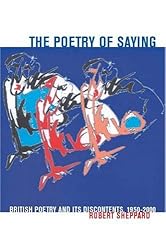
Patricia Farrell's cover image for The Poetry of Saying, which I dubbed 'Otherwise Than Beings'

Wednesday, September 09, 2015

Robert Sheppard: The Poetry of Saying: Technique: The Poetics of Form

This is the first level of analysis associated with the thesis of The Poetry of Saying. A general account (and further links) may be accessed here.

At the level of technique the work of the British Poetry Revival and the Linguistically Innovative Poetry that followed, differs from that of the Movement and its still dominant orthodoxy.The Movement style privileges a poetry of closure, narrative coherence and normative grammatical and syntactic cohesion, which colludes with the processes of naturalization, that is, with the ‘attempt to reduce the strangeness of poetic language and poetic organization by making it intelligible, by translating it into a statement about the non-verbal external world,’ as Veronica Forrest-Thomson puts it. Its poetry becomes an empirical lyricism of discrete moments of experience. Its insistence upon tone, and the speaking voice, strives to maintain the effect of a stable ego, present in the discourse as the validating source of the utterance. The principle of the Movement’s metrical practice, although used with greater laxity through the decades, has largely relied upon the iambic pentameter to level the tone, which both controls, and assists in the maintenance of, a coherent ‘voice’.

                 Postmodernism is a term I use exclusively in Lyotard’s sense of defining a condition, a generalized philosophical worldview, one that is useful to introduce a particular poetics of technique. Knowledge, scientific knowledge in particular, is not so much the result of the recording of empirical investigation but involves a permanent condition of exploratory and incomplete process. Rules are not normative prescriptions but are produced coterminously with the event or process they regulate. Rather than claiming, as has the orthodoxy, that a certain ‘irony’ and cultural melange denote postmodernist poetic practice, Lyotard’s formulation of the now famous resistance to grand narratives also involves a commitment to exploratory techniques that are spelt out precisely in terms of poetics:

A postmodern artist or writer is in the position of a philosopher: the text he writes, the work he produces are not in principle governed by preestablished rules.... Those rules and categories are what the work of art itself is looking for. The artist and the writer, then, are working without rules in order to formulate the rules of what will have been done.’ 

Any activity will be ‘producing not the known, but the unknown’.  In a purely literary sense, this suggests a mode of writing which acknowledges that its only possible condition is one of technical development, a process of working towards new, and initially difficult, meanings, and delaying naturalization. It cannot be the formulation of a product from prior assumptions of meaning. Larkin’s insistence of poetry as empirical reconstruction:
if you’ve seen this sight, felt this feeling, had this vision, and have got to find a combination of words that will preserve it by setting it off in other people

is clearly inadequate.

            This leads directly to the centrality of the notions of discontinuity and indeterminacy as technical elements of poetics, notions which Umberto Eco, writing of certain musical compositions in 1959, recognized were derived from science: ‘indeterminacy as a valid stepping-stone in the cognitive process’ and discontinuity as ‘an essential stage in all scientific verification procedures’. Perception  (Eco also has in mind the phenomenology of Merleau Ponty) is an indeterminate process, both for the writer writing and for the reader reading, to an extent denied by Larkin’s attempted poetic preservation. There is in the work discussed in this study a preference for, an imperative towards, various forms of indeterminacy: structural, syntactic, semantic and metrical; the effects of these difficulties will be to emphasize the activation of the reader so that he or she has to enter into the artwork to complete it.

            Techniques of indeterminacy and discontinuity range from the avoidance of narrative naturalization in Roy Fisher’s The Cut Pages or the referential and perceptual uncertainties of his short lyrics, to the invitation of Lee Harwood’s open syntax and collage structure. The development of collage into what I call techniques of creative linkage (where the linking is more radical) is a central device in the works of Tom Raworth, Allen Fisher, Adrian Clarke and Ulli Freer.

Considerations of metrics reveal the paucity of descriptive terms for new poetic experiments, which demonstrate the inadequacy of the dated term ‘free verse’, particularly in the case of the sound and visual poetry of Bob Cobbing, which is a precursor of the new non-linear poetry found in the radical collage of Maggie O’Sullivan. In both these cases, and in certain later texts of Allen Fisher, the transformation of materials plays upon their instability to produce new meanings. In the case of performance texts their realizations may be unique, different each time they are attempted.

Indeterminacy should not be assumed to imply randomness, but a process of working with contingency in a conscious fashion, even in the procedural and processual works of a writer like Allen Fisher, where a dialogue between choice and chance, a precisely stochastic process, ensures that systems are subject to disruptive interventions by the poet. Clarke’s isoverbalist metrics (counting numbers of words per line, per poem) is an instance of a closed system which is at one level an affront to traditional metrics, but one that is arguably as demanding, a modern constraint rather than a convention authorized by tradition, as the Oulipo movement defines it. At another level it only works as a vehicle for the hinging of phrases in an indeterminate syntactic practice, a practice which is arguably stronger for the tension between its systems.

Instead of proceeding as though the text is self-evidently a transparent communicative system (the orthodoxy occasionally takes this view in violation of its works’ obvious constructedness), these poets foreground the fact of the artificiality of the forms and discourses they employ. In Harwood’s narratives a self-conscious narrator is often presented, while Roy Fisher’s lyrics often make ‘the poem’ a counter in its own argument. Allen Fisher deliberately adopts techniques of ‘process-showing’ in his work. Cobbing’s processual pieces develop out of previous texts. By foregrounding artifice or construction, the poem suspends the inevitable act of naturalization; it can be said additionally to be de-automatizing the reader’s habitual responses, defamiliarizing them, in that deferral.

If the prescriptions of the Russian formalists are followed fully, defamiliarization is the technique which defines literature’s very literariness. However, in its weak from, it is merely used as a descriptive tag, as in the 1980s Movement Orthodoxy’s justification for ludic metaphorization. Too often it is forgotten that, when in the famous definition of the device, Shklovsky said ‘the purpose of art’ is ‘to impart the sensation of things as they are perceived not as they are known’ he was not merely pointing to a freshness of perception, the seeing as though for the first time.  He expounded ‘the technique of art’ as attempting ‘to make objects unfamiliar’, the famous ‘making strange’ of the more colloquial translation of the Russian ostrananie. It is often ignored that to effect an increase in ‘the difficulty and length of perception’ it is necessary not just to admit an estranging ‘content’, but to ‘make forms difficult’. This is not a question of likening a flowerpot to a fez as in a poem by Craig Raine, but of using the variety of formal techniques of indeterminacy and discontinuity, of foregrounding artifice and construction, outlined here.

A poem is an object, but it is also part of the reader’s responses, since he or she must complete it; any reader, in Umberto Eco’s words ‘is bound to supply his own existential credentials’. 8 This is, as the theoreticians of reception aesthetics have noted, an active fact of interpretation in both structurally closed works, and in the kinds of work examined here, such as the playful defamiliarized lyricism of Roy Fisher, for example. However, in other kinds of open works often offered by some writers of the British alternatives, who work in deliberate collusion with this fact, this is crucial. Eco calls artworks with such a radical structural indeterminacy and discontinuity ‘works in movement’ which he characterizes as involving ‘the possibility of numerous different personal interventions.’  Eco defines this limit case of an ‘open work’ as one that is ‘literally “unfinished”: the author seems to hand them to the performer more or less like the components of a construction kit.’  Harwood has at times thought of his work in this way, as leaving textual lacunae for a reader to complete. Yet Clarke’s syntactic play and catachresis also achieve this. Cobbing has indeed presented texts to be realized in performance from a few visual clues.    
Allen Fisher has most fully theorized this in relation to his own poetics. Poetry is at its most pertinent when fresh significations are produced by an active reader. A text is judged on its ability to escape the writer and invigorate the reader’s engagement. It is assumed that this is effected by means of technique: modes of creative linkage are utilized to present a plurivocal text to which a reader brings his or her existential credentials, which are, like the text itself, the results of historical and social processes.
              This emphasis upon the activity of reading brings us back to Forrest-Thomson’s notion of naturalization to focus upon and emend the distinctions she makes between good and bad naturalization. As opposed to reducing ‘the strangeness of poetic language ...  by translating it in to a statement about the non-verbal external world, by making the Artifice appear natural’, a reading practice with which most of the Movement Orthodoxy is complicit, and which she defines as ‘bad’ naturalization, she argues that ‘Good naturalization dwells on the non-meaningful levels of poetic language, such as phonetic and prosodic patterning and spatial organization, and tries to state their relationship to other levels of organization rather than set them aside in an attempt to produce a statement about the world’. Charles Bernstein argues that all levels of poetry, any discernable device, should be regarded as meaningful, but he merely widens the premises of one of the only attempts in the 1970s to develop a poetics of British poetry.  The whole text signifies for the engaged reader, as he or she enters it; ‘Whatever else I may get from a work of art,’ argues Allen Fisher, ‘because its dominant function is aesthetic it requires my engagement to create it, to produce it.’  Its artifice may not be willed away, in all its particularity and, even, in the case of some of the work I will be examining, its peculiarity; its artifice has to be read because no ‘paraphrase’ is accurate or full enough, or, in some cases, possible. Forrest-Thomson’s general account of artifice and naturalization reminds the reader always of the strangeness of technique, that to only read ‘formal features’ as ‘noteworthy components of the poem’ if they ‘can be shown to contribute to a thematic synthesis that is stated in terms of the external world’, is a denial of poetry’ singularity. She quotes Wittgenstein: ‘Do not forget ... that a poem, even though it is composed in the language of information is not used in the language-game of giving information.’

Accounts of the second level may be read here, and the third level here. And a lot that was thought-through here first, turns up in my more recent project The Meaning of Form. See here.

Tuesday, September 01, 2015

Robert Sheppard: The Poetry of Saying: British Poetry and its Discontents 1950-2000; its contents and theory and earlier posts

In The Poetry of Saying (2005), to which I refer across this blog, and also in my new work-in-critical-progress, The Meaning of Form, (particularly in the footnotes I comment on here; but access the whole project here) I argue that Linguistically Innovative Poetry (and that of the British Poetry Revival before it) may be best seen as regards to a tripartite theory, involving three levels: the technical, the social and political, and the ethical. (It is interesting I didn’t say The Formal, though the second is subtitled ‘The Poetics of Form’ .) I shall post on each of these levels separately.
The technical level concerns techniques of indeterminacy and discontinuity, of collage and creative linkage, of poetic artifice and defamiliarization.(Read about this level here.)
The social and political level concerns itself with a reading of the necessary dialogic nature of all utterance, including the kinds of poetry offered here. This will build on the technical devices described, ones which animate the reading process into necessary dialogue. (And this level is dealt with here.)
The ethical level of analysis extends from the first two levels into an understanding of the varieties of openness to the other implied by the techniques and social orientation of the work. (This level may be found described, and the thesis completed, here.)

https://images-na.ssl-images-amazon.com/images/I/512uq-o%2BmfL._UY250_.jpg

See here for contents and original availability. The book is out of print (literally no longer in print) but may be obtained second hand, via Amazon and its associated book-sellers, and electronically from Liverpool University Press, which is the book's future, of course. Start here:

www.liverpool.universitypressscholarship.com

Bits of it are displayed by Google Books (though I'm not sure what I feel about that) and there are some sites offering free downloads of it, but I'm not going to direct you to them.

Amazon link: http://www.amazon.co.uk/Poetry-Saying-Discontents-1950-2000-Liverpool/dp/0853238197 You can definitely buy it secondhand via Amazon's associated booksellers.

Some earlier Pages posts, on the British Poetry Revival and Linguistically Innovative Poetry, were associated with the historical chapters of the book. These are:


On the British Poetry Revival:


http://robertsheppard.blogspot.co.uk/2005/03/robert-sheppard-history-of-other-part.html

http://robertsheppard.blogspot.co.uk/2005/04/robert-sheppard-history-of-other-part.html

http://robertsheppard.blogspot.co.uk/2005/05/robert-sheppard-history-of-other-part.html


http://robertsheppard.blogspot.co.uk/2005/08/robert-sheppard-history-of-other-part.html


Here’s a later post on the British Poetry Revival:

http://robertsheppard.blogspot.co.uk/2014/09/robert-sheppard-return-to-british.html


Here are the posts on Linguistically Innovative Poetry:

http://robertsheppard.blogspot.co.uk/2005/09/robert-sheppard-history-of-other-part.html

http://robertsheppard.blogspot.co.uk/2005/10/robert-sheppard-history-of-other-part.html

http://robertsheppard.blogspot.co.uk/2005/11/robert-sheppard-history-of-other-final.html 

Wednesday, June 10, 2015

Robert Sheppard: The Meaning of Form; the first footnote and the Last Word

These notes bring together the work on form that I am finishing and the thesis of The Poetry of Saying (and work in previous book and articles, and on this blog) in a subterranian thread.

Introduction, footnote one: In Far Language, my adoption of the otherwise historicising term ‘linguistically innovative’ to encapsulate the poetry I studied throughout may be seen in the context of the poetics expressed in ‘Linking the Unlinkable’: 54-55. The Poetry of Saying offers a tripartite model of levels of analysis of the text: the technical, the sociolinguistic and the ethical (the last of which uses Levinas’ distinction between the saying and the said as ethical discrimination within technical and linguistic poetic practice.): 2-19. In those pages I make use of some earlier thoughts of Derek Attridge, which might be thought of as the lynchpin between that book and this. (See chapter 11, footnote 9.) When Bad Times Made for Good Poetry offers lightly theorised historical readings of ‘episodes’ in British poetry which I hope respect both the nature of poetry and poetics, while using Bourdieu’s sociological schema of fields of literary production, to outline a history of British poetry. For poetics, see most episodes of When Bad Times Made for Good Poetry; my Poetics as Conjecture and Provocation: an inaugural lecture delivered on 13 March 2007 at Edge Hill University’, New Writing. Vol 5: 1 (2008): 3-26; and my blogzine Pages (www.robertsheppard.blogspot.com), which carries a serial catalogue of poetics under the title ‘The History of Poetics’, posted August-November 2009. (See links below.)

Chapter 11, the last footnote: See footnote 1 of my ‘Introduction’. In The Poetry of the Saying (2005) the ‘saying’ is contrasted to the ‘said’ as a positive quality of eternal utterance as against the fixity of saidness, not in a simple and judgmental binary, but in the full acknowledgment that a formally investigative poem (though I did not then use that term) would need to concretise its eternality in fixed readings (which could range from the simple need to print a poem in a definitive form through to the sense that interpretation of necessity involves an act of violence to settle a reading long enough to re-articulate it). Reading for form rather neatly works to allow the saying to sound ever on while any particular forming of the text for an occasion is necessarily acknowledged as a provisional realisation, a product of the process, a said. 


The History of Poetics posts: ‘Part One: Poetics and Proto-Poetics’
(http://www.robertsheppard.blogspot.co.uk/2009/06/robert-sheppard-poetics-1-poetics-and.html); ‘Part Two: Through and after Modernism’
(http://www.robertsheppard.blogspot.co.uk/2009/07/robert-sheppard-poetics-2.html;
Part Three: North American Poetics’
(http://www.robertsheppard.blogspot.co.uk/2009/08/robert-sheppard-north-american-poetics.html); ‘Part Four: Some British Poetics’
(http://www.robertsheppard.blogspot.co.uk/2009/08/robert-sheppard-poetics-4-some-british.html)

See the rest of The Meaning of Form project here. I shall be posting chapters from Far Language in the autumn and winter of 2015. See here


For those who can buy The Meaning of Form in Contemporary Innovative Poetry, or order it for libraries, here are the places


Here is some book data:

eBook ISBN
978-3-319-34045-6
DOI
10.1007/978-3-319-34045-6
Hardcover ISBN
978-3-319-34044-9

Friday, May 22, 2015

Robert Sheppard: Bobliography: Make Perhaps This Out Sense of Can You: symposium on Bob Cobbing (set list)

Chelsea College of Arts: Thursday 21 May 2015

Bob Cobbing (1920-2002) was a sound, concrete and visual poet, best known
for his performed works in which language was anarchically stretched through
shouts and hisses, interspersed between more recognisable tracts of spoken
word. He was also a prolific organiser and collaborator: one of the founders of
the London Filmmakers Co-op in the 1960s, manager of Better Books from
1965-7, and his imprint Writers Forum was amongst the first in the UK to
publish works by John Cage and Allen Ginsberg.

Make Perhaps This Out Sense of Can You contextualised Cobbing’s work as
a concrete poet as well as looking at his legacy as an organiser. What was surprising was the number of people there (130), mostly young and mostly none who knew or saw Cobbing. Although there was an emphasis upon Bob as a maker of images and maker of performances, there was less a sense of him as the maker of books (that the work wasn't art or music, but was literary). Paula Claire called Bob's texts 'triggers' rather than 'scores' and this distinction, made the night before, was referrred back to by a number of speakers. But the interest was encouraging. One fellow ex-Writers Forumite commented, 'Who would have thought this would happen?' (I like to think I would have.) It was good to meet academics like Fiona Becket who is coming back to this material, as is the wonderful Stephen Willey, and Rozemin Keshvani (the 'historian' of Better Books; see here), as well as muscians Hugh Metcalfe, whom I have not seen for years, and David Toop, who I met at Phil Davenport's pioneering Cobbing exhibition in Bury in 2005 (see a little-read post on that here), as well as Rosie Cooper and William Cobbing. Tim Fletcher who recorded late Bob; a man called Mark who has interesting plans, and the young man who liked my homage poems to Cobbing and who came to Bob's work through a secondhand LP! 

Robert Sheppard (set list)

I orginally called my piece (which I conceived and delivered as a performance):
We are both: a collage of writings about and for Bob Cobbing: autrebiography,
unwritings, poems, critical articles, stuff.

Then I called it 'Bits and Bobs'. Finally I entitled it BOBLIOGRAPHY.

I read pages, complete, from top to bottom of the prose, but the poems complete:

A: The Poetry of Saying p. 228
B: Far Language p. 61(includes my account of meeting Bob; reprinted here. Here's another account of my first encounter.)
C: poem: 'Codes and Diodes are both Odes':

Invent icicles dripping interference
and discover structural lift
in emergent interchange
opening like a clam – multiply coherent
shoals of desire. Flashes classic Hollywood shot
in erotic slippage exhaustion,
scorched doors for release. Desire
dances in the polyphonic
sentence, means a world, slips through
the signified, refunctioned
in our critical hold: jigsaw
scales, particle syntax admitting
intertexts and music of rhizomatic
diodes. Overlay of systems,
enough revealed delight to design
us all, while
magnetic words twin the
reader swiftly across echo’s edge.


D; from the Introduction to the Veer edition of ABC in Sound (newly published: buy here) p. 1 (a small fragment of it and more information and links here).
E: poem: The Magnetic Letter
F: ABC p. 2
G: Time Out for Words Out of Time Outtake for Bob Cobbing: (from my new book Words Out of Time):
I don’t remember writing to Bob Cobbing. I don’t remember that Bob Cobbing still wore knitted ties. I don’t remember Jeff Nuttall saying, ‘This place is death!’ as we cabbed it through Norwich. I don’t remember that William Empson had wind. Who is the American expert who predicts peace at least until 1985? Can he have guessed that Phil Minton would one day work with Bob Cobbing? Groundhogs ticket in his pocket: Cobbing plays him ‘e’. Exchange employment between time, shadowgraph, black holes. Lol Coxhill watches them perform, back against wall, bald head shining, Hawaiian shirt loose over white trousers, bottle in hand. Looking over the shoulder of the Angel of History.

H: ABC p. 3
I: poem: Verse and Perverse are Both Verses
J: ABC p. 4
K: poem: The Micropathology of the Sign. Which was the introduction to Bob's 'Processual'. Read here.
L: The Poetry of Saying p. 227
M: page from 'The British Poetry Revival', ening mid-sentence...

(The poems are from my first collaboration with Cobbing, Codes and Diodes,1991; our second collaboration, Blatent Blather/Virulent Whoops of 2000-2001, may be read here.) And there's a video of its last outing with me playing myself and Patricia Farrell reading the parts of Cobbing: here.

Bio for the occasion:

Robert Sheppard has just published Words out of Time, his autrebiographies
in which Bob Cobbing's knitted ties and his 'E' poem appear, from Knives
Forks and Spoons. A Selected Poems is due later in the year. Sheppard met
Cobbing in 1973 and has written on his work, collaborated with him, and
attended the Writers Forum workshops up until Cobbing's death. He has
recently supplied an introduction to the new Veer edition of ABC in Sound.

Read more about Cobbing here

Other contributors

Holly Antrum
CATALOGUE2014, film, 20 minutes
Moving our attention between the near and the far, seriousness and humor,
Jennifer Pike (93) recites ‘ABC in Sound’ (1964) by her late husband, Bob
Cobbing.
Fiona Becket
The Poetics of the Machine: the example of Bob Cobbing
Fiona's paper addressed Bob Cobbing’s commitment to the
‘poetics of the machine’, and the relationship between the limitations and possibilities
of the technology in the formation of the text and its performance. , with plans to take
the exhibition to the Chinese University of Hong Kong in 2017.
Karen di Franco
Karen Di Franco is an archivist and a curator, based at CHELSEA space,
Chelsea College of Arts.
Oscar Gaynor
Oscar Gaynor is a writer and artist currently studying Critical Writing in Art &
Design at the Royal College of Art. He reworked a text originally written in response to the Bob Cobbing exhibition staged at Chelsea Space in December 2014, that combines the
experiences and ramifications of working in the archives of the (neo-)avantgarde
with the sound and images pioneered by Cobbing. For the reading, he
was joined by Henrik Heinonen to interpret the text, an artist predominantly
using sound, studying at the Academy of Fine Arts, Helsinki. It was all about worms.
Will Holder
Typographer Will Holder organises writing around cultural objects. Holder is currently developing a protocol and interface for a collectively compiled catalogue of the Bob Cobbing archive. He read conceptual writing drawn from Cobbing's fight with the housing people at the GLC.
Holly Pester
Low Loom Bleep Bleep
A play on sound poetry and poor language expression, in which Holly performatively explored the work of sound poetics in the context of deskwork.
David Toop
David Toop is a musician, author, professor and Chair of Audio Culture and
Improvisation at London College of Communication. He has collaborated with artists ranging from John Latham, Bob Cobbing,Carlyle Reedy and Ivor Cutler to Rie Nakajima, Evan Parker, Max Eastley and Akio Suzuki. He palyed recordings of Abana and Bob.  
Steve Willey
Poetry is not about death, dying only: the Event as a Mechanism of Survival in
the Work of Bob Cobbing. From Six Variations on Typestract One, made for the Destruction in Art
Symposium (1966), to the collaborative version of Chamber Music, produced
for the annual Swedish Text-sound festival in Stockholm (1968), events played an central role in directing and shaping Cobbing's poetic practice.
The symposium was organised by William Cobbing and Rosie Cooper.

William Cobbing
Starting from a sculptural sensibility William Cobbing’s artworks encompass a
diverse range of media, including video, installation and performance. Grandson.
Rosie Cooper
Rosie is Head of Programmes at Liverpool Biennial. She also has an independent curatorial practice, and with William Cobbing, she has co-curated a series of events, displays and publications titled Bob
Jubilé that examines the legacy of Bob Cobbing, through the family archive

The symposium coincided with the Raven Row event Bob Cobbiiiiiiiiing Live, an evening celebrating the work of Bob Cobbing, with highlight performances by Hannah Silva (brilliantly performing along to Bob's HANNAH pages from the ABC) and David Toop (and students) and Paula Claire (the Joyce Grenfell of Experimental Poetry). Hansjorg Mayer spoke, which was incredible. That was the night before. Wednesday 20 May, 6.30pm

Here is an early post on Cobbing's Third ABC and DANS.