Showing posts with label Liverpool. Show all posts

Monday, June 09, 2025

Taking part in The European Poetry Festival : Liverpool July 6th 2025 at Open Eye Gallery

NOTE: Our poem is to be published in Austria soon. For now, here's the running order and some links. All the videos of the whole festival are online now!

European Poetry Festival : Liverpool 

July 6th 2025 at Open Eye Gallery

3pm and Free Entry

19 Mann Island, Liverpool L3 1BP openeye.org.uk

Book your free ticket here! eventbrite.co.uk/e/european-poetry-festival-liverpool-tickets-1254623144599, or: 

European Poetry Festival: Liverpool Tickets, Sun, Jul 6, 2025 at 3:00 PM | Eventbrite

A brilliant afternoon of live poetry including some of the most exciting poets from Austria, Norway, Romania, Scotland and the North West England. What's the format? Pairs of poets present brand new works of live literature, made for the day, and drawing upon the local Liverpudlian poetry scene as well as visiting poets. Supported by the Liverpool Poetry Space programme, this is the last event of the European Poetry Festival for 2025! (Check the other gigs: EPF 2025 — European Poetry Festival. Featuring

Thomas Ballhausen and Robert Sheppard (and we're well underway with our collaboration!)

Lena Chilari and Michael Sutton 

Tom Jenks and SJ Fowler

Endre Ruset and Stephen Sunderland 

Julia Rose Lewis and Alec Newman

Carolyn Hashimoto and Sarah-Clare Conlon 

Lenni Sanders and David Spittle

Sarah Dawson and Andrew Taylor

Another event in partnership with Liverpool Poetry Space. Event curated by SJ Fowler and Chris McCabe. 

SJ Fowler has, of course, presented many collaborative readings, and I have had the pleasure of taking part in many of them. I have collected some of them (they are always videoed and archived online) here on my website: Collaborations - Robert Sheppard. (Scroll to the end.) 

On this blog, also I have featured a number of these events. Two years ago Sarah-Clare Conlon, who is back this year too, and I collaborated on our exploration of the River Mersey. I write about that, present the video, and indicate the text's publication, here, Pages: The Liverpool Camarade at Open Eye Gallery : May 2023: the videos of my collaboration with Sarah-Clare Conlon, and here Pages: UNTITLED by Sarah-Clare Conlon and Robert Sheppard is published in Blackbox Manifold 31.

That was the first Liverpool Camarade since 2015, about which I wrote here: Pages: Liverpool Camarade 2015: general introduction (set list) (robertsheppard.blogspot.com) with videos, of course. I was deep in the writing of what became the collaborative anthology Twitters for a Lark at that time. But now we have real  European writers.

However, this reading in Leeds in February 2017 was one of my favourites. Patricia (Farrell) was on tour and I joined her for this one gig, where I collaborated, quite explosively, with Ian McMillan. Here's an account: Pages: Ian McMillan and Robert Sheppard: Simultaneous Performance: Leeds Enemies (photo, video, set list and thoughts), and here's the video:


Largely featuring S.J. Fowler's passion for 'collaboration', I wrote a critical piece on literary collaborations (‘Doubling Up: Modes of Literary Collaboration in Contemporary British Innovative Poetry’, in Contemporary British and Irish Poetry, ed. by Samuel Rogers (Yearbook of English Studies, 51.1 (2021)), 247–64). But in preparation for it, I assembled a strand of posts on this blog, about collaboration as an art, with asides on my own collaborations, beginning here, with a hubpost: Pages: Robert Sheppard: Thughts on Collaboration 1: Introduction. Not all my collaborations have been literary of course. 

Tuesday, October 01, 2024

Details of Readings this Autumn (set lists and comments)

Readings this Autumn (set lists and comments)

During this autumn I have had, to my delight, six readings to perform, some full readings, others short contributions to larger events. (There were some earlier in the year too, bucking the post-Covid trend of fewer reading opportunities, though two of them were online, as was one earlier this year.) They are all quite different, with different work read, often from different books, or from no books (yet)! Sometimes with, or alongside Patricia Farrell, sometimes not.

As they 'passed', I converted my announcements of them on this post into 'set lists' and commentaries. I must admit it's rather taken up more of my time preparing than I expected, and time away from writing. I'm sure Taylor Swift thought the same about the Eras Tour!  

*

1. Liverpool 24th October 2024: for Liverpool Poetry Space hosted by The Open Eye Gallery (on the dockside). 

I read with Mandy Coe (I don't know how I haven't met her before) and Maria Isakova-Bennett (who I have seen develop as a poet over the the last decade into a fine writer who always keeps the analogy of her visual art practice to the fore). Eleanor Rees was ill, unfortunately. So we had to add an extra 5 minutes to our readings. 

I decided to launch British Standards (the first of two launches) and I read a bunch of Wordsworth 'transpositions', including this one:


. Then my version of Southey's 'Poem on the Slave Trade', which led, the slavery theme continuing, onto my versions of Mary Robinson, a few verses of 'Tabitha and Thunderer' (there was to be more of her at my November 12th London reading, see below); a bunch of John Clare; and the final final poem of the book, 'After Shelley' as I called it, slightly shortening its title.  

This seemed to go down well. Lots of laughter I was informed by some friends in the sizeable audience. However, the set was designed for sudden swings of mood, so that we were suddenly thinking about slavery or Covid deaths amid the capering of Bo, as the hubris of Brexit hit the mismanagement of public health during the Pandemic.  


2. London: Friday, 25th October 2024 

The Cock Tavern, 23 Phoenix Rd, London NW1


Friday night, it was great to see so many old friends and comrades of our London days, all still thrusting and vital. Here's a brief itinerary of the evening, mainly launches. 


Part One


Bob Cobbing/Robert SheppardCollaborations (Veer/Writers Forum): performed by Patricia Farrell and me. We read 'Blatent Blather/Virulent Whoops', my 2001 collaboration with Cobbing. Thanks to Patricia for all the rehearsing and hoarse throats!  


Karen MacCormackQuaquaversal (Veer): a fascinating unwriting of an earlier text into non-existent words, which were then discovered (mostly) to mean something in other languages. 

Steve McCafferyAlice through the Working Class (Blazevox) (What a great title!) A wonderful or outwonderlandish version of Alice.

Break


Ulli FreerTransition Pulse (Veer): Ulli pulsed this way through this new text, somewhat bucolic in places, excellent as ever.


Adrian ClarkeWalhalla (Veer): a few sequences from this excellent new book, plus a new sequence inspired by Bob Cobbing's decaying photocopier, now in Hugh Metcalfe's garden! This was in part an introduction to another 2 books relaunched that evening: Bob Cobbingthe five vowels & Third ABC in Sound (Veer/Writers Forum), two of his major works back in print. Get on the Veer website and find all these books (and more): Veer Books. (I wrote about the 'Third ABC' some 19 years ago on these pages: here: Pages: Robert Sheppard: Bob Cobbing: Two Sequences )

Although my Collaborations with Bob Cobbing was published by Veer in 2021, there wasn’t a launch (Covid, again) of this splendid box of pamphlets, reprints of Codes and Diodes and Blatent Blather/Virulent Whoops from 1991 and 2001, respectively. On the box: Pages: COLLABORATIONS (Bob Cobbing - Robert Sheppard) published in a box by Veer - out now. There is an earlier performance on video here (somewhere in this Cobbing tribute: OR 35 | Bob Cobbing: a celebration | Videos | 


Here's a very short video of me demonstrating how the 'box' of Collaborations is constituted. (The new Third ABC of Sound is similarly in a box.)  

Saturday morning, bag pretty heavy with all the new Veer publications, Patricia and I walked to the Wallace Collection. They have 3 portraits of Mary Robinson:


Romney, Reynolds and Gainsborough (the latter a huge canvas). This was connected to my editing of her work in Mary Robinson Selected Poems and my transposing of it in British Standards. Other specialities: a wonderful Poussin, two Rembrandts, some Boningtons, and an Icelandic drinking horn! Back to Euston... Liverpool ... home.

3. Wednesday November 6th: 7.30. An ONLINE reading from Aquifer Books

I read one part of my finely-designed Aquifer volume, Doubly Stolen Fire, introducing 'Malcolm Lowry's Land' with these words: ‘My book, Doubly Stolen Fire, which I’m so pleased Lyndon has published, is an exploration of various modes of authorship: actual and fictional. The last part, though, collects my contributions to the Liverpool celebrations of the Merseyside born author of Under the Volcano, Malcolm Lowry, [like this one 2024: Pages: The Lowry Lounge 2024 - an account and links] and I’m going to read most of one of these. It tracks a 1979 notebook which itself tracks my visit to Lowry’s grave in Sussex. [Holds it up]. It mimics Lowry’s own writerly methods as it re-narrates the notes for a long-abandoned poem.’

Details of the whole book: Pages: Reviews of my book DOUBLY STOLEN FIRE (robertsheppard.blogspot.com)

This Zoom reading was of new and forthcoming collections by Sarah Crewe, Mélisande Fitzsimons, Allen Fisher as well as myself. More info at: Glasfryn Project. It was good to hear the other readers, and I had Sarah's book to hand, to follow her reading. 


4. London 12th November 2024: 7.30: A Shearsman launch of 4 new Shearsman books. 

This reading took place at the Swedenborg Hall, 20/21 Bloomsbury Way, London WC1A 2TH, hosted by Tony Frazer, publisher of Shearsman Books. The building has a painting of the religious sage painted by P. Louthenburg (the subject of one of Mary Robinson's finer earlier poems, and the designer of 'light shows' from when she was an actor). I noticed too late to tell the audience!

I read from British Standards but pointed to The Necessity of Poetics AND to my edition of the Selected Poems of Mary Robinson.

My notes and set list

I’m very greedy – but very grateful (to Tony) for Shearsman publishing three books this year. I will only read from one of them, but I’ll sketch links between them. The Necessity of Poetics, which collects various works on, of, about and around ‘poetics’ as a speculative and anticipatory writerly discourse, also contains a treatise on poetic rhythm, an inaugural lecture, notes on the meaning of form, and some ancient documents which stretch back to the 1980s and 90s, but it comes up to date with a couple of pieces on the poetics of the book I will be reading from, British Standards.

British Standards, book three of ‘The English Strain’ project, was completed in September 2022. Brexit was originally the continuing theme of the project, but in early 2020 the Pandemic intervened to alter its trajectory, although the government's enthusiasm for the former contributed to its tardiness in the face of the latter, as celebratory hubris collided with the failure of Johnson’s government (he’s called Bo in my poems) to take sensible public health measures. Formally speaking, these are transpositions of sonnets of the Romantic period (Wordsworth, Keats and Shelley, but also Mary Robinson and Hartley Coleridge, and others, as you’ll hear), and I’m paying faithless homage to it.

I read three 'Wordsworth' poems. This one below (shown here from the pages of Shearsman magazine), and on video.


Then 'O Friend I know not which way I must look'. (See the other video above for a reading of it.) Followed by 'Vanguard of Liberty, Ye Men of Kent.' 

Then a shift to Robert Southey and his 'Poem on the Slave Trade'.

After that, I said (more or less): 

The third book launching today is my edition of the poems of Mary Robinson, which might seem a surprising departure for me, until it’s realised that I first came to her work through writing a transposition of her 1796 sonnet sequence ‘Sappho and Phaon’, an extraordinary work that (even at the time) was read as analogical of her relationship with Banastre Tarleton, Liverpool slaver referenced in the street name of the previous poem. I call them Tabitha and Thunderer, but Thunderer seems to become Boris Johnson at several points. Mary called herself ‘The English Sappho’ on occasions. My sequence is a corona, 14 sonnets, with a volta at which I’ll pause, to change the hapless narrative, to allow her, in Brexit-speak, to ‘take back control’. Sappho is hetereosexual in Ovid’s version of her life that Mary followed, though she has a troupe of women following her: they become the weather girls, registry girls and Mamas of this poem, written just after the first lockdown, summer 2020. Here is a video of me reading one of the sonnet-verses, the one which refers to Mary-Tabitha-Sappho having read Coleridge's 'Kubla Khan' long before it was published.


I finished with one of the 'final' final poems to the book: 'After Shelley, After Sheppard, which I wrote about when I wrote it, here: Pages: Robert Sheppard: A final final poem for British Standards! With pictures of some of the poem's weird contents.


Details of all three books: Pages: British Standards published by Shearsman - out now (robertsheppard.blogspot.com) and Pages: Selecting for a Selected: The Poems of Mary Robinson 1 (robertsheppard.blogspot.com).

Details of two of the books: Pages: British Standards and The Necessity of Poetics published simultaneously (robertsheppard.blogspot.com)


I was reading with Elaine Randell, which was very exciting. I'm never ceased to be moved by her accounts of working with children, AND by her affective lyricism. She was launching her Collected Poems

It was good to see some old friends, including those not associated with the poetry world.

5. Patricia and I had a very small part in From the Grooves of Vinyl at the Bluecoat on Saturday 16th November 2024 (Nobody said, but 15th November was Phil's birthday!)

As a tribute to Philip Jeck who died in 2022, the Bluecoat presented an evening of film and performance in celebration of the life and work of this remarkable composer and artist who wrought exquisite sounds from the worn grooves of old records. [I'm quoting the copy for the evening, and amending it.] An internationally renowned pioneer of experimental ‘turntablism’, he brought old record players and vinyl together with electronic effects to create expansive sonic landscapes.

Throughout his career Philip worked with dance and theatre makers, visual artists and musicians and composers across the musical spectrum and toured internationally. He was also a lover of poetry (he came to a lot of the readings I organised or gave.) Over three decades, his work was released and promoted by the experimental electronic music label, Touch.

Philip also had a long association with the Bluecoat and this special tribute included a screening of an excellent film by Gina Czarnecki of him performing in the intimate surroundings of a friend’s kitchen. (This was fascinating, not least of all because I was there, and have my own memories of that performance.)

There was also the launch of a double CD tribute to Philip collated by Touch, and performances from experimental composers Chandra Shukla (US), excellent sitar and electronics work, Benjamin Duvall and Andrew Hunt (Liverpool), who (Ben told me) have a complete album of work improvised with Phil in preparation. (They are half of the band Ex-Easter Island Head. Poets Patricia Farrell and Robert Sheppard briefly read (although Patricia ‘appeared’ via tape). The bar was open till 11pm, with a disco-banger DJ set from Bryan Biggs (and then off with Bryan to the Grapes for a last two).

Click here for further information on Touch, its work with Philip and his releases.

This was a moving evening, particularly when Bryan and Mary Prestidge introduced the event, and later, when Jon Wozencroft and Mike Harding from Touch introduced the new album (which I have bought and am much looking forward to). The music was inspiring, whether on film, tape or live. 

Patricia’s poem was written especially for the event, and was untitled.

I introduced my piece, ‘Spectres of Breath’ with something like these words:

‘I’m going to read a text I wrote for Phil’s birthday in 2012. It comes out of a conversation we had about writing about music, music journalism in particular. About that time I was subscribing to The Wire – and I was particularly taken by the short reviews which tried to describe the nature and quality of certain musics in very few words. Partly mimicking this facility, possibly purloining the odd phrase here and there, and condensing descriptions and coining the odd neologism, I proceeded to compose a compilation album in words. It is not – even in the passage that mentions ‘styluses scraped’ – an attempt to describe Phil’s own music. After all it is a ‘compilation’, though the imaginary musicians of this imagined music are unnamed. As we reach side B (how could this not be a vinyl record?) the descriptions become more synaesthetic, relating to more senses than sound. I’m not being entirely serious, which is fitting since Phil was the funniest man I’ve ever known, as well as a musical genius.’

It seemed to go down well, particularly with the two guys from Touch, for whom such language is a constant torture! The poem may be read here, after my memoir of Philip: Pages: Philip Jeck 2022. When I said ‘genius’ (Bryan also used the word) I mean ‘genius’. 

6: 2nd December : Online Reading by Paul Robert Mullen with Guests:


a landmark celebration of Paul Robert Mullen’s work as we launch it’s all come down to this, a powerful retrospective spanning 25 years of poetry and prose from one of contemporary and independent literature’s most distinctive voices. This special online event will bring together readers, writers, and fans for an unforgettable evening of live readings, conversation, and community.

Hosted by: Alan Parry, Editor-in-Chief, The Broken Spine

  • Readings by Paul Robert Mullen: Experience selected works from it’s all come down to this as Paul takes us through his journey from 1999 to 2024, offering insights and reflections on his evolution as a poet. This he did through short poems and a long extract from a long poem 'Vinyl Redux'. 
  • Open Mic with Special Guests: specially invited readers offered an intimate chance to hear voices that resonate with Paul’s own approach to life and poetry. In my case, I decided (as I did when I last read 'with' Paul, pre-Covid, see here: Pages: Robert Sheppard: The Broken Spine reading, Southport (set list)) to read poems about music (possibly amassing towards a collection), and (I'm certain) influenced by his 'Vinyl Redux'. I read a few sections from 'Tone Poem: Starlight and Stardust', the sections relating to recent albums by Fred Hirsch, James Brandon Lewis, Brad Mehldau, Donny McCaslin, Shakti, and Miho Hazama's m_unit.    

A fine ending to a mini-tour!

Locating Robert Sheppard: email: robertsheppard39@gmail.com; website: www.robertsheppard.weebly.com NEW, note: follow me on Bluesky not on X , at https://bsky.app/profile/robertsheppard.bsky.social

Saturday, February 03, 2024

My Verse Novel ELLE is excerpted in Shuddhashar 37: Surrealist Poetry edition

I am pleased to say that guest editor David Spittle has selected some work of mine for the special ‘Surrealist’ edition of the Bangladeshi magazine Shuddhashar. Or is it called FreeVoice - one word, like that?


Explore this issue, number 37 in full: Surrealist Poetry. Or follow the links below.  
  

It is a long time since I’ve thought about surrealism, but then again it isn’t. By that, I mean that, although I haven’t pronounced on the subject much, it’s never gone away. (Not quite true either, see Poetics, Robert Sheppard (lincolnreview.org) In any case, it came back with a mighty thud, when I started to write Elle. 

Anyway, the first four chapters of Elle may be read HERE: Elle:  a verse novel

The whole is due for publication by Broken Sleep in November 2025.

Other contributors include a brief description of their allegiance/connection to surrealism and I thought that my ‘introduction’ to my excerpt (it’s a long excerpt) which I’d sent would suffice (it is a long introduction!). It’s not there on the magazine. In fact, it is the intended ‘afterward’ of the verse-novel. Here’s a shortened version of it:

Sharp gas lips under her flesh suddenly white in the hallway 

Watching the early films of Jeff Keen, see Jeff Keen aka Dr Gaz | Jeff Keen. I noted the repeated appearance of what I thought of as ‘the pink auto’; I had read somewhere that this Pontiac Parisienne belonged to a nightclub owner in Brighton in the UK. Keen continued to use footage of this automobile throughout the 1960s, though I think he only borrowed its gangsterish gleam for an afternoon’s shoot, to make the 11-minute black and white silent 8 mm film Breakout (1962). (This isn’t it, but is a useful sample of Keen's approach:

Jeff Keen: Instant Cinema (1962/2007) - YouTube

 )The incongruity of seeing this mammoth American car on film squeezing past the familiar Clock Tower in Brighton (my local South Coast city as I remember it vaguely from the early 1960s) was most impressive, if uncanny. It was not until I read Richard Davenport Hines’ An English Affair (2013), about the nefarious goings-on of cabinet minister John Profumo, that I linked the car, which was mentioned in passing, and the films of Jeff Keen, which I knew, with a precursor scandal of the Profumo debacle, and its Brighton setting. It was a sordid story concerning a Conservative MP and washing machine importer, John Bloom, and Christine Holford, the wife of the nightclub and Pontiac owner. The result was that, in 1963, a jealous and taunted Harvey Holford murdered Christine Holford, spitefully shooting her in the genitals. The subsequent trial and the minimal sentence Holford received – before an all-male jury – leaves a bad taste in any aesthetic appetite that desires to utilise this material.

But I did want to utilise this material and I did want to make the link to the extraordinary films made by Jeff Keen, who I met on a couple of occasions, even visiting his Brighton flat with Lee Harwood; I remember a column – no other word for it, it reached the high ceiling – of Marvel comics, which he used as raw material in his later Blatz! movies. I felt that my raw material would have to include Keen’s work, the car, its murderous owner, his victim wife, as well as a favourite and iconic film of the era, Luis Buñuel’s Belle de Jour (1967), presented here in visual summary, as it were:


Belle de Jour - official rerelease trailer (youtube.com)
https://www.youtube.com/watch?v=dnYA6mj9hDU

Notably, this surrealist masterpiece of the sixties is based upon realist pulp from 1928: Buñuel hated Joseph Kessel’s moralistic and misogynist novel of that title, in which a woman is condemned for her secret sexual desires (as was Christine Holford with her more public affairs and flirtations). The film is not a parody or pastiche of its model; it’s perversely faithful to its twisted but conventional morality. The novel was perfect material for post-surrealist transformation. In 1969, an English translation by Geoffrey Wagner from 1962 was rushed into a second paperback edition with a picture of a simpering Catherine Deneuve on the cover, a 75p charity shop purchase.  

Uncertain how I would approach and proceed with these materials, I decided to work on my copy of the novel with an analogous disrespect to that shown by Buñuel: I treated Belle de Jour using the technique I have always called ‘Tom Phillipsing’, finding new linguistic content in this old novel, as Phillips had with A Human Monument, as he transformed it into the bubble texts of The Humument (ignoring for a moment the brilliant visual side of the work!). There is something of gentle gathering, enclosing, about the method, which is absent from the tearing violations of the superficially similar cut-up technique. Both are versions of collage, or montage, of course. 'Here's the book, and here's the method,' as I say on this 5 second video!  

At some point during this slow process (one page Tom Phillipsed a day, 140 pages), I watched Daniel Farson’s British ATV television programme Living for Kicks (1960) which partly took as its theme the teenage clientele of the Whiskey a Go-Go milk bar (such pre-Clockwork Orange innocence!) near The Clock Tower in Brighton. It was available for a short while on You Tube, but is no longer!

I already knew that this establishment was part of the entertainment complex run by Harvey Holford: upstairs lay the more exclusive Blue Gardenia and Calypso clubs (where alcohol was served). Farson’s documentary (the old Soho soak feigns shock at teenagers snogging and disdaining marriage) features an intelligent and knowing interview with a proto-Beat poet called Royston Ellis, whose name was familiar to me, but not from my knowledge of British underground poetry of the 1960s, which I’d foolishly thought comprehensive. In fact, the name was literally floating before me in Ye Cracke pub where, after lockdown, I regularly met a group of Liverpool friends (the informal 1955 Committee). On the mirror under which we often sat is an engraved commemoration of a joint poetry-music gig by Royston Ellis and John Lennon in Liverpool in 1960. [Note November 20205: I write more about Ellis here: Pages: More on the British Poetry Revival, Royston Ellis, and news of a forthcoming book, from a more academic point of view and with more information than I had when I posted this post.] 

One afternoon I suddenly noticed the memorial to this performance, seen above. (It's disputed whether Ellis is the 'Paperback Writer' of the song, but he did write books on pre-Beatles music.) Something was happening here, I felt, to speed this project along; I conceived of superimposing the shadowy Brighton reality upon my distorted version of Buñuel’s Ur-text. Both narratives involve a jealous murderer. I replaced Kessel’s names, Buñuel’s dramatis personae, with the names of the participants in the Brighton tragedy: acquaintances and lovers of the fatal couple (Thatcher, Hatcher, Bloom, Cresteef), and employees and habitués of the night clubs (Corvell and Bubbles and Squeak), with the addition of the artist figures Jeff Keen and Royston Ellis, and a few necessary others. (Not all of them appear in this first extract, of course.) ‘Elle’ was the Tom Phillipsed ‘Belle’ persona of Kessel’s anti-heroine, the titular haunting (but who is ‘she’?). I transposed place names from Paris to Brighton without irony. The text passed through many stages of transformation (‘states’ an engraver might have called them), both mechanical – I made use of the ‘dictate’ and ‘read as’ functions on my laptop – and deliberative: my choices were quite conscious, though guided by procedure. The process was my old friend, the stochastic. Then I revised the text in an intuitive way, unrecognisable in this latest (and perhaps not yet completed) form on Shuddhashar

I did not want to repeat the grim and ghastly scenarios that documentary sources had laid before me; (e.g www.pulpinternational.com/pulp/entry/Cover-of-the-National-Insider-with-Harvey-and-Christine-Holford.html)

I sought to introduce the main actors into a drama not quite theirs, and not quite mine, either. I wished to liberate them, albeit imaginatively, from history. I like to think that Keen and Ellis become the positive creative energies to transform this loathsome narrative towards different endings – or none. Those transformations are not just a matter of form, but of a forming of its matters, its matters of fact, and its matters of fiction.

The turn to the ‘verse-novel’, however ironical, reflects yet another, late, act of transformation, the sudden switch to ‘verse’, a term I seldom use…

So back to today. Just as Bunuel hated Kessel’s work I think I disapprove of the ‘verse-novel' – and, like Bunuel using Kessel, that’s just why I’ve 'written' one. I was somewhat relieved, when I witnessed Jen Calleja reading Vehicle: a verse novel to discover that it wasn’t, in fact, a ‘verse-novel’. (I did enjoy, though, Bernadine Evaristo’s The Emperor’s Babe, so maybe it’s the idea of the verse-novel that trips me up; I don’t like the term ‘prose-poetry’ either, but I'm a big fan of Ian Seed!).

Here’s a full list of the articles/poems/prose/images in this wonderful edition, with links to each: 

1.Note from Guest Editor Note from Guest Editor
2.Simon Perril 
Sun  Deck  Set  Cogitation
3.Lisa Samuels 
lodge in the zing of
4.Ali Graham 
My appetite wears metallic facepaint
5.James Byrne 
Apparitions
6.Geraldine Monk 
Let fly the unquiet tongue
7.Will Alexander 
The Sand Genie
8.Aase Berg 
Monday in the Mariana Trench
9.Tom Jenks 
Broccoli and chunky relish
10.Julia Rose Lewis 
through and through and through and through
11.Harry Man 
The Airborne Gooseberry Boy
12.Sascha Akther 
Anatomy of a Car Crash
13.Robert Sheppard: from 
Elle:  a verse novel
14.SJ Fowler The Parts of the Body that Stink
15.Lila Matsumoto 
the saws and hammers
16.Aaron Kent 
It is the most natural thing in the world to leave
17.David Spittle  
from HALLUCIGENIA
18.Stephen Sunderland 
Notes for a Revolution
19.James Knight 
Disappearing Subject
20.Joseph Turrnt 
In the fifteenth year I bought you crystals
21.Vik Shirley 
https://shuddhashar.com/hmm-sweetie/
22.W.N. Herbert 
A Dream of Vending Machines
23.David Spittle 
Seeing the Unseen: The Occult and Surrealism

Thanks to David and thanks to all at Shuddhashar. Shuddhashar is an exiled Bangladeshi publishing house with this magazine, and is currently based in Norway. Shuddhashar received the 2016 Jeri Laber International Freedom to Publish Award, given to publishers outside the United States who demonstrate courage despite restrictions on freedom of expression. They are brave people indeed, if you follow their publishing history, which is really a testament to their activism.  

*

Locating Robert Sheppard: books: Pages: Robert Sheppard: seeing what's in print and what's not!; email: robertsheppard39@gmail.com; website: www.robertsheppard.weebly.com Follow on Twitter (or X): Robert Sheppard (@microbius) / Twitter ; latest blogpost: www.robertsheppard.blogspot.com

Wednesday, August 23, 2023

The Poems of Mary Robinson 7: anti-slavery poems and Slavery Remembrance Day

Here’s a hubpost to all of those I’m posting now on my Selected Poems of Mary Robinson: Pages: Selecting for a Selected: The Poems of Mary Robinson 1 (robertsheppard.blogspot.com) 

The Selected Poems of Mary Robinson is now out from Shearsman – edited by me!

Publisher’s details HERE: Mary Robinson - Selected Poems (shearsman.com) 

The publisher's sample of the book may be read here: mary-robinson-selected-poems-sampler.pdf (cdn-website.com)

*

About a month ago I paid a visit to the Slavery Museum in Liverpool, as I explain in my email below. I thought I’d post it online, since it outlines ways in which Mary Robinson is travestied, even now. The contemporary scandal and the Victorian revulsion at it never quite rubbed off this remarkable woman. And I thought I’d post it today because it is Slavery Remembrance Day. Here’s what’s on today at the Museum : Slavery Remembrance Day 2023 | National Museums Liverpool (liverpoolmuseums.org.uk) And here’s what’s happening in London: Slavery Remembrance Day 2023 | National Maritime Museum (rmg.co.uk) .I haven’t received a reply to my email (yet). They probably think I’m a nutter. (They must get hate mail: a racist group protested outside the Museum last week, with a nice big banner saying ‘White Lives Matter’.) In some schools in the US the 'benefits' of slavery are being taught.

Dear Sir or Madam

(Please forward this email to a curator, please.)

I very much enjoyed my visit to the Slavery Museum yesterday afternoon, distantly some research for a poem I’m writing about blues music. [This is called 'Searching the Desert for the Blues', and I am currently revising it; there's a passage below.] I am also editing the poems of Mary Robinson, and so was interested in your feature on her Liverpool lover, Banastre Tarleton, an enthusiastic pro-slaver, right up to his death on the eve of abolition.

I’m glad he’s there, and I’m glad the feature reports his war career (today he would be classed as a war criminal). However, I was dismayed to see the unsubstantiated claim that he seduced Mary Robinson as a bet, and also that it referred to her by her nickname ‘Perdita’ (the part she played in a version of The Winter’s Tale which attracted the attention of the Prince of Wales, which led to their affair). Never have I seen the locution ‘Perdita Robinson’ (not even in the Gilray cartoons of the time). In fact, Mary was an abolitionist (later she was friends with William Godwin and other radicals). She also wrote about slavery in her poem ‘The Negro Girl’ and in her long political protest poem ‘The Progress of Liberty’. I intend to include both texts in my volume of her poems, and I attach my life of Robinson, [ that's also available here: Pages: Selecting for a Selected: The Poems of Mary Robinson 2: The Life of Mary Robinson (robertsheppard.blogspot.com)and the texts for your perusal. If such information was added to the display, the complexities, ironies and contradictions of the pro- and anti- slavery positions would be more apparent. In your account, Mary appears as a pawn in Tarleton’s roguery, but in fact their relationship was long-lasting, and Mary was just as able to seduce him.

Yours faithfully

Robert Sheppard

Emeritus Professor of Poetry and Poetics

Edge Hill University


Here's an excerpt from 'The Progress of Liberty': 


Shall the poor AFRICAN, the passive slave,

Born in the bland effulgence of broad day,

Cherish’d by torrid splendours, while around

The plains prolific teem with honey’d stores

Of Afric’s burning soil; shall such a wretch

Sink prematurely to a grave obscure,

No tear to grace his ashes? Or suspire,

To wear submission’s long and goading chain,

To drink the tear, that down his swarthy cheek

Flows fast, to moisten his toil-fever’d lip,

Parch’d by the noontide blaze? Shall he endure

The frequent lash, the agonizing scourge,

The day of labour, and the night of pain;

Expose his naked limbs to burning gales;

Faint in the sun, and wither in the storm;

Traverse hot sands, imbibe the morbid breeze,

Wing’d with contagion, while his blister’d feet,

Scorch’d by the vertical and raging beam,

Pour the swift life-stream? Shall his frenzied eyes,

Oh! worst of mortal miseries! Behold

The darling of his soul, his sable love,

Selected from the trembling, timid throng

By the wan tyrant, whose licentious touch

Seals the dark fiat of the slave’s despair!


And here's a fragment of what I wrote after visiting the museum, from my poem about the blues:

…localities on maps, familiar names on a manifest, a portrait or two in postures of Attic tranquility, pro-saccarites on porcelain sugar bowls, sketches of woolybacks unloading Confederate bales, proclaim the guilty-elect of this city, no step now without a blue note to trip us…


Mary by Reynolds: looking like she knows how she'll be treated by history. Talking of 'treated', I have bought a novel about Robinson, which I've speed-read. It's by Freda Lightfoot and it is entitled Lady of Passion. Despite the title, it's historically accurate (which in a weird way is disappointing). There are three very good modern biographies, as well as Mary's own Memoirs. Listed in the bibliography that appends my life (see the link above). 


*

Locating Robert Sheppard: email: robertsheppard39@gmail.com  website: www.robertsheppard.weebly.com Follow on Twitter: Robert Sheppard (@microbius) / Twitter  latest blogpost: www.robertsheppard.blogspot.com


Sunday, July 03, 2022

Refractive Pool Exhibition at the Walker Gallery (and my text from Micro Event Space)

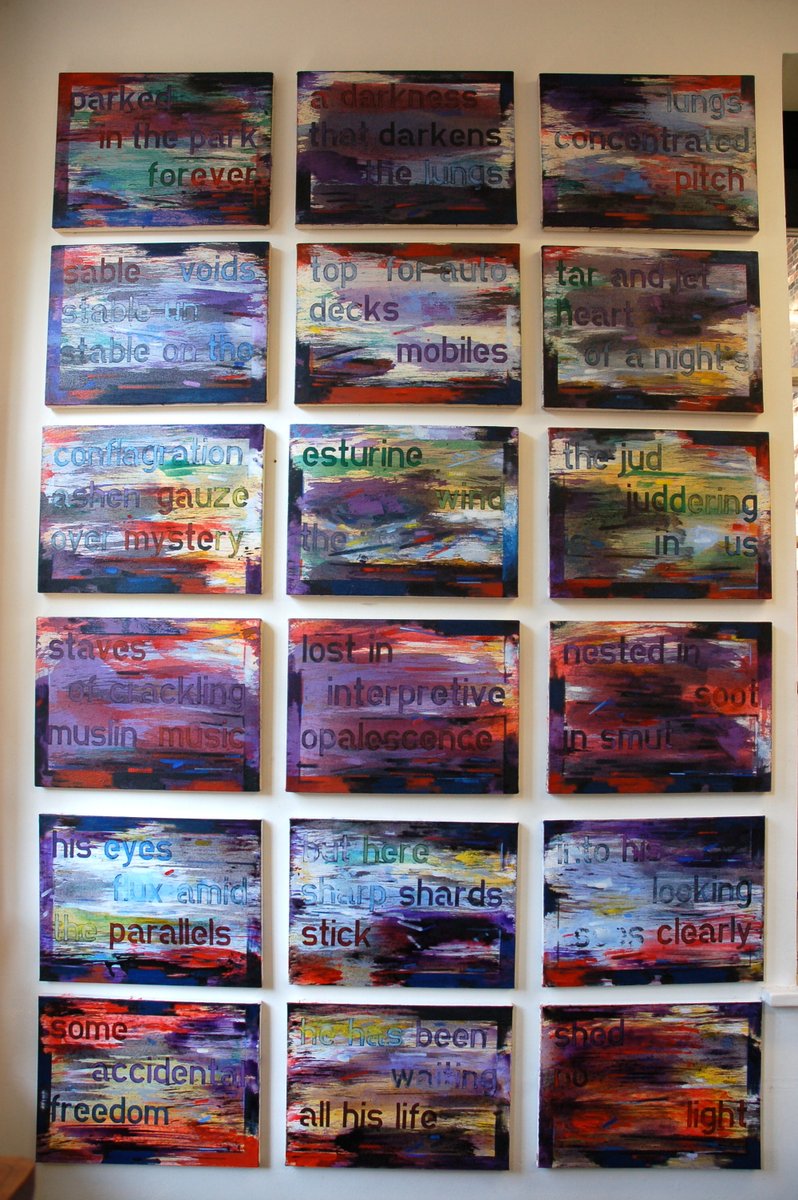
 I was blogging about my upcoming reading on Saturday the 9th (see updates to my last post), relieved that my radiotherapy won't begin until after that date, and I lost all sense of time. We had to rush to the Walker Gallery to see the current painting exhibition (again), Refractive Pool. This time to hear David Jacques’ excellent talk on his work, all monstrous pipes and evil oil, and intimidatingly huge. Pete Clarke was there, as was Mary Prestige, and as was Louis Jeck Prestidge, another contributor. Pete confirmed that some of the words on his four paintings, four versions of one ‘deconstructivating’ building are mine (unacknowledged). Here's an earlier piece of his using that poem, 'Arena Area':


Here are two sections that I recognised. (Famously, I arrived one day at Pete's house to face a painting upon which that I failed to recognise my own words!)

1


parked in the park forever


a darkness that darkens the lungs

concentrated pitch


8


shed


no

light


          blistered skin where windows

never blink


See here for this poem, as it appears in other paintings by Pete, and in my Red Ceilings publication Micro Event Space. https://robertsheppard.blogspot.com/2019/07/robert-sheppard-micro-event-space.html. Pete also provided the front cover image:

 There’s more about Pete here: Pages: Pete Clarke's new catalogue and our on-going collaborations (robertsheppard.blogspot.com) and here:

https://robertsheppard.blogspot.com/2021/12/pete-clarkes-new-catalogue-and-our-on.html

Refractive Pool is a project that was established by Josie Jenkins and Brendan Lyons to document and celebrate contemporary painting in Liverpool. The exhibition, features a number of painters I know: Pete Clarke, David Jacques, Louis Prestidge Jeck, and Bernadette O’Toole, (who I met up with to discuss Mallarme, in what seems another world, pre-Covid). Even being in an exhibition space seems strangely fresh. Another return trip will enable me to concentrate on those many others. Rather splendidly, the exhibition is on until January 2023.

Details: 

https://www.liverpoolmuseums.org.uk/refractivepool

 Here are two videos about the exhibition (and about the book, deliberately not a catalogue, accompanying it, with a painterly poem by Paul Farley). The first is a sweep across the images; the second has the curators talking about the exhibition and painting in Liverpool.