Showing posts with label Sophie Poppmeier. Show all posts

Friday, May 31, 2024

On a passage of Lutz Seiler and a lift from Billy Mills

I find the contemporary German lyric poet Lutz Seiler puts the matter better than I could:

'Everyone has only one song,’ said the writer Paul Bowles in one of his last interviews. (He was also a musician.) You recognise the song by its sound. The sound forms in the instrument we ourselves have become over time. Before every poem comes the story we have lived. The poem catches the sound of it. Rather than narrating the story, it narrates its sound. More than anything, ‘Everyone has only one song’ means that everyone has a song, and ‘only one’ means it’s their own song. The search for it can take a long time. Years of eavesdropping on the melodies of others – good to listen in to, but is it your own particular song? You could say: the poem is something that, of necessity, asserts itself through the life of its author, it is his song, his faith in an ‘absolute rhythm’ that is his own personal rhythm.

Lutz Seiler 2023: 97 

Seiler, Lutz. trans. Martyn Crucefix. In Case of Loss. Sheffield, London, New York: And Other Stories, 2023. Lutz Seiler | And Other Stories


I have been thinking a lot about this quotation from Lutz Seiler’s excellent new book of poetics, memoir and an odd kind of creative literary criticism (I mean he writes about other poets’ work from the point of view of a fellow-creative practitioner.) I’ve liked his work a long time, and read his work in translation by Tony Frazer. I hid my admiration behind the supposed admiration of my fictional poet Sophie Poppmeier! Indeed, she wrote a poem for him, that I dedicated to Tony Frazer. (It is in Twitters for a Lark but also here online: Robert Sheppard - A Festschrift for Tony Frazer (weebly.com)). What I think of this passage is that it strikes me with the power of truth, such that I am going to use it to structure my introduction to the work of Paul Robert Mullen that I am writing (see here for more on him: Meet The Author – A Deep Dive with Paul Robert Mullen – Animal Heart Press). It fits well with Paul’s development, and (I think) many other lyric poets. I can even mime the piece by appending parenthetically ‘(He is also a musician)’ at some point, but that’s not the big point. The problem is, however useful it might be for describing other poets’ works, I don’t think it applies to me! My invention of Sophie Poppmeier almost proves that. But nevertheless, it speaks to me. You will see that I’ve cut it off before I quote his explanation of ‘absolute rhythm’: it is, of course, a lift from Ezra Pound’s imagist manifesto, and sends us back to that area and era. I do use that a little in my ‘treatise on metre’, ‘Pulse’, that will be published in August in my The Necessity of Poetics volume, but that’s another avenue.

Coming back to the passage, the central statement for me is that ‘Rather than narrating the story, it [the poetry] narrates its sound.’ I DO like that sense of the debunking of narrative, or rather its displacement from the oxymoronic ‘narration of the story’ to the metaphoric ‘narration of the song’ of the story, the sound of the story. ‘Song’ suggests a condensing of the ‘story’ (again an echo of Pound, just where I’d prefer it not to appear), a shorter, purer music distilled from the narrative (we imagine a novel or autobiography at this point, I think, representing what such a ‘narrative’ could be, but remember Seiler tells us we’re still narrating a song!).

Perhaps what slightly unnerves me is the nearness the argument has to all that stuff about ‘finding one’s voice’, when I’ve preferred to think of ‘losing one’s voice’, or losing one voice to become the plural (voices) that we all are. Even Seiler has to remind himself (and us) that ‘“Everyone has only one song” means that everyone has a song, and ‘only one’ means it’s their own song,’ to interpret the Paul Bowles away from the implication that there’s only one song per person (I think of those blues singers that seemed to literally only have one song). Seiler doesn’t mean that – and I doubt that Bowles meant that too, otherwise we’d all be writing the same poem over and over. (I also recognise the distanciated truth of that sometimes, but that’s about another problem: obsession, forgetfulness, the need to say something again.) No, Seiler asserts: it’s our own song. As long as that’s not about developing a USP or a gimmick (eg ‘Let’s wear space suits when we perform,’ like the completely-forgotten band the Sputniks! Where did that story come from after all these years? The story of my life, of course, the only one I might only narrate the song of, without it ever being a ‘song of myself’, but ‘from myself’).

Before I start repeating myself, as they say, ‘my self’ as I often say, I must conclude that this passage by Seiler is rich with implication, much of it useful (particularly to my critical task in hand), but it has some unintended consequences that Seiler himself recognises. I also doubt it can be applied (un-detourned, unadorned) to my work, or perhaps only to my works that may be described as lyric. Looking for quotes for the back of my other upcoming volume British Standards I came upon this by Billy Mills about the preceding 2 books of the ‘English Strain’ project:

There is some inevitable tension between Sheppard the ‘avant-garde’ linguistically innovative poet and Sheppard the apparently insatiable sonneteer, a tension that he addresses head on in Sonnet XLII of the ‘Idea’ sequence:


Some like my multiform methods,

and commend my social poetics.

Some say I’m a funny old translator,

‘expanded’ like a supersized codpiece.

Some that I excel in explicit vitality….


Reading this sends the diligent reader back to these lines from one of the ‘original’ sonnets near the beginning of The English Strain, in a poem addressed to the memory of Lee Harwood:


I searched everywhere for your letter

that I know says something like You’ve

got a special language for poetry,

Robert, and I haven’t. I didn’t find it [it’s worth adding, I still haven’t!]
but I’m trying to lose that language now.

For me, this attempt to lose his ‘special language’ through the ‘strange ventriloquism’ of versioning is perhaps the most interesting part of these two books. When the politics pales, as politics always will in the end, we are left with some wonderful patterns of sound. Take, for example, the first four lines of the Drayton version just quoted: [I've just found this cheeky video of 'The Michael Drayton Companion' made at the time I had just published the book.]


Some say I’m a funny old translator,

‘expanded’ like a supersized codpiece.

Some that I excel in explicit vitality.

But others call this strange ventriloquism…

Other readers may place the stresses differently, in an attempt to force the lines to match the rhythm of an iambic metronome, but I’m taken with the idea of a kind of mad ballad metre being imposed on the sonnet form. More interestingly, the patterns of assonance and consonance that Sheppard weaves here, primarily the sibilant alliteration and the predominance of short vowels in stressed positions, with an exception for that vital ‘strange’ marks a kind of departure for Sheppard, a move away from his ‘special language’ towards something of a new departure. (The whole is on his excellent ‘Elliptical Movements’, permanently linked to in my ‘blogroll’ to the right of this post!)

That’s probably a long way from where this post started, and the Mills quotation came in during the process of writing this piece. Ah! there’s another issue: finding the song in the process of narrating the song, and maybe there are a thousand ways to make the connection with the narrative of one’s life. Connection within that (welcome) ‘tension’ Billy identifies, and that potential ‘new departure’ he detects. Always a question for poetics. (Here’s my most recent: MY OWN CRISIS:  https://www.futchpress.info/post/my-own-crisis, and my comments on that: Pages: My poetics piece 'My Own Crisis' is published by Futch (robertsheppard.blogspot.com).

31 May 2024


Update: Paul's book is now published; details here, with my now complete introduction:  

https://thebrokenspine.co.uk/product/itsallcomedowntothismullen/

it's all come down to this: a retrospective [selected poems & writings 1999-2024] - Paul Robert Mullen –


Sunday, July 02, 2023

Circle of the City published now on Osmosis/New book coming soon

I’m pleased to announce a couple of related things before I have a little summer break from blogging (and Twitter). One is the publication of a poem (today) and the other is the publication of a book (later).

The poem has been mentioned before on the blog, because it relates to the celebrations of the life, times and writings of Malcolm Lowry that are held every year in Liverpool. Indeed, it relates to this post about the 2021 celebration, here:  Pages: The Lowry Lounge 2021, Bluecoat, Liverpool (and my poem 'Circle of the City: following in the steps of Chapter Five') (robertsheppard.blogspot.com). On that you will find references to my poem ‘Circle of the City’, which I read in the Open Malc (ouch!) section and which I also describe in my book (more of that later!) thus:

This poem is a series of interrupted haiku written (or drafted) while following the walk taken by sailor-revolutionary Sigbjørn and his shipowner father as described (in both senses of the word) by Lowry in his unfinished novel, written in the mid-1930s, In Ballast to the White Sea (ed. P.A. McCarthy, Ottawa: University of Ottawa Press, 2014). Their Liverpool walk starts (and ends) at Exchange Flags and skirts the docks, the shopping centre, and rests at a cinema to view a Russian revolutionary film. They discuss politics generally and, more personally, their culpabilities in the deaths of others. Like Lowry, I take in the messages of the urban environment I pass through: street signs, adverts, t-shirt slogans. There are, oddly, both in Lowry’s chapter and my poem, references to Melville’s Redburn (1849). The Liverpool guidebook Redburn carried was 50 years out of date. My ‘guidebook’ was Lowry’s novel itself, Bodega and cinema both long gone. The poem was first performed at the 2021 Lowry Lounge, Saturday 30 October 2021, The Bluecoat, Liverpool [as described in the link above].

I am now pleased to say this is published today on the 'Featured Writing' section of the Osmosis website HERE:

 Robert Sheppard: Circle of the City: following in the steps of Chapter Five – OSMOSIS PRESS

 Thanks to all at Osmosis for selecting this. They publish 'Featured Writing' every Sunday, and books, of course, every now and then (as a press). Check them out: OSMOSIS PRESS – where writing shifts and spills across boundaries


[Updatde: the book was launched at the 2023 Lounge: Pages: Launch of Doubly Stolen Fire at the Lowry Lounge 2023, Liverpool (set list) (robertsheppard.blogspot.com) and may be purchase via this link.]

The post above to the Lowry Lounge 2021 also presents links to some previous years’ meetings. Of course, that won’t let you link with the 2022 meeting, about which I had some thoughts here: Pages: The 2022 Lowry Lounge - a few thoughts (robertsheppard.blogspot.com). The 2023 meeting is in preparation: 28 October. A date for local diaries.


The poem is the final piece in my hybrid book
Doubly Stolen Fire, which is subtitled ‘authorship imaginary and real’ and will be published by Aquifer Press, which is run by Lyndon Davies. The second half of the book is indeed about real authorship, since it contains my writings on Lowry, a handful of poems including today’s, and my prose piece ‘Malcolm Lowry’s Land’, which is a psychogeographical exploration of walking to Lowry’s grave in 1979, imaginatively re-tracing my textual steps 30 years later (it's a sort of 'reading through' of a poem I never published). 

The first book of the fictional poetry project, A Translated Man.

The first half of Doubly Stolen Fire is about imaginary authors and is, in essence, the third part of my imaginary authors project. Read about the published first two books of it here: EUOIAEuropean Union of Imaginary Authors (EUOIA) - Home (weebly.com)

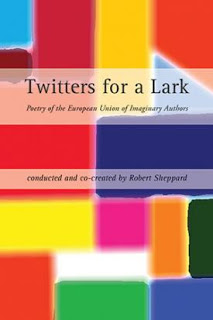
The second book of the fictional poetry project, Twitters for a Lark.


A long piece in Doubly Stolen Fire is culled from the lockdown diary of Sophie Poppmeier, my imaginary Austrian poet, who appears in each part. 
Pages: Reflections on Fictional Poetry and Fictional Poets (1 and hubpost for the sequence) (robertsheppard.blogspot.com) BUT I also consider the Ern Malley Hoax, Pages: Robert Sheppard: My essay on Ern Malley and Fictional Poets appears in International Timesa famous talking visitor to the Isle of Man (not Lowry), a talking mannequin (of course) and a couple of other people who have lifted themselves into fiction. The writing weaves and matches and mixes hybrid modes: memoir, essay, creative non-fiction, fiction, fictional poems, psychogeographical derives, jokes and poetics. Oh, and a lot of footnotes!


Keep checking this blog for updates. And read my poem online as a taster (though there is no sample of the book that could be thought ‘typical’).  Nearly there! Here's me holding the proof copy:


*

Locating Robert Sheppard: email: robertsheppard39@gmail.com  website: www.robertsheppard.weebly.com Follow on Twitter: Robert Sheppard (@microbius) / Twitter  latest blogpost: www.robertsheppard.blogspot.com

Thursday, March 03, 2022

Reflections on Fictional Poetry and Fictional Poets (part 6 - the final part)

 [This is the last post in this sequence. The rest may be accessed from here: Pages: Reflections on Fictional Poetry and Fictional Poets (1 and hubpost for the sequence) (robertsheppard.blogspot.com) What is noticeable is the change in world politics in the time I posted these extracts. They were pre-posted before Russia violated Ukraine, and I'll repeat it again: Sophie Poppmeier refers to her dirty burlesque performance called 'Pegging Putin', performed by her Angela Merkin persona, using her uniformed mannequin (see below) as a prop. Imagine her now performing in blue and yellow. See here: Pages: A Fictional Poet's Notebook (part 3) (robertsheppard.blogspot.com)

Some of these posts have been incorporated into a prose chapter of my 2023 book, Doubly Stolen Fire, which you may read about, and purchase, here: Pages: Doubly Stolen Fire (a new book of hybrid texts) is now OUT (robertsheppard.blogspot.com)

Now back to the last post:]

If Van Valckenborch (who has a whole page here: Rene Van Valckenborch - European Union of Imaginary Authors (EUOIA) (weebly.com) were to re-appear, he would have a legitimate complaint, against those readers, and me, who encourage thinking only about the fictional poets’ biographies (see last post), when what he would want to say (and A Translated Man exemplifies this to an extent) is that he would like his poems to be read as poems. There is no reason to suspect the poets of the EUOIA and EUGE, or even Different Lines, would disagree. Whatever their ontological status, and even as they supposedly divide into two bodies of work, along Belgium’s linguistic lines, his poems can be read in relative autonomy to the fiction in which they are deployed (one which includes the deceptions of fictional editor and fictional translators).


One of the translators, Annemie Dupuis, conducts a vain search for Van Valckenborch, a man they have never met, which she records in a diary reproduced at the end of A Translated Man. In it she expresses what might be the enduring equivocation of the project. On 12 August 2010 she dreams that she is in a foreign court (but also dreams that she is in a dream). ‘I’m accused of people-trafficking,’ she admits, but only slowly realises why. ‘I have made up a fictional national poet – his name at least – by combining the forename and surname with the most diacritics in the language, the least vowels.’ This is also the name of a criminal, ‘an unshaven giant’ who is present in court. ‘I realise the improbability of my alibi,’ such as it is, and it is beyond her professional skills to plead her case: ‘The interpreter squints at me, lost’. ‘I hear my name mispronounced by the judge in his frayed crimson gown. I am nudged to my feet. He looks through me,’ we are told, but instead of receiving a sentence for trafficking, she lists a roll-call of EUOIA poets, beginning with Sophie Poppmeier. It could be an admission of previous offences, but it also opens my project towards books two and, now, part three. She dismisses herself from her crime and its possible punishment by waking up. I read this now as an allegory concerning the ethics of fictional poet-making. As Erwin Wertheim once asked: ‘One voice torn into two./ Or two sewn into one?’ (All the poets of the EUOIA are listed (with videos) here: The Poets - European Union of Imaginary Authors (EUOIA) (weebly.com))   


His French investigation of the world of things, his Flemish exploration of space, to pick two consciously constructed poetics, are both serious and genuine, if not real. He would plead – as he cannot – to be read as a poet with two poetics. (Read Eric Canderlinck’s introduction to A Translated Man here.) I would plead for these fictional poems to be read as real poems. Commentators are very good on my framing fictions, but tend not to take the poems seriously. They are!

 As Van Valckenborch says, in an unpublished note, ‘On the one (French) hand, a vectoral poetics, “timely” as well as “thingly”, in rolling and tumbling unpunctuated tercets. Metrics as breakage. Language is not the horizon of thought; enigmatic things are. On the other (Flemish) hand, geography investigated in forms that use spatial devices on the page. Levels of attention to human interaction through slowing down the method and means of representation. A retardational ethics.’ (Again, his page is invaluable should you find any value in him at all: Rene Van Valckenborch - European Union of Imaginary Authors (EUOIA) (weebly.com))

 It is part of my understanding of poetics (if not his) that the poems may do any other number of things of which I might (he might) be unaware. This occurs at the moment when the act-event of the writing is filtered through the acts-events of actual and various readings. Rather than propagating, diffusing or dissipating new fictional poets, I want to direct readers back to the stark challenge of my existing fictional poems, authored and co-authored. Tbey are enough. No more are needed. The circus animals are indeed deserting.

You may wonder whether you may ever allow fictional poets to exist enough to really read them, so that the poems come alive. The first readers of Ossian or Ern Malley (See here: Pages: Ern Malley 1918-1943: Celebrating the centenary in his place of birth Liverpool (set list) (robertsheppard.blogspot.com) would have told you that you can. They feel so alive that they may not be picked out of the fabric of disbelief, even after irrevocable proof. These readers think only this of their authors, and of their works: If they had not been invented, they would have to exist.

For Sophie Poppmeier’s lockdown journal, begin here:  https://robertsheppard.blogspot.com/2021/10/a-fictional-poets-notebook-entry.html

A related piece begins here: Pages: One Off Episode: Transient Global Amnesia and the Fictional Poetry Project (EUOIA and all that) (robertsheppard.blogspot.com)

All these entries may be thought of as the working notes towards the third book of my fictional poets project, after A Translated Man and Twitters for a Lark, which has its own website, EUOIAEuropean Union of Imaginary Authors (EUOIA) - Home (weebly.com) ; this contains a page about Poppmeier too: Sophie Poppmeier (1981-) Austria - European Union of Imaginary Authors (EUOIA) (weebly.com) ) I have no idea whether this will appear in print as a third book, but I'm working on that assumption.

Books one and two are described here: Pages: Celebrate Belgium’s Independence Day with European Union of Imaginary Authors poet Paul Coppens and with Rene Van Valckenborch (robertsheppard.blogspot.com).

 These six posts (actually outtakes of a longer work called ‘Vestigial Gestures’, with text and footnotes combined) are now finished and we hope you found them of interest. They push my thinking ahead, and makes way and waves for the proposed third volume of fictional poet(ries), Doubly Stolen Fire, which will not be a collection of fictional poets, but meditations upon authorship, imaginary and real. You have read excerpts from the ‘imaginary’ half. The ‘real’ authorship will concern Malcolm Lowry and his writings. 


[Actually, there is a further post, written after these: Pages: A further thought on fictional poetry and imaginary authors (robertsheppard.blogspot.com) 26th March 2022.

Wednesday, March 02, 2022

Reflections on Fictional Poetry and Fictional Poets part 5

 [A hubpost for this sequence may be accessed here: Pages: Reflections on Fictional Poetry and Fictional Poets (1 and hubpost for the sequence) (robertsheppard.blogspot.com) Some of these posts have been incorporated into a prose chapter of my 2023 book, Doubly Stolen Fire, which you may read about, and purchase, here: Pages: Doubly Stolen Fire (a new book of hybrid texts) is now OUT (robertsheppard.blogspot.com)]

 In the third 'book' of my ‘Fictional poet’ project, in which these sentences are intended to appear, I prefer to work by meta-commentary, and mainly in prose. I prefer to explore authorship in vestigial gestures, by temptation rather than through fulfilment.     

This means that Sophie Poppmeier may confidently return to her Book Five or Six or Seven – and proceed where we may not follow her, into the accomplishment of her fictional future, beyond the potentiality she clearly displays, a potentiality built upon incommensurable mathematics, unlike that of the EUGE, with its eternal addition. (See her page on the EUOIA site for full details of her biography:  Sophie Poppmeier (1981-) Austria - European Union of Imaginary Authors (EUOIA) (weebly.com)

René Van Valckenborch threatens to return (he used to say so on his Twitter feed) but, even though he would have more to say, he has nothing new to enact or transact. Neither would fictional contributor James Johnston, if I were to pursue Different Lines: he is too obviously twinned (as anti-self) with Donald Davie in New Lines. But isn’t Davie partly his own anti-self, turning from the Movement into wider perspectives by the 1960s, until he’s writing on Charles Olson? And Tristram Garner, marking Thom Gunn like an opposite number in a football team, would have to tackle the brilliance of late Gunn, friend of Robert Duncan. Not so Perceval Lynam, of course, who must now carry the burden of the ‘Different Lines’ confection, in the singular poem of that title, which I have written; it overdubs one of Philip Larkin’s prize contributions to New Lines and it is more than enough work for me. (I don’t address my sheer exhaustion with this kind of work in these posts, but it’s there – and real). Hasn’t David Malcolm proved that New Lines is a more variable anthology than its detractors make out? It is, though the existence and persistence of ‘the Movement Orthodoxy’ – however attenuated today – is more important than the anthology itself, which, as Malcolm points out, never went into a second edition. (Malcolm 2021: 213-221: in the critical volume described here: Pages: My two pieces (British Poetry Revival & Harwood) & editorial exhibit in CONTEMPORARY BRITISH AND IRISH POETRY, 1960 – 2015 Edited by Görtschacher and Malcolm (robertsheppard.blogspot.com) )

What looks like a confession of failure is in fact a measure of qualified success. Whether it is a few lines, a single poem, or a whole book, the textual spoors of a fictional poet or imaginary author, will of necessity prove incomplete, twitching with the electricity of unfinish that I would wish for my other writings, as it happens. In any case, such poems are ‘held in place less by literary history’, such as that of the British poetry that I have investigated elsewhere, ‘than by one of the categories that the logical world keeps in supply’, hypothetical entities that are at once unfinished and infinite. (Gerald Bruns 2005: 105-6) In this sense, New Lines will never be as various as Different Lines, though Different Lines will never actually disrupt literary history. Nevertheless, we may turn from fictional poems, refreshed by our contact with them, brief or sustained, throbbing with possibility.

Fictional poets, on the other hand, have a habit of haunting the imagination, as skeletal bibliography expands into fleshly biography. Heroes or villains, their names stand as cyphers for their fragmented (or even merely hypothecated) bodies of work, as well as suggesting the work (or leisure) of actual bodies (and minds): hints of Van Valckenborch’s uncertain domicile in Belgian towns and cities ‘Ghent, where I have never lived’ he protests too much), my imaginings about Poppmeier’s traumatic lockdown in Berlin, even my account of Ern Malley’s spoof natality in Liverpool (which is related in an unpublished essay). Even Elaine Jackson, the single female poet of Different Lines, we feel, must have a backstory, if only the thumbnail of an anthology’s biographical note: ‘Jackson lives in Cambridge, an Anglican nun and landscape gardener.’ (Or ‘Jackson lives in Bradford, a Buddhist herbalist and magistrate.’) This is why the biog note Tom Jenks and I concocted for our fictional Luxembourgish poet Georg Bleinstein is long – longer than other such notes, longer than his single poem in Twitters for a Lark – and why it projects into the future, until 2086, in fact, long after his death. An overkill of a biography, it may be read online here:  Pages: Luxembourg’s Georg Bleinstein says Don't leave the EUOIA (robertsheppard.blogspot.com)

(The fictional poetry of the future is just slightly less possible to write or imagine than the alternative historical poetry of Different Lines; others have attempted it, I know, usually with a science fiction frame.)

We cling to such details, however improbable (‘Jackson now lives in Southwick, a cryptocurrency influencer and militant single-use plastics advocate, and performs as Nasty Nancy in a dirty burlesque troupe based in Steyning’) in the hope it brings us closer to the poet, who we imagine like the crispest figures of our favourite novels, even as we know that such things should not influence us.

For Sophie Poppmeier’s lockdown journal, begin here:  https://robertsheppard.blogspot.com/2021/10/a-fictional-poets-notebook-entry.html

A related piece begins here: Pages: One Off Episode: Transient Global Amnesia and the Fictional Poetry Project (EUOIA and all that) (robertsheppard.blogspot.com)

All these entries may be thought of as the working notes towards the third book of my fictional poets project, after A Translated Man and Twitters for a Lark, which has its own website, EUOIAEuropean Union of Imaginary Authors (EUOIA) - Home (weebly.com) ; this contains a page about Poppmeier too: Sophie Poppmeier (1981-) Austria - European Union of Imaginary Authors (EUOIA) (weebly.com) ) I have no idea whether this will appear in print as a third book, but I'm working on that assumption.

Books one and two are described here: Pages: Celebrate Belgium’s Independence Day with European Union of Imaginary Authors poet Paul Coppens and with Rene Van Valckenborch (robertsheppard.blogspot.com).


Monday, February 28, 2022

Reflections on Fictional Poetry and Fictional Poets part 3

 [A hubpost for this sequence may be accessed here: Pages: Reflections on Fictional Poetry and Fictional Poets (1 and hubpost for the sequence) (robertsheppard.blogspot.com) Some of these posts have been incorporated into a prose chapter of my 2023 book, Doubly Stolen Fire, which you may read about, and purchase, here: Pages: Doubly Stolen Fire (a new book of hybrid texts) is now OUT (robertsheppard.blogspot.com)] 

The third volume of the fictional poet project, as I am assembling it (see links below to other parts, and to the hubpost for this sequence, above) offers glimpses of writers, both hoaxing and hexing, and of impossible and improbable oeuvres. (Poppmeier appears in all three parts, indeed is the link between them, importantly. Here’s another link about her: Pages: Sophie Poppmeier says Don't Leave the EUOIA (robertsheppard.blogspot.com) )

In her perceptive essay, ‘European Fictions’, Zoë Skoulding describes A Translated Man and Twitters for a Lark as ‘the first two of [Sheppard’s] planned trilogy by fictional poets’. (Skoulding 2019: 176, in The Robert Sheppard Companion: see here: Pages: The launch of The Robert Sheppard Companion (set list)) This was news to me when I read it. It must have been something I said! In any case, it had been Zoë’s insistence that we develop one of René Van Valchenborch’s own fictional poets, Cyprus’s Gurkan Arnavut (for an ‘Enemies’ collaborative reading in March 2012) that had kickstarted the processes of conducting and composing the second book, so there is some justice in this. (All the poets of the EUOIA are listed (with videos) here: The Poets - European Union of Imaginary Authors (EUOIA) (weebly.com))  Here’s Zoe reading our collaboration at that event:


 She warns, ‘The use of heteronyms is often a high-risk enterprise, breaking the conventions of authorial guarantee and shifting the habitual grounds of reading.’ (Skoulding 2019: 176) Indeed, announced on a poster (see below) as Van Valckenborch himself, I performed (uneasily) at the North Wales International Festival in 2013, see here: Pages: Reflections on A Translated Man (set list) (robertsheppard.blogspot.com) but not everyone was amused: ‘an audience member took exception to the perceived colonialism of a project that would invent poets of other languages’, and Skoulding notes that ‘heteronymic play does not replace the need to attend to perspectives that are offered by translation’, though in this third part of the trilogy, as I piece it together (and then take it apart for posting on this blog) I am largely bypassing the ethics of translation, but not ethics itself. (Skoulding 2019: 180) Skoulding, after a complex investigation of both books, concludes that their ‘poems ... are speculative, conjectural unsettlings of identity that resist damaging simplification. They imagine unknowable viewpoints and explore imagined frames of reference, but they also lay claim to a shared European vision that has shifted, since the first poems were written, towards something that can less easily be taken for granted’ after Brexit (a subject that is confronted in the translational poems of my other trilogy, ‘The English Strain’, in which I largely offer intralingual transpositions of traditional English sonnets). (Skoulding 2019: 188) (See here: Pages: Transpositions of Hartley Coleridge: the end of British Standards (and of The English Strain project) (robertsheppard.blogspot.com)


For Sophie Poppmeier’s lockdown journal, begin here:  https://robertsheppard.blogspot.com/2021/10/a-fictional-poets-notebook-entry.html

A related piece begins here: Pages: One Off Episode: Transient Global Amnesia and the Fictional Poetry Project (EUOIA and all that) (robertsheppard.blogspot.com)

All these entries may be thought of as the working notes towards the third book of my fictional poets project, after A Translated Man and Twitters for a Lark, which has its own website, EUOIAEuropean Union of Imaginary Authors (EUOIA) - Home (weebly.com) ; this contains a page about Poppmeier too: Sophie Poppmeier (1981-) Austria - European Union of Imaginary Authors (EUOIA) (weebly.com) ) I have no idea whether this will appear in print as a third book, but I'm working on that assumption.

Books one and two are described here: Pages: Celebrate Belgium’s Independence Day with European Union of Imaginary Authors poet Paul Coppens and with Rene Van Valckenborch (robertsheppard.blogspot.com)


Sunday, February 27, 2022

Reflections on Fictional Poetry and Fictional Poets part 2

 [A hubpost for this sequence may be accessed here: Pages: Reflections on Fictional Poetry and Fictional Poets (1 and hubpost for the sequence) (robertsheppard.blogspot.com) Some of these posts have been incorporated into a prose chapter of my 2023 book, Doubly Stolen Fire, which you may read about, and purchase, here: Pages: Doubly Stolen Fire (a new book of hybrid texts) is now OUT (robertsheppard.blogspot.com)]

Different Lines (the fictional anthology) is a chimera and will remain so, the invisible mirror of the Movement’s New Lines. It shall never be written, beyond its sample title poem. Its poets – Elaine Jackson, Joshua Henderson, Perceval Lynam even (he has one poem written for him, by me!), Tristram Garner, Keith Ashville, M.C. Evans, James Johnston, Rupert Collyer, and Manxman Reginald Killip – remain spectres of its hauntology.


Its single review – the one ‘produced’ by ‘Shexit’ Sheppard – also remains unfinished, beyond its opening volley: ‘Rather than review this anthology,’ Archibald Pratt is supposed to have opined, writing in The Witness in early 1956, ‘I propose to walk it up and down, as one would an intoxicated stranger, but I will refrain from taking it home with me, to impose upon wife and servant.’ The title of the anthology is an own goal: Pratt surely would have called his riposte ‘Indifferent Lines’! Rather than form its content (as I thought I might) I propose to set it free, like a mythical beast, a phantom or rumour of implication. Or like Prospero, releasing Ariel, drowning his books. If that isn’t a far-fetched analogy.

Of course, something (or somebody) inside me wants to write such poems: all 78 prospective contributions to Different Lines, (imagine!) as well as Sophie Poppmeier’s innumerable new poems, but I need motivated impetus to propel me, or compel me. A Translated Man already traces the complexities of an author function – René Van Valckenborch’s – haunting its own bibliography. Rene Van Valckenborch - European Union of Imaginary Authors (EUOIA) (weebly.com) Twitters for a Lark expands on that, through literary collaboration, across a continent, into multiple biographies. (See here: European Union of Imaginary Authors (EUOIA) - Home (weebly.com) All the poets of the EUOIA are listed (with videos) here: The Poets - European Union of Imaginary Authors (EUOIA) (weebly.com))   

)


In my essay, ‘Doubling Up: Modes of Literary Collaboration in Contemporary British Innovative Poetry’, composed after completing Twitters for a Lark, I define the activity: ‘Literary collaboration is the co-creation of a literary work or works by two (or more) writers by whatever method.’ More importantly, I wonder if ‘the possibility that a writer’s most important work might be that which is produced collaboratively may be seriously entertained.’ (Sheppard 2021: 247) While privately reflecting on my own experience of making fictional poet translations with a dozen or more other writers, I remark of others' collaborations: ‘One of the frequent traits of this kind of to and fro-ing coauthorship is what we might call diversive responsiveness,’ (Sheppard 2021: 250) and I conclude: ‘Collaboration … produces a double entity that the single author could not have produced by other means… It is something we experience as growth.’ (Sheppard 2021: 264) See  Pages: My piece on 'Collaboration' is published in The Yearbook of English Studies 2021 (robertsheppard.blogspot.com)

and the ‘Collaborations’ posts out of which the essay emerged: I assembled 14 posts (with links to one review on Stride and another on Litter related to it). You can find all that here:

  https://robertsheppard.blogspot.com/2020/01/robert-sheppard-thughts-on.html

For Sophie Poppmeier’s lockdown journal, begin here:  https://robertsheppard.blogspot.com/2021/10/a-fictional-poets-notebook-entry.html

 A related piece begins here: Pages: One Off Episode: Transient Global Amnesia and the Fictional Poetry Project (EUOIA and all that) (robertsheppard.blogspot.com)

 All these entries may be thought of as the working notes towards the third book of my fictional poets project, after A Translated Man and Twitters for a Lark, which has its own website, EUOIAEuropean Union of Imaginary Authors (EUOIA) - Home (weebly.com) ; this contains a page about Poppmeier too: Sophie Poppmeier (1981-) Austria - European Union of Imaginary Authors (EUOIA) (weebly.com) ) I have no idea whether this will appear in print as a third book, but I'm working on that assumption.

Books one and two are described here: Pages: Celebrate Belgium’s Independence Day with European Union of Imaginary Authors poet Paul Coppens and with Rene Van Valckenborch (robertsheppard.blogspot.com).


Saturday, February 26, 2022

Reflections on Fictional Poetry and Fictional Poets (1 and hubpost for the sequence)

Some of these posts have been incorporated into a prose chapter of my 2023 book, Doubly Stolen Fire, which you may read about, and purchase, here: Pages: Doubly Stolen Fire (a new book of hybrid texts) is now OUT (robertsheppard.blogspot.com)


*


It seems a different world, doesn’t it, in which my piece of fictional dirty burlesque performed by the fictional poet Sophie Poppmeier called ‘Pegging Putin’ could be thought of as quite funny. And it was funny, but its resonances seem a little unreadable now, as the Russians invade Ukraine. For Sophie Poppmeier’s lockdown journal, to which this piece refers, and of which it is a sequel, and to which this new sequence of posts is a sequel, read here :  https://robertsheppard.blogspot.com/2021/10/a-fictional-poets-notebook-entry.html


A related ‘transient’ piece begins here: Pages: One Off Episode: Transient Global Amnesia and the Fictional Poetry Project (EUOIA and all that) (robertsheppard.blogspot.com)

 Now you are ready to move on.

*

This story (as largely told in the serial posts of Sophie Poppmeier’s journal; see link above) bifurcated as soon as she sold Danny/i. (Again, you can read about Danny/i via the links below: it was a poeticising mannequin dressed in Russian military uniform. Again, that seemed quite funny at the time it was written.) It was collected by a collector of such remains. 

a.      In England, Jason Argleton concocted his fiction. During a house clearance, he explained, to whom isn’t entirely clear, the manuscript Different Lines, that strange re-write of the canonical Movement anthology New Lines, was discovered in the loft of an elderly English teacher on the Isle of Man. It fortuitously found its way to Jason (and to his mentor, that’s some version of me) in Liverpool, who realised its value. Only they knew this bevvy of English poets was fictional, and their poems are fictional too, so fictional that they need not exist (the poems, that is). There was no need for them to have been written. But there they are, attempting to re-write literary history. A temporal-spatial transposition, to which is added Sheppard’s single ‘lead’, a hostile review of Different Lines, purporting to come from a reputable journal of the time. (Of course, that’s only a fiction too, but you’ll have to wait to read the wee fragment of it that exists.) 

b.     ‘In Berlin,’ Sophie Poppmeier wrote in the last entry to her lockdown diary, ‘my silence proved temporary, once Danny/i had gone. I sat brooding no longer over the file of scribbles, Book Five, or the inviting empty notebook, Book Six. I may yet cross the threshold of lyricism into something beyond. : Sophie Poppmeier (1981-) Austria - European Union of Imaginary Authors (EUOIA) (weebly.com) Even if the post-Covid world (and Jason too, judging by his silence) had no use for me, I deserved a projected future, as did every creature emerging from lockdown with a vaccine pulsing in the muscles. I would come into my own, by coming out of my own.’


See the next instalment for an update. As usual, this post will become a hubpost for this sequence.

Part two: Pages: Reflections on Fictional Poetry and Fictional Poets part 2 (robertsheppard.blogspot.com)

Part three: on the political pitfalls of fictional poetry: Pages: Reflections on Fictional Poetry and Fictional Poets part 3 (robertsheppard.blogspot.com)

Part four: on cultural appropriation: Pages: Reflections on Fictional Poetry and Fictional Poets part 4 (robertsheppard.blogspot.com)

Part five: on the distinction between fictional poets and fictional poems: Pages: Reflections on Fictional Poetry and Fictional Poets part 5 (robertsheppard.blogspot.com) 

Part six (final post): on my first fictional poet, Rene Van Valckenborch; some reminders and lessons: Pages: Reflections on Fictional Poetry and Fictional Poets (part 6 - the final part) (robertsheppard.blogspot.com)

A further section was written after posting the six parts above, and may be read here: Pages: A further thought on fictional poetry and imaginary authors (robertsheppard.blogspot.com)

All these entries may be thought of as the working notes towards the third book of my fictional poets project, after A Translated Man and Twitters for a Lark, which has its own website, EUOIAEuropean Union of Imaginary Authors (EUOIA) - Home (weebly.com) ; this contains a page about Poppmeier tooSophie Poppmeier (1981-) Austria - European Union of Imaginary Authors (EUOIA) (weebly.com) ) I have no idea whether this will appear in print as a third book, but I'm working on that assumption.

Books one and two are described here: Pages: Celebrate Belgium’s Independence Day with European Union of Imaginary Authors poet Paul Coppens and with Rene Van Valckenborch (robertsheppard.blogspot.com).


In addition to my work with fictional poets (there are lots of links to that on this blog, and on this post, actually) I have been part of a Malley ‘centenary celebration’, that you may read about here:
Pages: Ern Malley 1918-1943: Celebrating the centenary in his place of birth Liverpool (set list) (robertsheppard.blogspot.com)

But there's more to say about Ern. An essay on the Ern Malley affair and its Liverpool celebrations may be read here:

https://robertsheppard.blogspot.com/2022/05/robert-sheppard-my-essay-on-ern-malley.html

An essay on the Ern Malley affair and its Liverpool celebrations may be read here:

https://robertsheppard.blogspot.com/2022/05/robert-sheppard-my-essay-on-ern-malley.html